
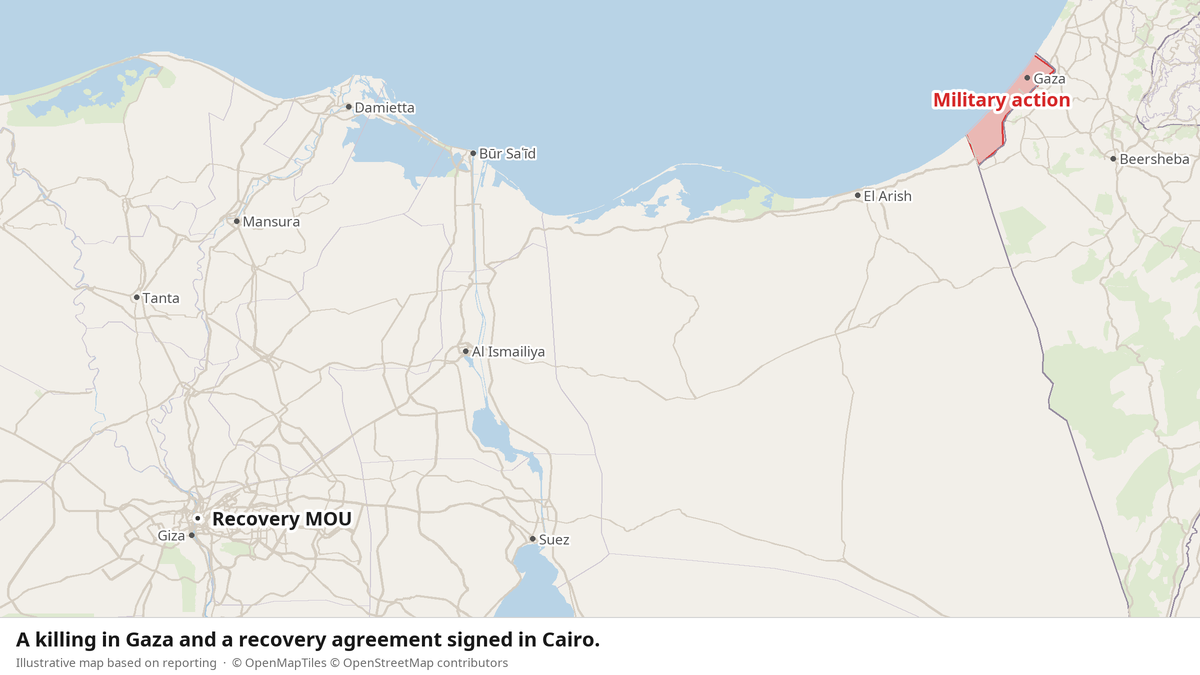
The Palestinian technocratic committee tasked with governing Gaza still hasn’t entered the Strip. A US-backed recovery plan remains stalled, and the Israeli military says it killed a Hamas military commander in an airstrike. The committee’s new agreement with Germany offers a framework for technical cooperation; it doesn’t resolve who controls Gaza or the disputes blocking the plan.
Recovery by memorandum
The National Committee for the Administration of Gaza (NCAG) announced Wednesday, October 14, that it had signed a memorandum of understanding with the German Corporation for International Cooperation, or GIZ, in Cairo the previous day. The framework covers economic recovery, institutional development, municipal services, social protection, education, employment and planning, as well as water, agriculture and energy.
The NCAG says GIZ will provide technical expertise and specialized advisory services, contribute to needs assessments and support capacity-building. Those are the terms in the announcement. It doesn’t specify a budget for the agreement, which services will reach Gaza first, or how residents will help set priorities. Another layer of administration is taking shape from outside the Strip.
NCAG head Ali Shaath praised Germany and GIZ, expressing appreciation for the organization’s longstanding contribution in Gaza. GIZ has long maintained staff in Jordan, Israel and the Palestinian territories. The announcement describes expertise and institutional capacity, but says nothing about how the committee can carry out its responsibilities while it remains unable to enter Gaza.
The stalled apparatus
The US-backed Board of Peace oversees the NCAG and is seeking to advance a $2.45 billion, six-month recovery plan. Disputes over Hamas’s disarmament and Israeli Defense Forces withdrawals have stalled implementation. The Palestinian technocratic committee still can’t enter the Strip to assume its governing responsibilities. A large plan, an oversight board and a signed cooperation framework. Control remains the basic obstacle.
The details reveal the limits of reconstruction language. Progress on the proposed plan depends on disputes over armed power and military withdrawal, while the body meant to govern Gaza can’t get in. The announcement doesn’t say how those disputes will be resolved or when implementation will begin. It also identifies no role for grassroots organizers or residents in setting the recovery agenda. Those omissions matter: officials discuss institutional capacity, but the account leaves the committee’s authority on the ground absent.
Separately, the Israeli military said Wednesday that an airstrike in Gaza City on Tuesday killed Momen Ahmad Salameh Ay, whom it identified as an aide to commanders of Hamas’ Gaza Brigade. The military alleged that he had helped hold Israeli hostages captive during the war, recently advanced attacks on Israeli troops and civilians, and sought to restore the group’s capabilities in violation of the cease-fire. Those are the military’s allegations; the article includes no response from Hamas and no independent account of the strike.
The recovery framework and the airstrike appear in the same report, but they rely on different machinery: one promises technical cooperation and administration; the other uses military force. The source describes no grassroots alternative to either, and no independent mechanism to resolve the competing claims over disarmament, withdrawal or authority. For now, those disputes hold up Gaza’s planned recovery, while institutions retain control over governance decisions and military action; ordinary residents are not shown exercising authority.