
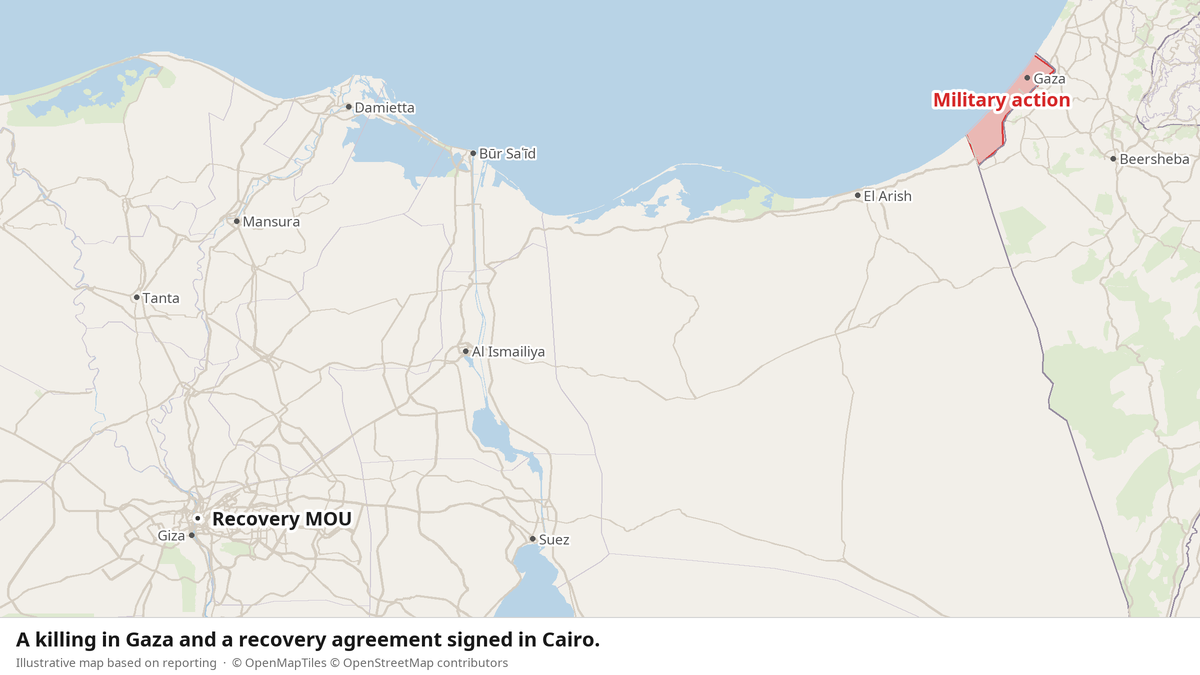
A Palestinian technocratic committee that still can’t set foot in the territory it’s meant to govern signed a reconstruction deal in Cairo this week, even as the Israeli military confirmed another airstrike inside Gaza City.
On Wednesday, October 14, 2026, the National Committee for the Administration of Gaza (NCAG) announced it had signed a memorandum of understanding the previous day with the German Corporation for International Cooperation, known as GIZ. The agreement sets a framework for technical cooperation on recovery and reconstruction in the Gaza Strip. It covers economic recovery, institutional development, municipal services, social protection, education, employment and planning, as well as water, agriculture and energy.
The Humanitarian Picture
The list reads like a catalog of what a shattered territory needs: water, power, schools, jobs and a functioning municipal system. Under the deal, GIZ will provide technical expertise and specialized advisory services, contribute to needs assessments and support capacity-building, the NCAG said on X.
NCAG head Ali Shaath expressed appreciation to Germany and GIZ, praising the organization’s longstanding contribution in the Gaza Strip. GIZ has long had staff working in Jordan, Israel and the Palestinian territories.
But paper commitments run into hard realities on the ground. The agreement comes as the US-backed Board of Peace, which oversees the NCAG, seeks to advance a $2.45 billion, six-month recovery plan for Gaza. Disputes over Hamas’s disarmament and Israeli Defense Forces withdrawals have stalled implementation. Meanwhile, the Palestinian technocratic committee still can’t enter the Strip to take on its governing responsibilities.
That gap matters. A reconstruction framework needs people on the ground. Until the committee can enter Gaza, the water, schools and municipal services it plans to rebuild remain plans, not projects.
Military Action Under the Cease-Fire
The diplomatic news came with a reminder of how fragile the truce remains. On Wednesday, the Israeli military said it killed a Hamas military commander in an airstrike in Gaza City on Tuesday, October 13, 2026. It identified him as Momen Ahmad Salameh Ay, an aide to commanders of Hamas’ Gaza Brigade.
The military alleged he had taken part in holding Israeli hostages captive during the war. It also alleged he had recently advanced attacks on Israeli troops and civilians and sought to restore the group’s capabilities in violation of the cease-fire.
Those are the Israeli military’s claims; the base reporting doesn’t include independent verification or any account of civilian harm from the strike. The allegation that Hamas is rebuilding its capabilities points to the disarmament dispute holding up the recovery plan. Israeli officials cite such activity to justify their continued military posture. For Gazans waiting on reconstruction, each episode offers another reason rebuilding keeps slipping further out of reach.
The Road to Peace
Two tracks are running side by side, and they’re pulling against each other. One is a slow technical effort to restore basic services, backed by Germany’s development agency and an American-led board. The other is a security confrontation where strikes and counter-allegations continue despite a cease-fire.
The stalemate is specific. The reporting names Hamas’s disarmament and Israeli withdrawals as the two disputes blocking implementation. Neither side has moved far enough to let the committee enter Gaza and begin the work it was created to do.
Why This Matters: Civilians pay the cost of every delay. A $2.45 billion recovery plan that can’t be implemented leaves Gaza’s residents without the water systems, schools and jobs described in the Cairo agreement. The committee designed to administer the territory remains outside it, leaving the governance question at the heart of any lasting settlement unanswered. Meanwhile, strikes carried out in the name of enforcing the cease-fire feed the mistrust that stalls disarmament and withdrawal talks in the first place. International agreements like the one signed in Cairo signal goodwill and technical readiness, but they can’t replace the political decisions on disarmament and withdrawal needed to let recovery begin. Without those decisions, the framework risks joining a long list of commitments that never reached the people they were written for.
- gaza strip
- ali shaath
- hamas
- israeli military
- momen ahmad salameh ay
- recovery efforts