
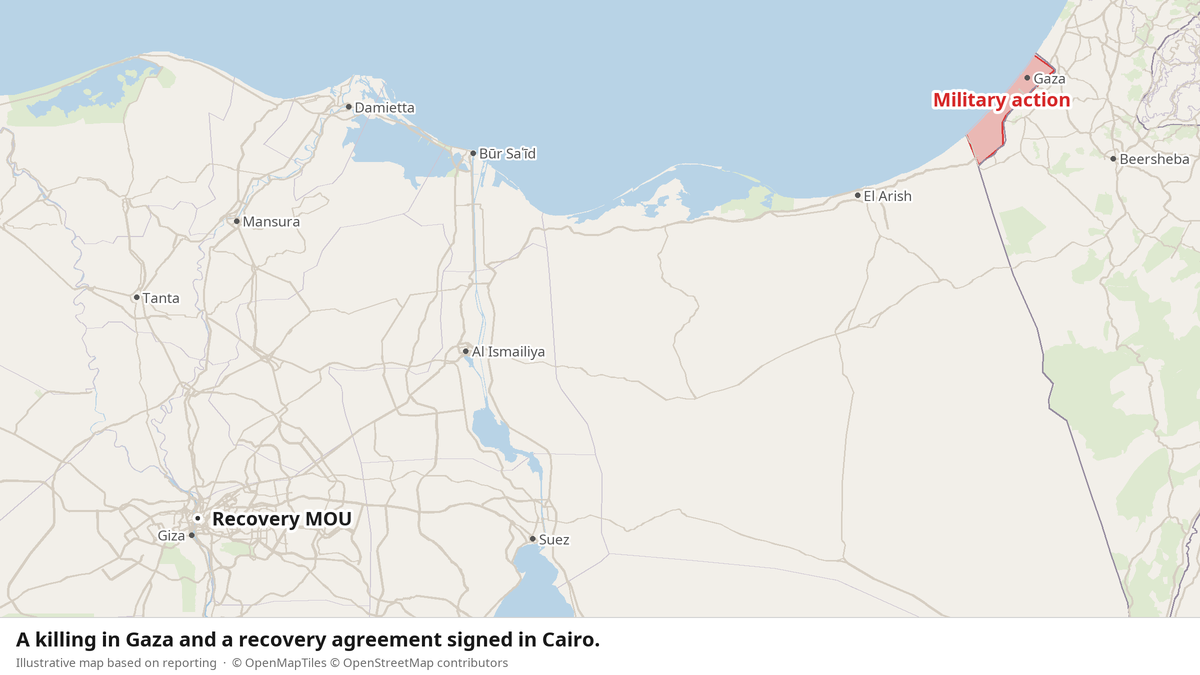
On Tuesday, October 13, 2026, the Israeli military said it killed a Hamas military commander in an airstrike in Gaza City. The military alleged he had helped hold Israeli hostages captive during the war and had recently pushed attacks on Israeli troops and civilians, violating the cease-fire.
The military identified him as Momen Ahmad Salameh Ay, an aide to commanders of Hamas' Gaza Brigade. It said he had sought to restore the group's capabilities while the truce was supposed to hold. The strike came one day before the military announced it.
The Security Picture
The military's account is blunt. Ay wasn't a bystander, it says. He was a hostage-holder turned rebuilder, working to rearm and reorganize an organization that the cease-fire was supposed to sideline. Hamas hasn't been disarmed, and that's the heart of the problem.
Reporting on the issue makes clear that disputes over Hamas's disarmament are among the main reasons the postwar framework remains stuck. Israel's argument is simple enough: a ceasefire means little if the armed group on the other side uses it to regroup and plan new attacks on soldiers and civilians. The airstrike reflects that logic. Israel says it's acting against active efforts by Hamas to rebuild.
A Recovery Plan Without a Governor
Diplomacy moved on a parallel track. The National Committee for the Administration of Gaza (NCAG) signed a memorandum of understanding in Cairo with the German Corporation for International Cooperation, known as GIZ, to establish a framework for technical cooperation on recovery and reconstruction. The committee announced the deal Wednesday, October 14, 2026, and said the parties signed it the day before.
The framework covers a wide range of areas: economic recovery, institutional development, municipal services, social protection, education, employment and planning, as well as water, agriculture and energy. GIZ will provide technical expertise and specialized advisory services, contribute to needs assessments and support capacity-building, the NCAG said on X. NCAG head Ali Shaath thanked Germany and GIZ, praising the organization's longstanding contribution in the Gaza Strip. GIZ has long had staff working in Jordan, Israel and the Palestinian territories.
But here's the catch. The committee that signed the agreement can't actually enter Gaza. According to the reporting, the Palestinian technocratic committee has been unable to enter the Strip and take on its governing responsibilities. The body charged with administering Gaza remains outside it.
Diplomatic Dead End
The agreement comes as the US-backed Board of Peace, which oversees the NCAG, tries to advance a $2.45 billion, six-month recovery plan for Gaza. Disputes over Hamas's disarmament and Israeli Defense Forces withdrawals have kept implementation stalled.
The sequencing dispute is hard to miss. Reconstruction money and technical advisers are lining up, but the central security questions remain unresolved. Hamas hasn't disarmed. The IDF hasn't withdrawn. The technocrats can't go in. Each problem feeds the others, and the strike in Gaza City shows what Israel believes it still faces on the ground.
No one in the reporting says the planning work is worthless. Needs assessments, water systems and municipal services will matter whenever conditions let them move forward. The question is whether any of it can start while an armed organization with intact command structures remains the de facto power inside the Strip.
Why This Matters: Reconstruction depends on security, and the two tracks are colliding. A $2.45 billion plan and a German technical partnership can't take hold in a territory where Hamas, by Israel's account, is rebuilding its military capabilities and the governing committee can't even set foot. From a security standpoint, any IDF withdrawal before Hamas is disarmed risks leaving a vacuum the group would likely fill. That's the concern driving Israeli decisions. Until the disarmament dispute is resolved, expect more of the same pattern: planning in Cairo, strikes in Gaza City, and a recovery that remains on paper.
- gaza strip
- ali shaath
- hamas
- israeli military
- momen ahmad salameh ay
- recovery efforts