
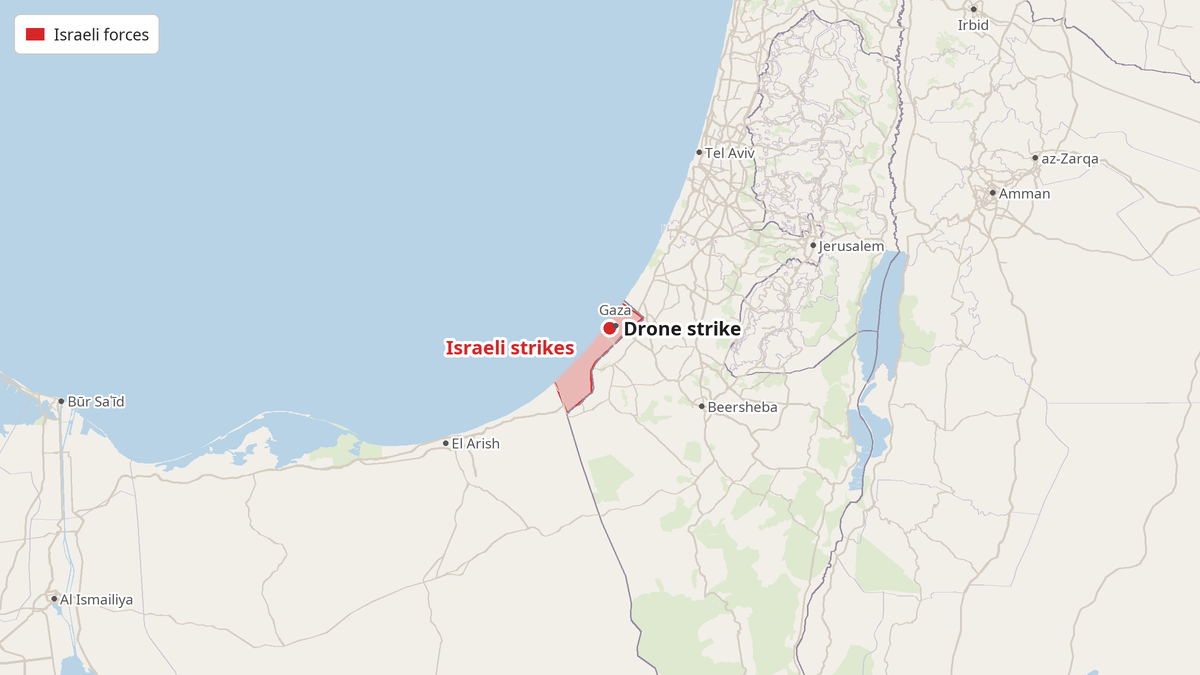
At least four Palestinians were killed in Israeli attacks in Gaza on Saturday, including three men in a strike on a vehicle carrying food in Gaza City and a man shot at the Halawa displacement camp, east of Jabalia refugee camp. Witnesses said the vehicle was preparing to distribute food and drink to children. The Israeli military said it had struck militants.
Food vehicle struck in Gaza City
The vehicle was hit in the Tel al-Hawa neighborhood. Al Jazeera reported that at least three people were killed when an Israeli drone struck a car there. The Associated Press reported that an Israeli strike hit a food-carrying truck in the district, killing three men. Mohamed Abu Selmiya, director of Shifa Hospital, where the casualties were taken, told the AP that three men in the truck had died.
Videos circulating online showed a pickup truck reduced to twisted metal, with boxes of cooked rice torn open in the back. The Associated Press said it wasn't immediately known where the food was going or whether the vehicle was connected to an aid organization.
Abu Zein al-Daya, a witness, told Reuters that papers inside the vehicle bore the World Central Kitchen logo. Haaretz reported that the vehicle carried papers and food for the organization, citing Gaza's health ministry and eyewitnesses. World Central Kitchen told Reuters the vehicle wasn't affiliated with it. The Jerusalem Post also reported that the organization denied an affiliation, while saying the vehicle appeared to contain packaged food and papers bearing its logo.
Al-Daya said the vehicle was about to stop when the missile struck. “It's a bus that distributes food and drink to the poor, to the people in tents, to the displaced. It was just about to stop to distribute the food and drinks to children, and then it was hit by a missile. The target is anyone who is giving the people food,” he told Al Jazeera. The Jerusalem Post reported that cooked rice was scattered around the vehicle after the strike and that it was partly covered in victims' blood.
The Israeli military said it struck militants in the area and was checking reports that a food truck had been hit, according to the AP. The Jerusalem Post reported that the military described the three men as Palestinian Islamic Jihad members traveling in a vehicle used to transport food and logistics for militants. The military said: “Gazan sources portrayed the terrorists as aid workers for an international organization,” adding that the claims were false and served as “further proof of the cynical tactics employed by terrorist organizations.”
Attacks continue during ceasefire
Separately, Israeli gunfire killed a Palestinian man at the Halawa displacement camp. Al Jazeera correspondent Ibrahim al-Khalili said the man was taken to al-Shifa Hospital. Earlier on Saturday, an Israeli attack targeted a young man riding an electric bicycle in al-Mawasi, Khan Younis, injuring three people who were taken to Nasser Medical Complex, al-Khalili said.
“The ceasefire has yet to deliver a change for the people in Gaza,” al-Khalili said. “Israeli attacks and gunfire have been part of the grim reality for the people in Gaza.”
The Associated Press reported that Israel had continued airstrikes almost daily after a ceasefire deal with Hamas took effect in October 2025. Gaza's Health Ministry said 1,671 people had been killed since the ceasefire began. The AP described the ministry's toll as more than 1,650 and said U.N. agencies and independent experts generally consider its detailed records reliable. The ministry doesn't distinguish civilians from militants and says women and children account for around half of those killed. Al Jazeera reported more than 600 ceasefire violations since the agreement began.
Al Jazeera reported that 74,736 Palestinians had been killed since Israel launched its war on Gaza three years earlier. It also reported that winter flooding had worsened the humanitarian crisis. The World Food Programme warned earlier that week that Palestinians had been forced to burn rubbish to cook. “Now even the rubbish is wet,” Shaun Hughes, WFP's country director for Palestine, said.
Restrictions deepen shortages
The International Organization for Migration said more than 100,000 tents in Egypt couldn't be delivered to Gaza because of Israeli restrictions, including limits on the diameter of the tents' central poles. “Usually anything under 38 millimetres is OK; anything above, it's usually deemed as not acceptable,” Hughes said. Karl Baker, head of the IOM's Gaza programme, said: “It is not a statement of dual use; it is just that this tent at this time is not allowed to enter Gaza ... We don't get the specifics.”
“The coming days are uncertain, and the lack of basic necessities looms,” al-Khalili said.
- gaza city
- israeli strikes
- gaza conflict
- world central kitchen
- israel defense forces
- jabalia refugee camp
- ceasefire
- humanitarian aid