
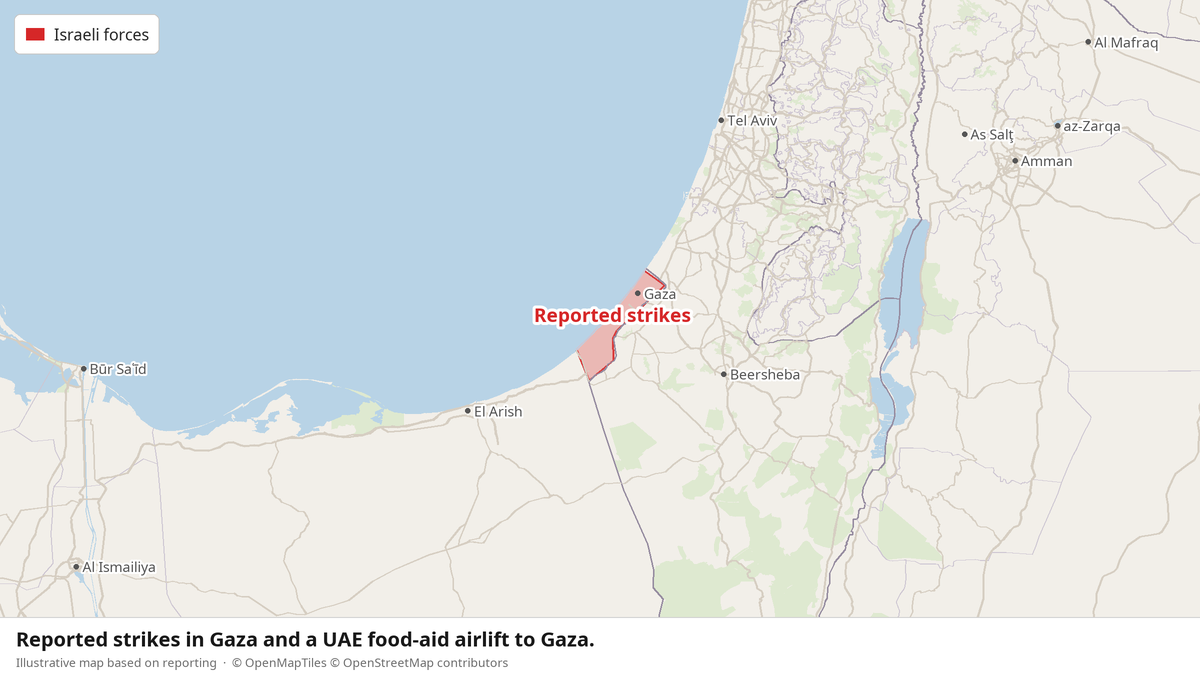
Israel said Hamas is rearming and carrying out attacks in violation of the ceasefire. Saturday’s strikes in Gaza City were the latest result. Health officials said Israeli strikes killed at least five Palestinians in two separate attacks on Oct. 10: four near Panda Mall and one in the Tuffah neighbourhood. The Israeli military said both strikes targeted militants but offered no further information.
The deaths came on the first anniversary of the US-brokered ceasefire, a truce that has frayed badly. Israel has stepped up strikes against Hamas in recent weeks, citing what it describes as the group’s rebuilding and attacks on Israeli forces. Israel said militants in Gaza have killed four of its soldiers since the truce took hold.
Hamas denies rebuilding its arsenal or planning attacks. It accuses Israel of undermining the agreement.
The Security Picture
The Palestinian figures are stark. They deserve a plain account. Gaza health officials say Israeli fire has killed at least 1,400 Palestinians since the ceasefire was agreed last October. Al Jazeera reported that Israeli forces had killed at least eight Palestinians in several areas of Gaza since dawn Saturday, including an eight-year-old girl. Middle East Eye also put the post-truce toll at more than 1,400. Gaza health officials supplied those figures, and the Israeli military hasn’t offered a breakdown of how many of the dead were militants. The military said only that Saturday’s strikes in Gaza City targeted militants.
The broader arithmetic points back to how this began. Hamas-led attacks on Israel on Oct. 7, 2023, killed 1,200 people and resulted in 251 people being taken hostage. Saturday also fell near the third anniversary of that assault. Gaza health officials say Israel’s subsequent bombardment and ground operations have killed more than 74,000 people.
Diplomatic Dead End
The ceasefire agreement calls for the territory’s eventual reconstruction. Little progress has followed on a deal to end the conflict, which includes terms for Hamas to disarm and Israel to withdraw its troops. That sequencing lies at the heart of the impasse. Israel won’t pull back while the group that carried out Oct. 7 keeps its weapons. Hamas denies rebuilding, but it hasn’t shown any sign of accepting disarmament.
The truce has frozen the fighting. It hasn’t resolved the question that started it.
The Humanitarian Complication
As the strikes continued, the United Arab Emirates began airlifting food aid to Gaza on Friday under the newly launched Ahmed bin Rashid Humanitarian Bridge. The initiative aims to supply more than 10 million meals to Palestinians. Mohammed bin Rashid Al Maktoum Global Initiatives and Operation Chivalrous Knight 3 launched flights carrying food parcels from Al Maktoum International Airport. The effort honours Sheikh Ahmed bin Rashid, brother of Dubai’s ruler, who died on September 21.
The bridge will move aid in seven consignments: six flights carrying 450 tonnes of food parcels, plus one vessel carrying 4,000 tonnes of supplies. Hammoud Al Afari, director of UAE relief operations under Operation Chivalrous Knight 3, said the launch “reflects the high level of efficiency and expertise of the Emirati teams involved.”
The UAE’s involvement is considerable. Since November 2023, it has provided more than $4 billion in humanitarian assistance to Gaza, accounting for 46 per cent of global humanitarian aid since 2023. That total includes 130,708 tonnes of supplies delivered by 796 aircraft, 25 ships and 14,483 lorries. Operation Chivalrous Knight 3 began in November 2023, nearly three years before this latest airlift.
Why This Matters: A ceasefire that has produced roughly 1,400 Palestinian deaths and four Israeli military deaths in a year isn’t functioning as a ceasefire in any ordinary sense. The core problem hasn’t changed. Israel says Hamas is rearming; Hamas denies it, and the disarmament-for-withdrawal bargain remains unimplemented. Without verifiable disarmament, any Israeli pullback leaves a militant group that carried out Oct. 7 free to rebuild. The Emirati airlift shows Arab states with ties to Israel are willing to carry much of the humanitarian burden, a role that matters while reconstruction stalls. But aid alone won’t settle who governs Gaza or who holds its weapons. That question decides whether the truce becomes a path to stability or a pause before the next round.