
A child has been killed almost every day since the Gaza ceasefire was announced, Save the Children International CEO Inger Ashing said. On the first anniversary of the Oct. 10 agreement, more than 100 humanitarian and human rights organizations said the truce exists "in name only." They said Israeli forces have killed more than 1,400 Palestinians over the past 12 months, including at least 327 children.
"A ceasefire is meaningless if children are still being killed and families are still unable to rebuild their lives," Ashing said. She urged the governments that backed the agreement to ensure children have adequate food, healthcare, shelter and education.
The Humanitarian Picture
The figures in the groups' joint statement are hard to absorb. Nearly 2 million people still need shelter. None of Gaza's 36 hospitals fully functions. More than 18,500 patients, including at least 4,000 children, are waiting to be evacuated for medical care, and more than 1,000 people have died while waiting for treatment.
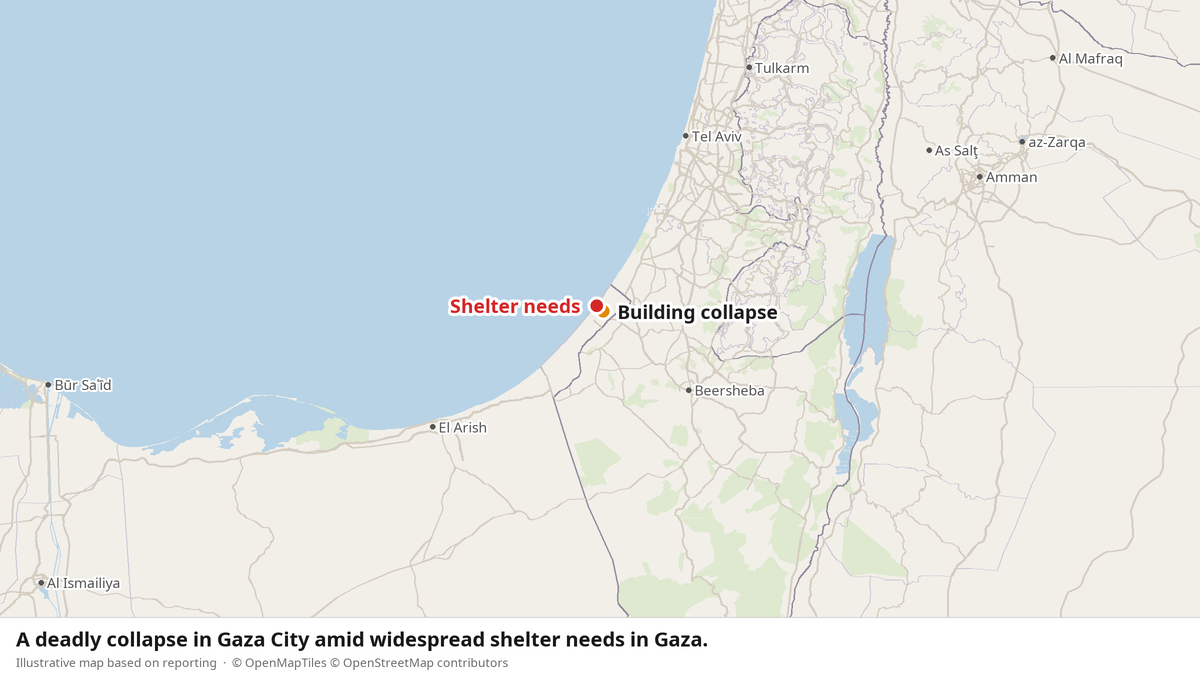
The organizations said damage affects more than 80 percent of structures across Gaza, and about two-thirds lie completely destroyed. Hundreds of thousands of families live in tents, makeshift shelters or buildings at risk of collapse. In September, a damaged building collapsed in Gaza City, killing 21 people, including 12 children, and injuring 45. Rescuers pulled the injured out despite a shortage of heavy equipment.
Hunger is spreading, too. The groups expect 1.4 million Palestinians to face crisis-level hunger or worse by the end of the year, while clean water runs short and sanitation infrastructure lies wrecked.
Winter, and a Strong El Niño
The cold is coming. On Friday, the UN migration agency said almost all of Gaza's population needs tents or other shelter assistance ahead of winter, while Israeli restrictions keep supplies scarce. The International Organization for Migration (IOM) said the El Niño weather phenomenon is expected to bring heavier rainfall. That could weaken unsafe buildings and cause flooding in a territory where damaged drainage systems already pose a serious problem. The UN weather agency said El Niño could be the strongest ever.
Humanitarian actors have met only about 17% of winter shelter-supply needs, IOM Director General Amy Pope said. "Families who have already endured repeated displacement and devastating loss must be able to face the winter in safety and dignity," she said. She added that restrictions imposed by Israeli authorities made it difficult for agencies to expand their response.
The IOM said Israeli authorities had not allowed 8,600 emergency shelter kits into Gaza, ruling them dual use. Each kit comprises wood, a tarpaulin and basic materials. COGAT, the Israeli military arm that oversees aid flows into Gaza, did not immediately respond to a request for comment. Israel cites security concerns to justify its restrictions. The IOM said it had brought in some tarpaulins and tents, but not enough.
More than half of the tents and makeshift shelters need replacement because they're in poor condition, and few alternatives exist because war-damaged buildings pose safety risks. In August, officials identified more than 3,600 structures as dangerous and at risk of collapse. Around 1.8 million people live in displacement sites, most in areas at risk of flooding.
A Stalled Peace Plan
The warnings come as US President Donald Trump's 20-point Gaza peace plan remains stalled. Key provisions, including Hamas' disarmament, a full Israeli military withdrawal and postwar reconstruction, haven't been implemented. Israel still controls about two-thirds of Gaza. Disagreements over Hamas' disarmament have blocked further withdrawals and the deployment of an international stabilization force. Reconstruction has barely begun, with an estimated $71.4 billion needed.
The organizations also accused Israeli forces of extending control beyond the ceasefire withdrawal boundary known as the Yellow Line, further shrinking the territory available to displaced Palestinians. They urged the international community to press Israeli authorities to end all attacks, lift restrictions on aid and reconstruction supplies, and ensure accountability for violations of international law.
Jan Egeland, secretary-general of the Norwegian Refugee Council, said Israeli restrictions on construction equipment and building materials continue to obstruct recovery. "It is utterly shameful that a full year after the ceasefire was signed, so little has improved for Palestinians in Gaza," he said. Agnes Callamard, secretary-general of Amnesty International, said Gaza's recovery can't be separated from justice and victims' rights. "Accountability cannot be swept under the rubble," she said.
The war began in October 2023, when Israel launched its offensive in response to Hamas' assault. Three years on, survivors are still looking for a roof.
Why This Matters:
A ceasefire that doesn't stop the killing, feed the hungry or house the displaced leaves civilians carrying the cost of political deadlock. The facts point to a blocked sequence: disarmament disputes stall withdrawals, stalled withdrawals delay a stabilization force, and reconstruction can't start at scale without either. Israel cites security concerns for restrictions on dual-use items, and the Hamas disarmament dispute is a real obstacle. But shelter kits, heavy equipment and building materials can decide whether a family survives a flood. With El Niño approaching and only 17% of winter shelter needs met, the humanitarian calendar is moving faster than the diplomatic one. The accountability rights groups demand is also a question of whether international law means anything once the headlines move on.