
A year after the Oct. 10 ceasefire took effect, Hamas still hasn’t disarmed, leaving undone the central provision of President Donald Trump's 20-point Gaza peace plan. The first anniversary arrives with the armed group still in the picture, an international stabilization force undeployed, and Israel holding about two-thirds of Gaza.
That is the backdrop to Friday's warning from more than 100 humanitarian and human rights organizations, which said the ceasefire exists "in name only." In their joint statement, they said Israeli forces had killed more than 1,400 Palestinians, including at least 327 children, over the past 12 months. Nearly 2 million people still needed shelter. None of Gaza's 36 hospitals was fully functioning.
The Security Deadlock
The organizations acknowledged what has frozen the process. Key provisions of the Trump plan, including Hamas' disarmament, a full Israeli military withdrawal and postwar reconstruction, remain unimplemented. Disagreements over Hamas' disarmament have blocked further Israeli withdrawals and the deployment of an international stabilization force. The sequence matters: withdrawal and reconstruction hinge on a force that can replace the armed group, while Hamas hasn’t surrendered its weapons.
The war began in October 2023, when Hamas launched the assault that prompted Israel's military campaign. Three years on, the group that started it remains an obstacle to the plan meant to end it.
The groups also accused Israeli forces of extending control beyond the ceasefire withdrawal boundary known as the Yellow Line, further restricting territory available to displaced Palestinians. The base reporting doesn’t include an Israeli response to that allegation.
The Humanitarian Complication
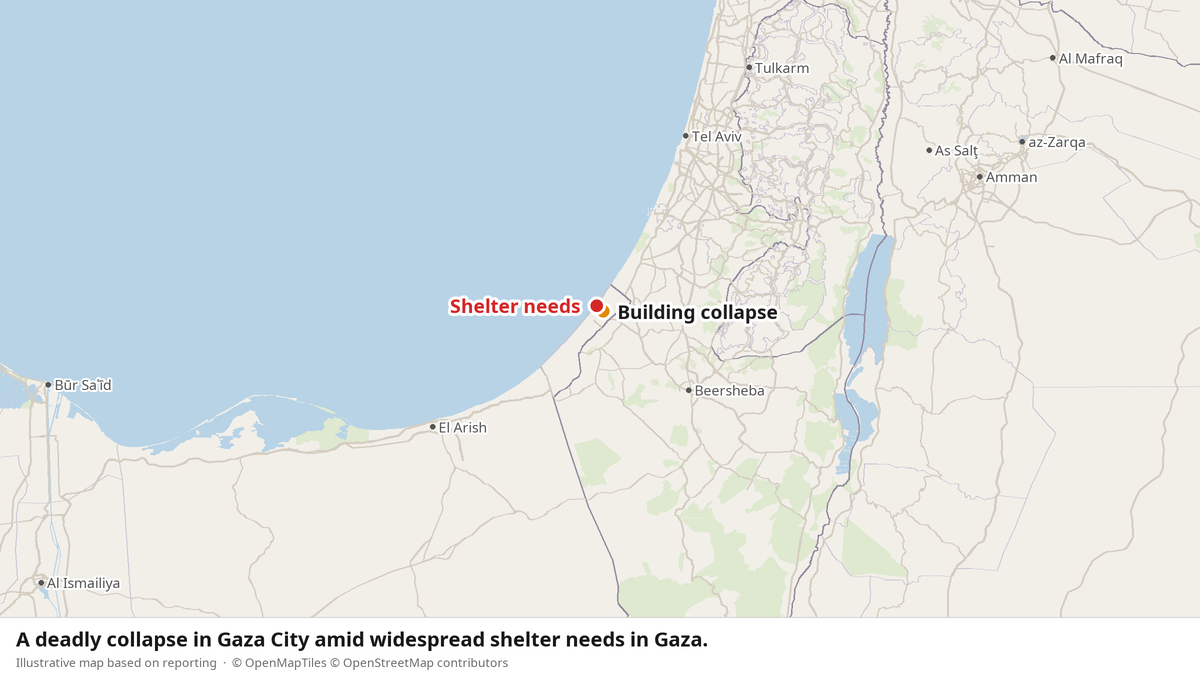
The human cost the organizations describe is severe and deserves plain reporting. More than 80 percent of structures across Gaza have been damaged to some degree, with about two-thirds completely destroyed. Hundreds of thousands of families live in tents, makeshift shelters or buildings at risk of collapse. In September, a damaged building collapsed in Gaza City, killing 21 people, including 12 children, and injuring 45. More than 18,500 patients, including at least 4,000 children, are awaiting medical evacuation. Rebuilding requires an estimated $71.4 billion. By year's end, 1.4 million Palestinians are expected to face crisis-level hunger or worse.
Winter and El Niño add urgency. The International Organization for Migration said the weather phenomenon could bring heavier rainfall, weaken unsafe buildings and cause flooding in Gaza's damaged drainage systems. The UN weather agency said it could be the strongest ever. IOM Director General Amy Pope said humanitarian actors have met only about 17% of winter shelter-supply needs. In August, officials identified more than 3,600 structures as dangerous, while around 1.8 million people live in displacement sites, most in flood-prone areas.
Aid screening is the friction point. IOM said Israeli authorities hadn’t allowed 8,600 emergency shelter kits into Gaza, deeming them dual use. Each kit comprises wood, a tarpaulin and basic materials. COGAT, the Israeli military body overseeing aid flows, didn’t immediately respond to a request for comment. Israel cites security concerns for its restrictions. Those concerns aren’t abstract in a territory where the armed group that attacked Israel in 2023 hasn’t given up its arms, and where construction materials have a documented capacity to serve military ends. Whether a tarpaulin and timber kit poses that risk is precisely what the dispute is about; aid agencies and Israeli officials plainly disagree.
Accountability and Its Audience
Norwegian Refugee Council Secretary-General Jan Egeland called it "utterly shameful" that so little had improved. Amnesty International's Agnes Callamard said "accountability cannot be swept under the rubble." Save the Children International CEO Inger Ashing said a child had been killed almost every day since the ceasefire was announced. The statement's demands, however, run almost entirely in one direction: end attacks, lift restrictions, ensure accountability for violations of international law. As reported, the joint statement doesn’t describe what Hamas must do to unlock the withdrawal and reconstruction it says Gaza needs.
Why This Matters: The anniversary shows how a ceasefire can hold on paper while the underlying security question goes unanswered. Until Hamas' disarmament is resolved, there’s no stabilization force, no further Israeli withdrawal and little prospect of the reconstruction Gaza's civilians need. Pressure that falls only on Israel's aid screening and military posture, without addressing the armed group at the center of the impasse, risks prolonging the suffering it aims to relieve. From a security perspective, a premature withdrawal without guarantees would leave a vacuum that armed factions could fill. Winter is weeks away. People living in flood-prone tents can’t wait for diplomacy to catch up.