
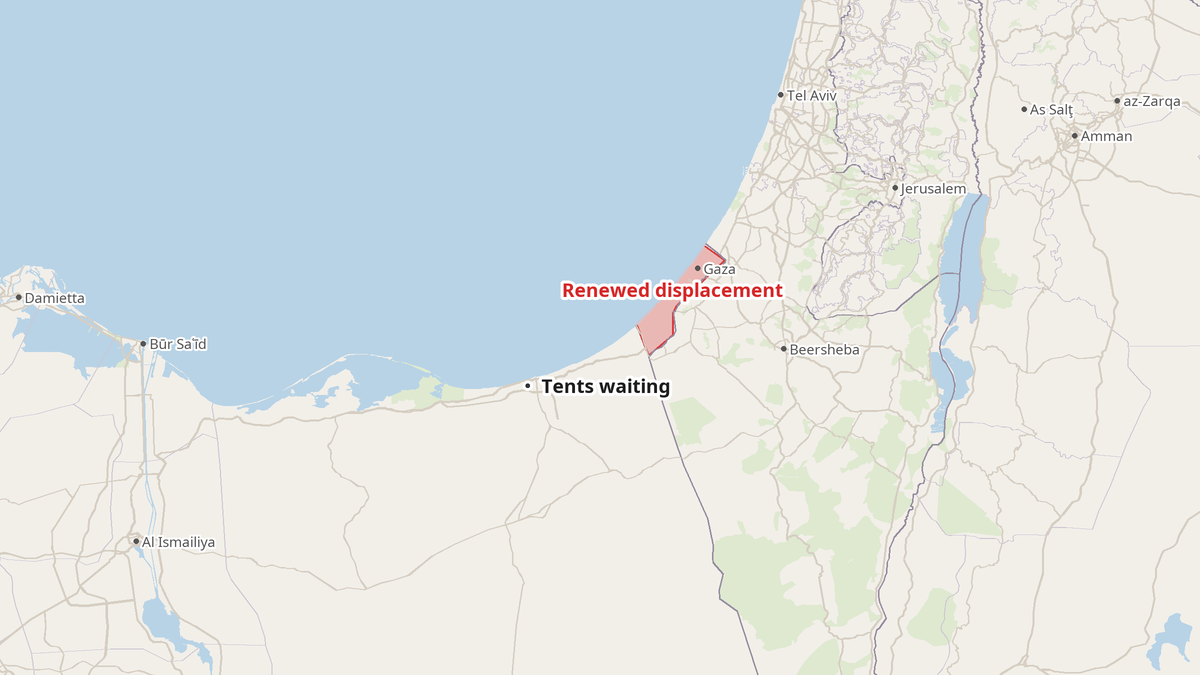
About 1.36 million Palestinians—65 percent of Gaza's population—are living in tents and makeshift shelters, according to the UN Office for the Coordination of Humanitarian Affairs (OCHA). When November rain floods those shelters, people have nowhere safe to go. The machinery governing access, movement and aid keeps narrowing the choices.
Shelter Under a Blockade of Options
The storm that began on the evening of November 6 flooded about 70,000 tents within 12 hours, according to Gaza's Government Media Office. Preliminary UN estimates said about 226,000 people were affected, more than 5,000 households were left without shelter, and about 600 households had to move again. On November 8, a sand embankment collapsed onto tents south of Deir el-Balah, killing five people, including children. OCHA reported that an infant drowned during the storm; a nine-month-old baby died of hypothermia on November 13.
Jaber al-Kaseeh, who fled Beit Lahiya in northern Gaza, said his tent in az-Zawayda flooded three or four times the previous winter, driving many neighbours away. In Nuseirat, Nasser al-Hajj took his children to a neighbour's home when debris fell from the ceiling of the flat an Israeli attack had damaged. “But where am I supposed to go? Rent is expensive, and a tent is not safe either,” he told Al Jazeera.
Israeli restrictions leave Palestinians fewer options to move to safer areas, OCHA said. On November 17, the International Organization for Migration (IOM) and the World Food Programme said Gaza's population had been confined to less than 40 percent of the territory, while more than half of 1,700 displacement sites were on flood-prone land. Israel Katz, the defence minister in Israel's caretaker government, threatened a new offensive that would move one million Palestinians south if Hamas did not disarm. He called Hamas's control over the remaining 30 percent of Gaza “an illusion.” He did not issue an evacuation order.
Gaza was entering its fourth winter since Israel launched its war in October 2023. About 82 percent of Gaza's structures had been damaged or destroyed by mid-June, according to UN satellite analysis. In Gaza City, eight pumping stations and three main rainwater collection basins were out of service when the first storm hit. Municipal spokesperson Hosni Muhanna said the remaining network could handle no more than a fifth of the rainwater even under the best conditions.
Aid Waiting at the Gate
The UN humanitarian team said on November 13 that more than 150,000 tents purchased by aid organizations and governments were waiting outside Gaza, mostly in Egypt's El Arish. On Wednesday, the European Commission said tents and equipment needed to put them up were still waiting on trucks because Israel had not allowed them to enter. Goods from Egypt were routed for inspection through the Karem Abu Salem crossing, called Kerem Shalom in Israel, rather than entering directly through Rafah. Israeli authorities also classify some shelter supplies as “dual-use,” limiting how much aid organizations can bring in.
COGAT, the Israeli military body that coordinates aid, said nearly 100,000 tents had entered Gaza under its winter program. It said more than 67,000 tents and other winter supplies had been approved but not yet brought in. The Norwegian Refugee Council (NRC) said shelter agencies inside Gaza had fewer than 6,500 tents in stock. The gap between approval and arrival is measured in flooded homes and families still waiting.
The NRC said basic winter supplies for a family of six could cost more than $6,000 inside Gaza, compared with about $700 when aid agencies buy them abroad and bring them in. Donors had funded 35 percent of the $283 million needed for the minimum winter shelter response. In al-Mawasi, near Khan Younis, Fadi Wafi told the Palestinian news agency Wafa that his name was on a list of people affected by the last storm, but he had received no shelter supplies. His family of five had two mattresses and two blankets.
A Network Strained to Breaking
Gaza's civil defence received 2,166 distress calls on November 7 but sent crews to only 218; most callers received advice by phone. UN crews used suction trucks to remove water mixed with sewage from 58 shelters. At the Patient's Friends Benevolent Society Hospital in Gaza City, water flooded the basement housing the children's department, pharmacy and radiology services. Flooded roads elsewhere kept patients and staff from reaching clinics.
The World Health Organization recorded 692 suspected meningitis cases from October 1 to November 23, most among babies under one year old. Gaza's Ministry of Health issued an epidemic alert on November 24 after recording 272 cases in October, compared with a usual monthly average of 30 to 50. Paediatrician Sharif Matar told Al Jazeera that families in crowded tents had too little water to maintain basic hygiene.
Aid workers have cleared drains, reinforced shelters and installed flood barriers, but OCHA reported on November 20 that work had been recorded at only 162 of 356 flood-prone locations teams were tracking. IOM said Israeli authorities had approved about 70,000 pieces of timber and more than 1,200 toolkits for sturdier emergency shelters for about 1,200 families. COGAT also said it had approved pumps and generators and would allow partial repairs at the Sheikh Ijlin and Sheikh Radwan sewage facilities; it did not say the equipment had arrived. COGAT said reconstruction equipment would enter only after Hamas had fully disarmed.
Gaza's municipalities continued to request pumps, backup generators and fuel. The Government Media Office warned on Tuesday that another storm was expected within days. Om Hani Hamouda, whose family had been displaced about 15 times, put the demand plainly after her tent flooded in az-Zawayda: “We want these tents to be replaced with caravans. Even a simple caravan would be better.”
- gaza
- displaced palestinians
- winter storms
- flooding
- shelter shortages
- humanitarian aid
- ocha
- israel-gaza war