
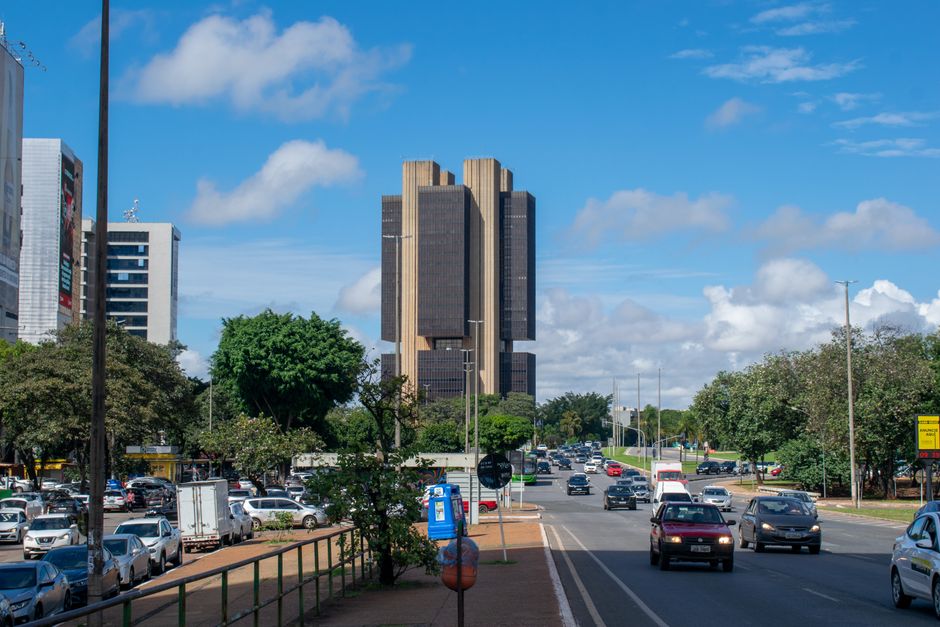
Brazil’s central bank decision-makers will set the Selic rate Wednesday evening. Traders are weighing whether it will stay at 13.75% or fall to 13.50%. The briefing lists 13.75% as the consensus, unchanged, but says some market pricing points to a quarter-point cut. The outcome remains open: the Copom will decide, not the people whose economy the rate helps shape.
Who Holds the Levers
Gold rose 1.87% to US$3,948 an ounce at the Nov. 2 market close, while the Nasdaq Composite fell 1.07% to 25,164. The VIX climbed 8.91% to 21.15, and the US 10-year Treasury yield eased to 4.909%. The Dow Jones Industrial Average rose 0.41% to 51,984, but the S&P 500 fell 0.51% to 7,541. The dollar index slipped 0.07% to 101.805.
The report says the Dow’s gain alongside losses for the S&P 500 and Nasdaq suggests investors concentrated selling in technology and growth stocks, rather than across the entire market. The Nasdaq stood 8.8% below its Oct. 6 peak; the S&P 500 was 3.5% below its high from that date, which the briefing describes as its best close in a year.
Brazil’s manufacturing PMI was forecast at 43 on Nov. 3, down from 44.8, pointing to a deeper contraction. Mexico’s PMI was forecast at 50.1, compared with 50.3 previously, near stagnation. Colombia’s Davivienda PMI was forecast at 54.2, against 54.6. These indicators offer a snapshot of production, while rate decisions and market pricing remain the briefing’s main account of economic power.
The report says a softer US dollar and lower US yield eased pressure on the Brazilian real and Mexican peso. The US 10-year yield fell 0.51% to 4.909%, and the dollar index eased 0.07% to 101.805. On Oct. 28, those figures stood at 5.045% and 102.194, respectively.
The Numbers Behind the Apparatus
Gold remained about 28% below its late-January peak near US$5,500. The briefing says the lower Treasury yield and slightly softer dollar made gold, which pays no interest, cheaper to hold. The US Oil Fund, which tracks crude futures, dropped 7.1% to US$156.87 on Monday; the reason wasn’t clear at the time of reporting.
The US Energy Information Administration reported commercial crude inventories at 410.6 million barrels in the week to Oct. 23, down 1.9 million barrels. Gasoline stocks rose 3.9 million to 209.2 million barrels, a build the briefing said signalled soft demand.
China’s manufacturing PMI came in at 52 in October, above the 51.6 consensus but just below September’s 52.1. Japan’s PMI was 53.3, down from 54.1 and in line with forecasts. Peru’s monthly inflation in October was 0.57%, against a zero consensus and 0.12% previously.
What the Calendar Leaves Out
The Nov. 3 calendar lists US midterm elections, Brazil’s BCB Focus Market Readout, manufacturing indicators, job openings, factory orders and other releases. It also schedules Brazil’s Copom decision, ADP jobs data, an ISM services report and a US Treasury refunding announcement for Wednesday. The calendar records the election alongside institutional and market events; it doesn’t describe any community-led response, direct action or mutual aid. Nor does the briefing provide figures on how these market moves affect households.
A live global market board timestamped Nov. 3, 2026, at 01:24 showed the S&P 500 at 7,722, up 0.59%, and the Nasdaq 100 at 29,646, up 1.27%. The Dow stood at 52,367, up 0.01%, while the Russell 2000 gained 0.97%. The same board listed gold at 4,073, up 0.85%, and Brent crude at 109.58, down 5.38%. Those live readings sit alongside the separate Nov. 2 closing figures: the briefing tracks prices, forecasts and decisions by financial institutions, but offers no account of people organizing around the consequences.
- gold
- nasdaq composite
- global markets
- selic rate
- brazil
- manufacturing pmi
- treasury yields
- us dollar