
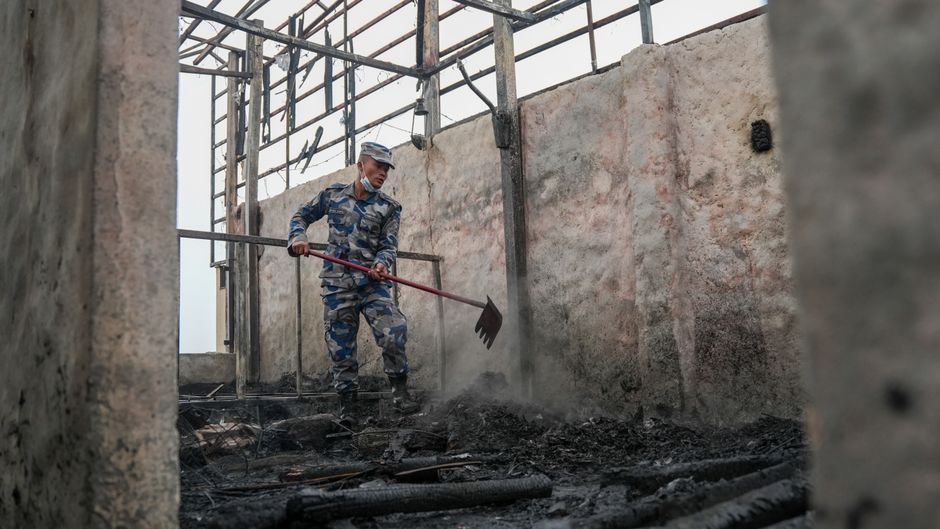
One hundred sixty-eight people died in the November 2025 fire that consumed seven buildings of the Wang Fuk Court apartment complex in Hong Kong's Tai Po district. Now, as an independent committee hears final arguments, the structural failures and corporate negligence behind the tragedy are laid bare, with residents expressing deep skepticism about the official process. The fire, Hong Kong’s deadliest in decades, shattered a community housing thousands.
Who Pays the Price
Former residents and relatives of the deceased have waited for answers from the committee, established by the Hong Kong city government in December 2025. Betty Ho, a former resident, expressed doubt about the inquiry's ability to uncover the truth. "I don’t think we’ll get what we hoped for in the end," she stated. Patrick Liu echoed this sentiment, noting, "Basically, everyone is just shirking responsibility. There’s no need to even think about it." Their words reflect a profound distrust in a system that consistently prioritizes profit over human life.
Capital's Negligence Exposed
Evidence presented since hearings began four months ago in March 2026 points to multiple factors contributing to the disaster. Fire alarms and hose systems were shut off. Non-fire-retardant scaffolding netting was used. Windows were covered with foam boards, trapping residents. Martin Ho, representing ISS EastPoint Properties, the property management company, admitted their in-house electrician inadvertently switched off the fire alarm system. He called the mistake "regrettable." However, Ho also pointed to a fire service installation contractor who was not present during the process and later failed to follow up on the issue. A director of that contractor cited the "industry’s mentality of not teaching other companies how to work," a statement that reveals the cutthroat, competitive nature of capital.
Further charges filed one month ago in June 2026 by authorities implicate two companies: Will Power Architects Company, a consultancy, and Prestige Construction & Engineering Co., the main contractor for a major renovation project at Wang Fuk Court. These companies, along with seven individuals, face offenses including manslaughter and conspiracy to defraud. Authorities allege serious negligence in monitoring materials and procedures. They also claim the companies conspired to defraud apartment owners by concealing Prestige's previous litigation records and inflating its score in a tender analysis report. This systematic deception underscores how the pursuit of profit directly compromises safety and accountability.
The State's Limited Inquiry
The independent committee, led by High Court Judge David Lok and including Executive Council member Chan Kin-por and Hospital Authority Board member Rex Auyeung, has a narrow scope. Its mandate explicitly excludes possible legal liabilities for those linked to the fire’s outbreak; law enforcement authorities will handle those. This structural limitation ensures the inquiry serves primarily as a fact-finding exercise, not a mechanism for holding powerful entities truly accountable. Judge Lok even intervened when a lawyer for an installation contractor director, Aaron Chan, seemed to suggest alarms were useless, asking Chan not to tell him that.
The committee is also examining whether systemic problems like bid-rigging plague Hong Kong’s large-scale building maintenance and renovation works. A representative of the Competition Commission, an antitrust organization, confirmed the existence of bid-rigging groups in the city, some associated with criminal organizations known as triads. This revelation exposes the deep-seated corruption within the construction industry, where collective resources are siphoned off through illicit means, often at the expense of public safety. The committee is expected to offer suggestions on regulations and penalties, a reformist approach that avoids addressing the fundamental profit motive driving such systemic failures.