
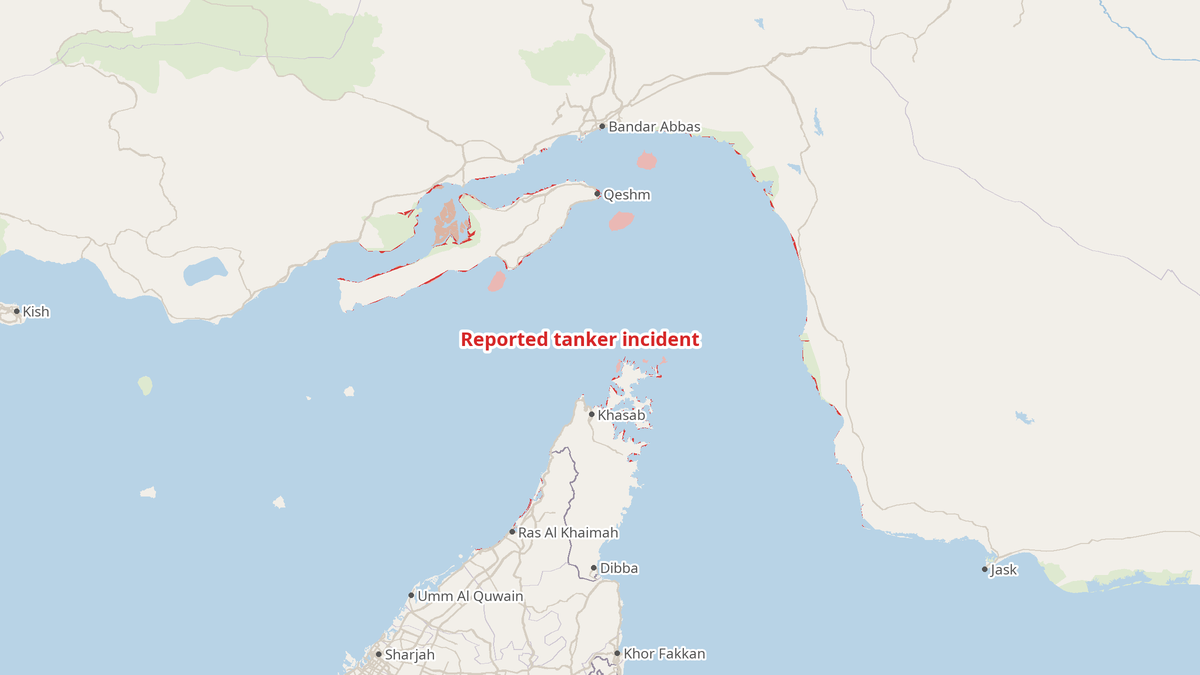
An oil tanker carrying more than 2 million barrels of crude exploded and caught fire in the Strait of Hormuz on Saturday after striking a naval mine, Iran's Revolutionary Guards said. Iranian media carried Tehran's account, but nobody has independently verified it.
The Guards didn't stop at describing the explosion. They said the vessel was trying to transit the waterway along a route Iran had not authorized. That phrasing matters. It presents the blast as the consequence of a ship defying Iranian instructions in one of the world's most strategic chokepoints, while casting the IRGC as the arbiter of who may pass.
The Security Picture
The tanker incident wasn't Saturday's only maritime alarm. The National's live updates, citing the UKMTO, reported that an unknown projectile hit a separate tanker off the Saudi coast. The same coverage said transits through the Strait of Hormuz remain 70 percent below pre-conflict levels.
That figure tells its own story. Seven of every ten pre-conflict transits are simply gone. Shipping that once moved freely through the strait is now rerouted, delayed or deterred, and a mine-strike claim involving an "unauthorized" route will only reinforce shipowners' and insurers' caution.
The available reporting offers no independent confirmation of the mine claim. It doesn't identify the vessel or its flag, and says nothing about the crew's condition. What's available is an assertion from a military force that says it controls the passage and reports a disaster on a route it says it never cleared.
The Regional Threat
The tanker reports form part of a wider pattern of activity across the region. The National's updates also noted a coalition claim that it destroyed missile launchers in Yemen's Saada. Saada is the Houthi heartland, and a projectile strike on a tanker off the Saudi coast fits a Red Sea and Gulf security environment where commercial shipping has become a target set.
The update list placed Iranian Foreign Minister Abbas Araghchi in Baghdad that same day for an OIC summit. The juxtaposition is hard to miss. Iran's top diplomat arrived at a gathering of Muslim-majority states as Iran's armed forces announced an explosion on a tanker in waters over which they claim authority.
Questions That Remain
Several basics remain unanswered. Who laid the mine, if anyone laid one? When? Why would anyone mine a route Iran says it didn't authorize? The IRGC statement raises each question and answers none. A state claiming the right to approve transit through an international strait, then reporting a mine strike on a ship that ignored its instructions, has effectively described a system of control enforced by hazard.
The separate projectile strike off the Saudi coast remains just as uncertain. The UKMTO described the weapon only as unknown.
Why This Matters: Roughly 70 percent of normal Hormuz traffic is already missing, and every new incident, verified or not, tightens the squeeze on global energy flows. The IRGC's claim that a ship was punished for taking an unapproved route amounts to an assertion of authority over international shipping that no independent body has endorsed. Gulf states and coalition forces now face threats from multiple directions at once: mines in the strait, projectiles off the Saudi coast, and launchers in Yemen. From a security standpoint, that pattern argues for hard-edged deterrence and credible maritime protection, since diplomacy alongside unverified claims of mine strikes carries little leverage. This is perspective, not conclusion. But the facts on the water point one way: freedom of navigation is no longer something shippers can assume.
- strait of hormuz
- oil tanker
- naval mine
- iranian revolutionary guard
- oil spill
- maritime incident
- crude oil