
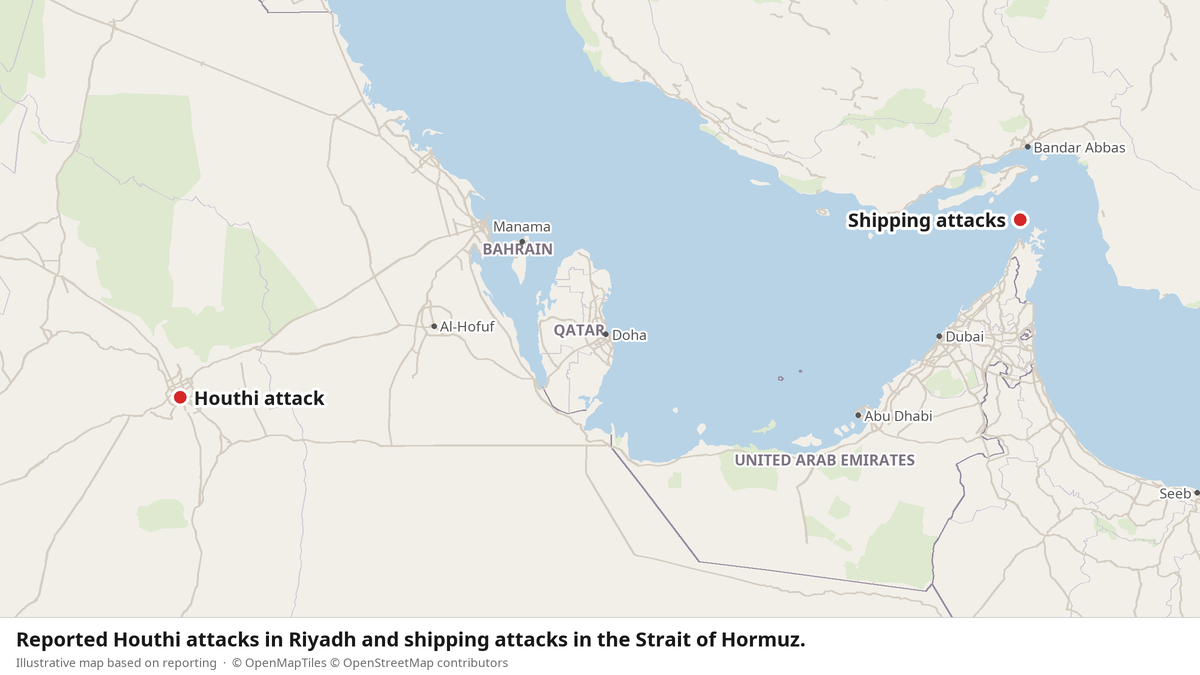
Four people were injured in Riyadh after Houthi missiles were intercepted over the Saudi capital, The National reported in its October 14 update. A separate Houthi attack set fire to an Aramco building in the city. No one at the facility was injured. The wounded were people on the ground, hurt in a city that had received warnings only minutes earlier.
The warnings came in two waves. Saudi Civil Defense issued an early alert for the eastern province on Tuesday, then another for Riyadh shortly after the interceptions, according to The Jerusalem Post's live updates. Those updates also reported explosions in Riyadh and at Aramco headquarters as the Saudi coalition worked to intercept incoming attacks. The Jerusalem Post page carried a photograph caption describing flames at an Aramco facility south of Riyadh on October 3, 2026, eleven days before the latest reports. Fire at an Aramco site, then, isn't a one-day event.
The Humanitarian Picture
The National reported that a Saudi-led coalition said it struck fuel sites to neutralise Houthi war capabilities. The reports don't say where those sites are, who works there, or what the strikes cost civilians living nearby. That gap matters. Fuel infrastructure is rarely isolated from communities around it, and the coverage so far leaves residents' fate unaddressed. Neither the Houthi attack on Riyadh nor the coalition's response has come with a public accounting of civilian harm beyond the four injured.
For those four people in Riyadh, political arguments over oil prices and regional power are secondary. They were hurt by debris and fire from missiles stopped in the air. Interception reduces harm, but it doesn't erase it.
Washington Raises the Temperature
The attacks came amid sharp rhetoric from the United States. US President Donald Trump said the Houthis were "behaving very badly" and accused them of striking Saudi Arabia to drive up oil prices. He said Turkish President Recep Tayyip Erdogan would "do as I ask" regarding a possible Turkish role against the Houthis, and that the United States would decide on Iran "very soon." The National reported that Erdogan told the Saudi Crown Prince the Houthi challenge would be overcome.
In another update, Trump threatened to hit Iran hard as Iranian officials revealed new tactics targeting ships in the Strait of Hormuz, aimed at keeping oil prices high ahead of US midterm elections. The Jerusalem Post page also carried a headline saying Netanyahu and Trump had discussed renewing strikes against Iran before elections. Its accompanying text said senior US officials told Axios that Netanyahu cited alleged Iranian efforts to rebuild nuclear capacity as the reason for launching new strikes.
Diplomacy Left Behind
What's missing from this day's reporting is any diplomatic track. The statements on the record concern interceptions, strikes on fuel sites, threats toward Iran, and possible military roles for third countries. The talk is about who'll hit whom, and when. No ceasefire proposal, mediation effort, or humanitarian corridor appears in the updates. Oil prices and election timing, rather than the safety of people in Riyadh or in Houthi-held areas, are the stated stakes in much of the rhetoric.
Why This Matters: Four injured civilians in Riyadh are the visible human cost of a confrontation that's widening faster than any effort to contain it. The reports link Houthi strikes, Iranian maritime tactics in the Strait of Hormuz, and talk of renewed US and Israeli action against Iran into a single escalation ladder, each rung justified by the last. When fuel sites are struck and leaders speak of deciding "very soon," people living near those sites and shipping lanes carry the risk. The updates cite oil prices and midterm elections as motives, raising a question for diplomats: who's working to step this down? On this day's record, no one is publicly doing so. The longer that remains true, the more likely civilians on every side pay for it.