
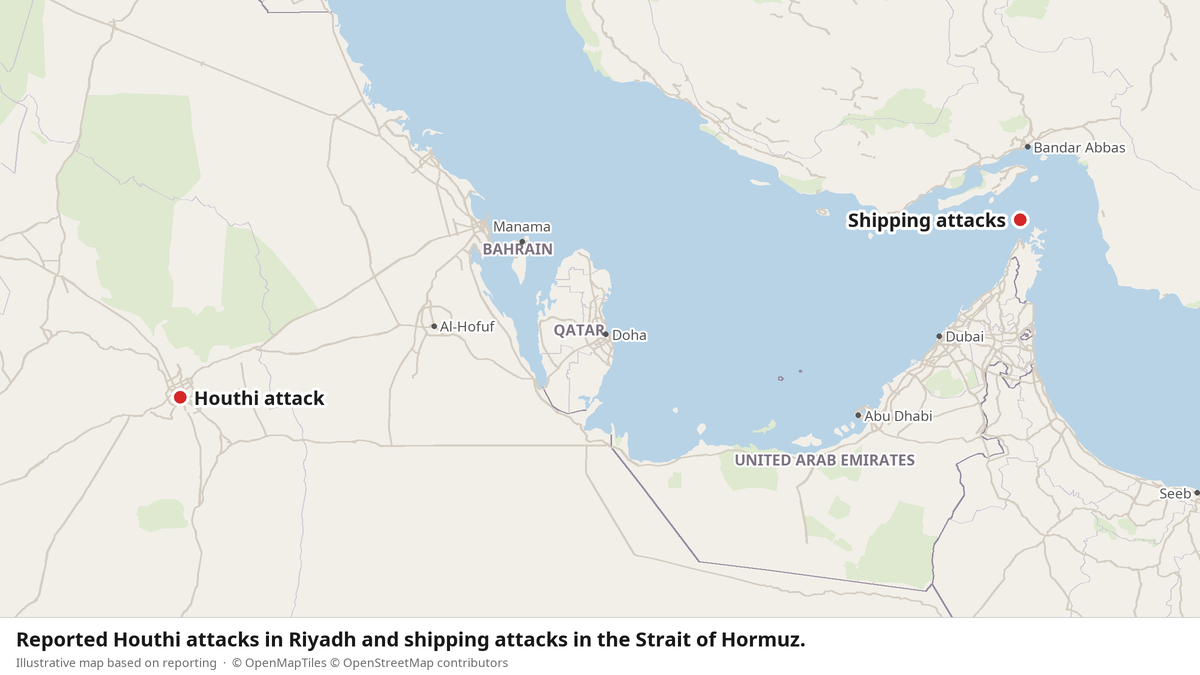
A Houthi attack set fire to an Aramco building in Riyadh, while four people were injured in the Saudi capital after Saudi forces intercepted Houthi missiles, according to an October 14 update from The National. No one was injured at the Aramco facility. Explosions rang out in Riyadh and at Aramco headquarters as Saudi-led coalition forces tried to knock down the incoming fire, The Jerusalem Post reported in its live updates.
The strikes hit the kingdom’s oil business at its core. They came from a militia that answers to Tehran.
The Security Picture
Saudi Civil Defense issued an early warning for the eastern province on Tuesday, then sent another for Riyadh shortly after the interceptions, The Jerusalem Post reported. That's a population living through rolling missile alerts.
The Saudi-led coalition said it had struck fuel sites to neutralise Houthi war capabilities, The National reported. Turkish President Recep Tayyip Erdogan told the Saudi Crown Prince the Houthi challenge would be overcome, according to the same update. A Jerusalem Post photograph caption also described flames at an Aramco facility south of Riyadh on October 3, 2026, 11 days before the latest reports. This isn't a one-off.
Washington Weighs In
US President Donald Trump said the Houthis were "behaving very badly" and accused them of striking Saudi Arabia to drive up oil prices. The National reported that he threatened the Houthis over the attacks. Trump also said Erdogan would "do as I ask" regarding a possible Turkish role against the Houthis, and said the United States would decide on Iran "very soon."
In another update, Trump threatened to hit Iran hard as Iranian officials revealed new tactics for targeting ships in the Strait of Hormuz. The tactics aim to keep oil prices high ahead of US midterm elections, according to The Jerusalem Post's live coverage.
The Iran Question
The Jerusalem Post page also carried a headline saying Netanyahu and Trump had discussed the possibility of renewing strikes against Iran before elections. In accompanying text, senior US officials told Axios that Netanyahu cited alleged Iranian efforts to rebuild nuclear capacity as the reason for launching new strikes. The reports describe discussions and allegations, not decisions. No strike has been announced.
The reporting shows a connected set of pressure points: missiles over Riyadh, a threatened shipping lane at Hormuz, and an unresolved nuclear question. Each one feeds the same oil market, and each one leads back toward Tehran's network of partners and proxies.
Why This Matters: Strikes on Saudi oil infrastructure show how an armed group can threaten a major energy producer and push up prices far beyond its own borders. The reported tactics in the Strait of Hormuz suggest Iranian officials see pressure on shipping as a lever over oil prices, according to the reporting. For Israel, discussion of renewed strikes over alleged nuclear rebuilding underlines why its leaders treat Iranian capabilities as a strategic threat, not a distant one. From a security-first perspective, the episode shows the cost of leaving armed proxies unchecked: the danger doesn't stay inside one conflict, and Gulf states, Washington, and Jerusalem are all being pulled toward the same set of decisions.