
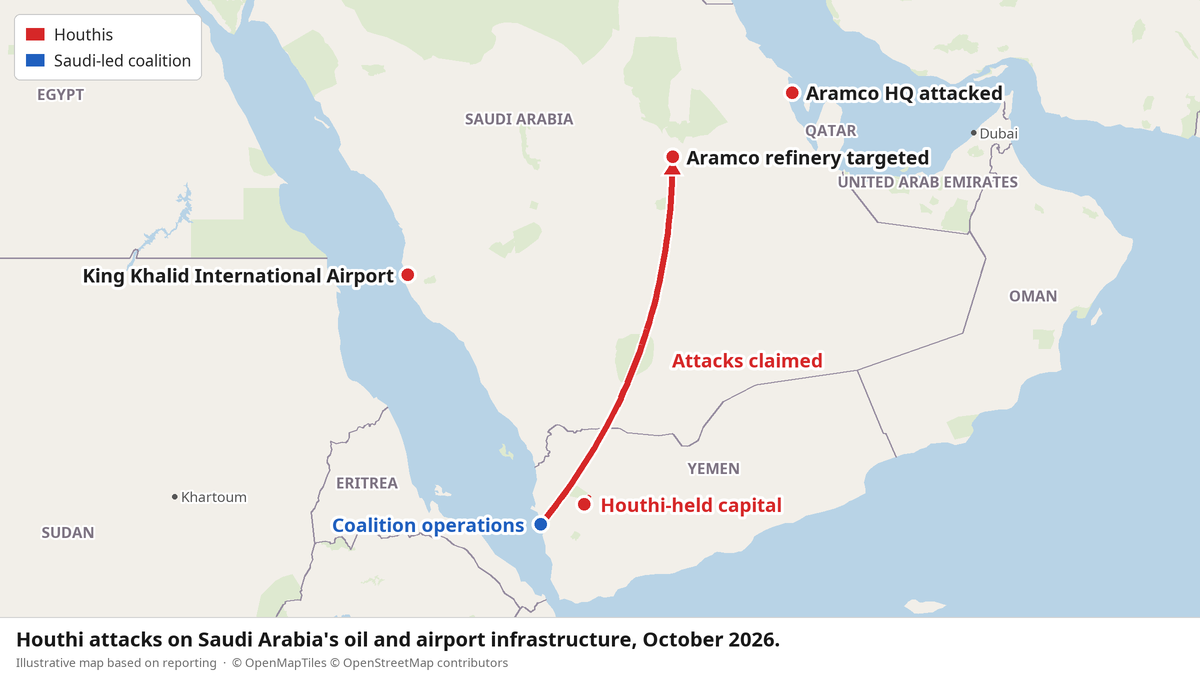
An administrative building belonging to Saudi Aramco in Dhahran, the eastern city, came under attack on Wednesday, causing a limited fire, according to a statement from Saudi Arabia's Energy Ministry. The ministry chose its words carefully: a limited fire, an administrative building. The statement mentioned no casualties, and the wire report offers none.
The target wasn’t a village or a market. It was a corporate office owned by the state. That tells you what the fight is actually over.
The State's Monopoly
The attack came, the report says, “as fighting between Yemen's Iran-allied Houthis and the kingdom intensified.” Read that sentence slowly. On one side stands a kingdom, a hereditary state that owns the oil company, runs the Energy Ministry and issues the statements. On the other stand the Houthis, described in the report as Iran-allied: an armed authority with a patron of its own. Two organized powers, each backed by organized force, each claiming the right to decide who gets hurt.
The report identifies the company as state-owned. That detail matters. Aramco isn’t some private bystander caught in a crossfire. It is the Saudi state's revenue engine, the thing that pays for the apparatus. When fighting reaches an Aramco building, it has reached the treasury.
Who Benefits, Who Gets Crushed
The Energy Ministry's statement spoke of a building and a fire. It didn’t speak of the people who live in Dhahran or those across the border in Yemen, where the war's costs are paid in a different currency. The base report doesn’t give casualty figures, displacement numbers or names of anyone harmed. That silence is itself a feature of how these conflicts get reported: the ministry counts property damage first, and the wire service repeats its account.
Notice who speaks. The only voice quoted in this report is the Saudi government's, delivered through a ministry statement. No Houthi spokesperson appears. No Dhahran resident. No Yemeni civilian. The state that owns the oil describes the fire in its own language, and the public gets a bulletin instead of a story.
Both Sides of the Same Coin
The report's framing, an Iran-allied group against a kingdom, reduces a war to a contest between patrons and clients: Tehran's proxy against Riyadh's army. The people living under either flag don’t appear in the sentence. They are the terrain, not the participants.
That’s the logic every state-versus-state war runs on. Each side calls its own violence defense and the other's aggression. Each side keeps the monopoly on deciding what counts as a legitimate target, while its elites keep their headquarters, ministries and revenue streams as stakes worth escalating over.
The report offers no sign of an off-ramp. It says the fighting is growing. There are no talks, no ceasefire, no international body stepping in, no resolution waiting to be ignored. Just intensification, delivered in a single paragraph from a government statement.
A limited fire in an administrative building is the kind of detail that makes a headline. The war that produced it, and the people living inside it, are the story the ministry's statement was built to leave out.