
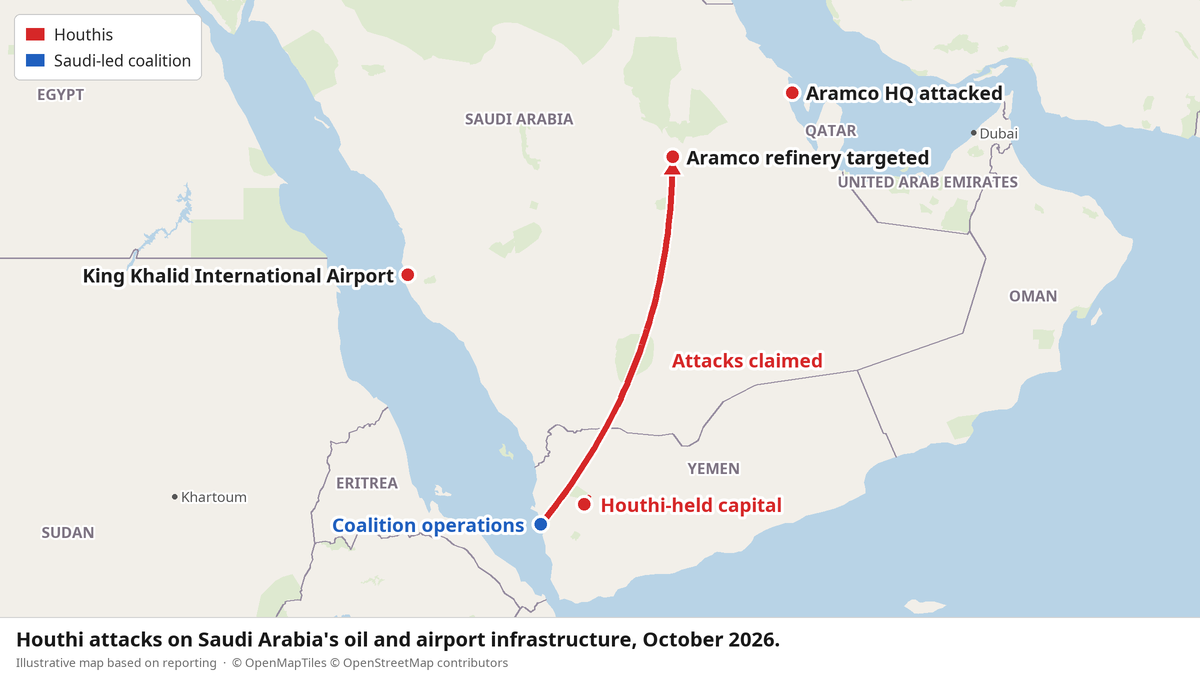
Saudi Aramco’s administrative building in Dhahran was attacked on Wednesday, causing a limited fire, the kingdom’s Energy Ministry said in a statement. The strike came as fighting between Yemen’s Iran-allied Houthis and Saudi Arabia intensified.
The target matters. Dhahran sits at the heart of the kingdom’s oil-producing east, and Aramco is the state-owned company at the center of Saudi Arabia’s energy economy. This isn’t a skirmish on a distant frontier. It reaches into infrastructure that supports the kingdom’s economy and, by extension, global energy markets.
The Security Picture
The Energy Ministry said the attack caused a limited fire. Its statement, as reported, didn’t describe any wider disruption to oil output at the site. It did confirm that an administrative building belonging to Saudi Arabia’s national oil company was hit, while the broader confrontation with the Houthis is escalating rather than winding down.
Source reporting describes the Houthis as Iran-allied, a label that places the confrontation beyond Yemen’s borders. A movement aligned with Tehran is trading blows with the Gulf’s largest oil exporter, and the fighting is growing. That fits a pattern in which Iran-backed armed groups use their proximity to critical infrastructure to pressure states Tehran views as rivals.
The Regional Threat
The escalation shows how far Iranian-aligned forces can reach. A Yemeni armed group striking a company facility in Saudi Arabia’s Eastern Province demonstrates a capacity to threaten energy assets deep inside a neighboring state. For Gulf governments, that’s no abstract concern. Oil facilities support national revenue and offer an obvious target for any adversary seeking maximum economic and psychological effect.
The source report gives few details about the attack itself, including who claimed responsibility or what weapon was used. Those points remain unconfirmed in the information available. What’s established is the Energy Ministry’s account of the incident and its description of the wider fighting as intensifying.
What Comes Next
Saudi Arabia now faces a familiar dilemma. It can absorb attacks on its energy infrastructure and risk emboldening the group behind them, or respond and risk deepening a conflict that’s already growing. Neither choice is cost-free, and the kingdom’s leadership hasn’t, in the available account, laid out its next steps beyond acknowledging the damage.
The fire’s limited scale may offer some reassurance. Still, the symbolism of hitting an Aramco building in Dhahran is hard to miss, and the fighting’s trajectory points toward more of the same unless deterrence returns.
Why This Matters: Attacks on Aramco property tie a regional proxy conflict directly to global energy security. When an Iran-allied group can strike a facility belonging to the world’s most important oil company, the exposure isn’t Saudi Arabia’s alone. Every economy that depends on stable Gulf supply shares it. From a security-first perspective, the episode shows the strategic cost of allowing armed groups aligned with Tehran to operate with impunity near critical infrastructure. It also reinforces why Gulf states and Israel treat the Iranian proxy network as a connected threat, not a set of isolated local disputes.