
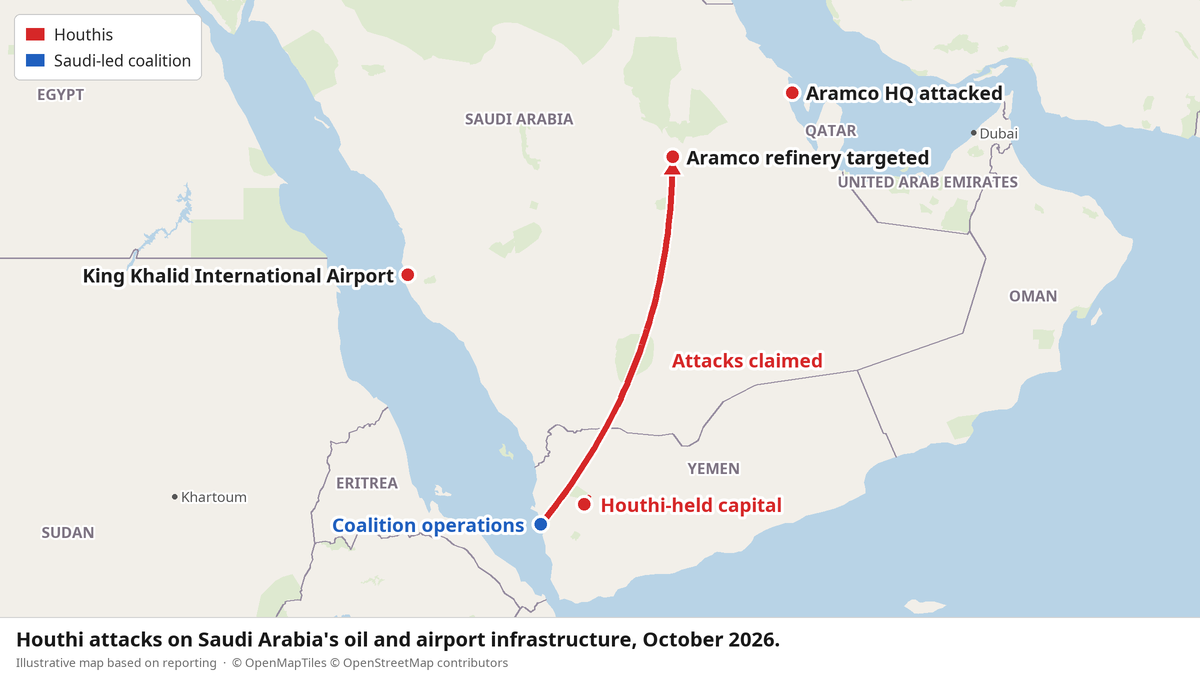
An administrative building belonging to Saudi Arabia’s state-owned oil company, Saudi Aramco, in the eastern city of Dhahran was attacked on Wednesday, causing a limited fire, the country’s Energy Ministry said in a statement. The strike came as fighting between Yemen’s Iran-allied Houthis and the kingdom intensified.
The target wasn’t a military base. It was an administrative building for the state oil company, a civilian-run commercial facility in a major eastern city. The Energy Ministry reported a limited fire.
Iran’s Proxy Network
The Houthis are described in the base reporting as Yemen’s Iran-allied movement. That description carries weight. Tehran’s partners don’t operate in isolation. The same axis that arms and backs one armed group on Israel’s borders supports another on the Arabian Peninsula, and now that second group is striking infrastructure belonging to the Gulf’s largest oil producer.
Saudi Arabia is confronting a militia that answers to a foreign sponsor’s strategic interests. The Energy Ministry confirmed that fighting has intensified, framing Wednesday’s strike as part of a widening confrontation, not an isolated incident.
The Terror Threat to Energy Infrastructure
Aramco isn’t an abstraction. Its facilities sit at the center of global energy supply, and an attack on its administrative building in Dhahran strikes at the Gulf’s economic nerve system. The ministry said the fire was limited, suggesting the damage remained contained. The intent behind such a strike is a separate question, and Western capitals should be asking it.
The base reporting says fighting between the Houthis and the kingdom has grown. It doesn’t detail casualties from Wednesday’s strike, and the Energy Ministry described only a limited fire. What the report does establish is the direction of travel: escalation, not restraint.
What the West Should Be Asking
The pattern raises questions that deserve answers. Who supplies weapons capable of reaching Dhahran from Yemen? What does it say about Iran’s regional strategy that allied militias now contest the security of Saudi Arabia’s core economic assets? And where is the coordinated Western response to a group that treats critical energy infrastructure as a legitimate target?
For Israel, Houthi escalation against Saudi Arabia is one piece of a larger picture. The Iran-aligned network threatening Jerusalem is the same network pressing against Riyadh. Gulf states and Israel face an overlapping adversary, even where their diplomatic positions differ.
The Energy Ministry’s brief statement leaves much unanswered. The base reporting doesn’t say how the building was struck, who claimed responsibility, or what Saudi Arabia plans in response. Those gaps matter. They’re the details that determine whether Wednesday’s fire was a warning shot or the opening of something larger.
What’s confirmed is narrow but clear. An Aramco administrative building in Dhahran burned. The Energy Ministry said so. The Houthis, backed by Iran, are fighting the kingdom, and that fighting is growing.