
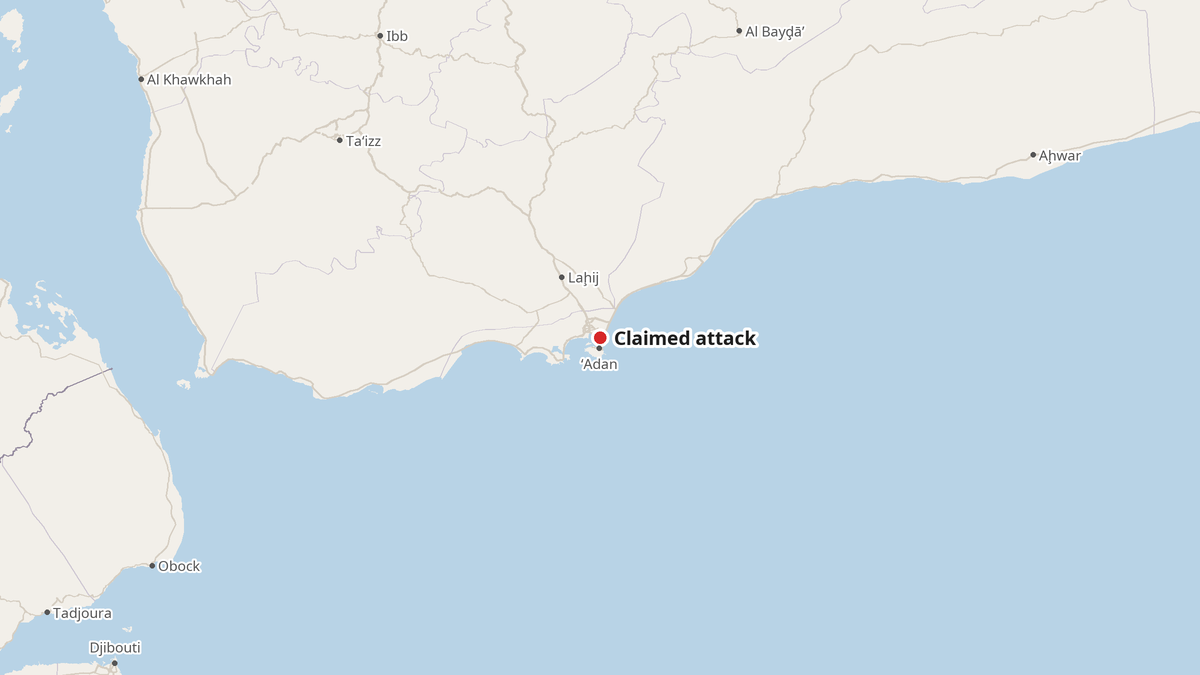
Two missiles landed near the airport in Aden, Yemen’s interim capital, after the Houthis said they were targeting a Saudi command centre, police sources reported. Saudi Arabia, meanwhile, said it intercepted a ballistic missile headed for Yanbu, two cruise missiles over the Red Sea and three unmanned aerial vehicles in southern Saudi Arabia and the Riyadh region. Both combatants announced their operations. Neither disclosed details about interception damage, injuries or launch sites.
The Houthis are fighting Yemen’s internationally recognised government and its Saudi allies. The competing military powers have made airports, energy infrastructure and shipping routes part of the confrontation, while civilians face alerts, travel disruption and restrictions on what they can record.
Missiles, warnings and silence
Saudi Arabia’s coalition said it would soon release footage of what it described as Houthi weapons-smuggling operations by sea to Yemen’s Al Hudaydah governorate. The Saudi Press Agency shared the announcement on social media, but provided no further details. The claim remains a coalition statement; the article reports no footage or independent verification.
The Gulf News report said King Khalid International Airport in Riyadh remained suspended through October 17. Airports in Jeddah and Dammam were operating with some delays and cancellations. The U.S. Mission warned citizens in Saudi Arabia about potential airport attacks, airspace closures and flight disruptions, and advised travellers to check with airlines and airports, follow Saudi security alerts and consider alternative transport.
People on the ground faced another instruction. Filming or sharing images of missile interceptions and impact sites could bring legal consequences under Saudi law. Saudi Civil Defence said the danger had passed in Khamis Mushait Governorate, urged residents to follow instructions and avoid gathering or filming, and gave 998 as the emergency number. Authorities had also sent a warning through the National Early Warning Platform. The apparatus issued alerts, restricted public documentation and directed residents where to turn for help.
Claims of help, claims of independence
The Wall Street Journal reported that many recent Houthi drone and missile attacks on Saudi Arabia used targeting intelligence provided by Iran. Danny Citrinowicz, described by the Jerusalem Post as a former Israeli official who previously headed the Iran branch for Israeli defense intelligence, called the intelligence connection “very, very strong on the operational level.” He said Iran had a strategic interest because Houthi attacks harm Saudi Arabia and raise oil prices, while stressing that the relationship was “not based on a client-patron relationship, but rather on strategic cooperation.”
The Times of Israel, citing sources familiar with Saudi and Yemeni intelligence, reported that Tehran had provided intelligence, training, tactical advice and targeting assistance. It said the support helped the Houthis make rapid territorial gains and carry out increasingly sophisticated attacks. The report said the group controlled Yemen’s coastline along the strategic Bab al-Mandeb Strait and had targeted Saudi tankers, energy infrastructure and airports.
Iran denied involvement. Foreign Ministry spokesman Esmail Baghaei said the Houthis were “entirely independent actors who make their decisions based on their own interests,” the Jerusalem Post reported. The Gulf News report quoted foreign ministry spokesman Esmaeil Baqaei saying, “The Islamic Republic of Iran rejects any claim that Iran has played a role in Yemeni (Houthi) operations.” It also said he reiterated Tehran’s offer to act as a bridge between the Houthis and Riyadh. The Jerusalem Post reported that members of Iran’s Islamic Revolutionary Guard Corps had commended recent Houthi strikes.
Adam Baron, a Yemen expert and fellow with Washington-based policy institute New America, told the Wall Street Journal that recent Houthi military gains were “undeniably” based on external Iranian assistance. “The support the Houthis received from Iran and other Axis actors undeniably paved the way for the rapid-fire gains they’ve made over the past few months,” he said. The competing accounts leave the public with denials, intelligence claims and military communiqués, while the strikes keep reaching civilian infrastructure.
Allies, deployments and the wider machinery
U.S. President Donald Trump urged Saudi Arabia to accept Israeli assistance against the Houthis. “Yeah, I do, sure. Israel has been very helpful to Saudi Arabia,” he said when asked whether Riyadh should accept Israel’s offer. He added that the possibility of Saudi Arabia normalising relations with Israel could return to the agenda “maybe more than ever.”
The Gulf News report said the commander of U.S. Central Command reported more than 50,000 U.S. military personnel deployed across the Middle East. CENTCOM also said Iran couldn’t access $25 billion in oil export revenues and that the United States had frozen about $350 million in cryptocurrency. Its fact sheet described financial pressure across multiple Iranian sectors and said the strain limited Iran’s ability to fund allied militia groups, criminal networks and attacks against the United States and its allies. Those are CENTCOM’s claims, presented by the military command itself.
A tanker took a hit from an unknown projectile about 68 nautical miles northeast of Al Jubayl, Saudi Arabia, on October 16, at around 9 a.m. UTC, according to a delayed report in a UKMTO warning issued October 17. All crew members were reported safe and evacuated, with no environmental impact reported at the time. UKMTO advised vessels to transit cautiously and report suspicious activity as authorities investigated. The warnings reach crews and passengers. The armed blocs keep issuing their claims.
- houthi attacks
- saudi arabia
- yemen
- iran
- missile interceptions
- drone attacks
- united states
- king khalid international airport