
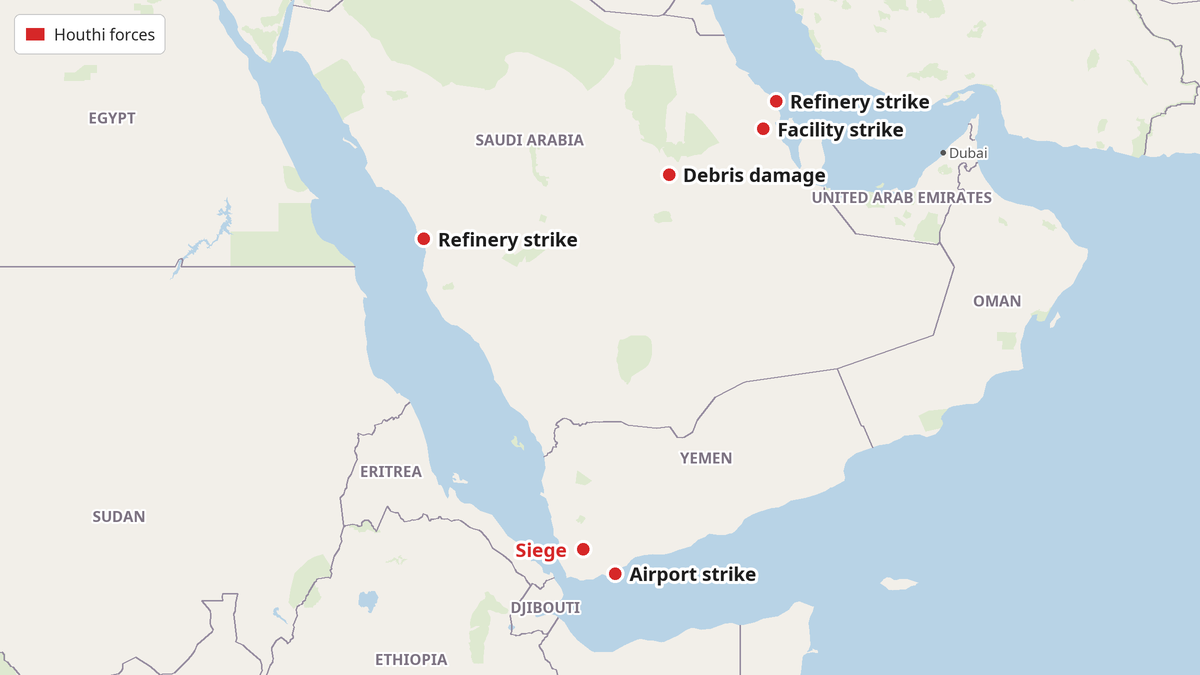
More than 800,000 people in and around besieged Taiz remain cut off from food and other life-saving aid. At the same time, Yemen’s Houthi forces claim they attacked Saudi airports, oil facilities and a military position. Saudi authorities said air defenses intercepted missiles fired toward Riyadh, where shrapnel wounded one person and damaged a house and a vehicle.
The Houthis said they targeted Ras Tanura oil refinery, an Aramco facility in Abqaiq, King Khalid International Airport in Riyadh, King Fahd International Airport in Dammam, Rabigh oil refinery and a Saudi military headquarters in the Najran region. The group said the attacks answered recent Saudi strikes on Houthi-held areas. Al Jazeera reported that no independent source had corroborated the claims, and Saudi Arabia hadn’t confirmed that the six sites were struck.
Missile claims and interceptions
In a statement posted on X, Houthi spokesperson Yahya Saree said the group used missiles against several targets and a drone against King Fahd International Airport. The Houthis claimed the drone disrupted air traffic and the Najran attack caused casualties among soldiers and officers. Gulf News identified the spokesman as Yahya Sarea and said his televised statement aired on Houthi-run al-Masirah TV.
The Saudi-led coalition said its air defenses intercepted and destroyed two ballistic missiles fired toward Riyadh on Thursday evening. Coalition spokesman Turki al-Maliki gave that account. Saudi Civil Defence said shrapnel wounded a Saudi citizen and damaged a house and vehicle. Authorities had issued warnings about potential threats in Riyadh and Al-Kharj governorates, as well as in Najran city.
On Wednesday, the coalition also said it intercepted and destroyed a ballistic missile launched toward Taif. Debris from two intercepted ballistic missiles damaged a building, a construction project and a vehicle in Riyadh on Tuesday evening. Gulf News reported that the coalition had earlier said Saudi air defenses intercepted three Houthi ballistic missiles: two aimed at Riyadh and one at the Eastern Province.
Taiz’s aid blockade
The United Nations said Houthi detentions of 71 U.N. staff had made humanitarian operations in areas controlled by the group “untenable.” Shirin Yaseen, associate spokesperson for U.N. Secretary-General Antonio Guterres, said the detentions “directly affect millions of people in need.” Some detainees had spent years in custody, while their families received no news. “We have cases of people who died in detention,” Yaseen said.
The Houthis intensified the siege of Taiz in early October, after taking the road linking the city with Aden, the seat of Yemen’s internationally recognized government. The World Food Programme estimated that about three-quarters of the more than 800,000 people cut off in Taiz depended on humanitarian assistance. Taiz, Yemen’s third-largest city, has faced varying degrees of Houthi siege since 2015.
The U.N. has no presence inside Taiz city and relies on Yemeni aid workers with local and international nongovernmental organizations. Yaseen said access and ongoing fighting remained core obstacles, and called for humanitarians to reach people in need. Asked about Human Rights Watch’s assessment that the blockade might amount to a war crime, she said she couldn’t provide a legal characterization. The U.N.’s human rights chief, Volker Turk, warned of a looming catastrophe unless aid was allowed in. The Houthis accuse detainees of espionage without providing evidence; the U.N. rejects that accusation.
Regional diplomacy
The attacks came during talks in Tehran attended by representatives from Saudi Arabia, Turkiye and Pakistan. An Iranian press release carried by Fars said participants agreed to continue discussions to strengthen cooperation among the four regional countries. Saudi Arabia’s foreign ministry stressed “the importance of opening channels of negotiation to prevent a return to military escalation.”
Yemen’s conflict began in late 2014, when the Houthis seized Sanaa and much of northern Yemen. The Saudi-led coalition intervened in 2015 to support the Yemeni government. The two sides have exchanged cross-border attacks in recent weeks. Earlier on Thursday, Yemen’s internationally recognised government called on the U.N. Security Council to take “deterrent and punitive measures” to stop Houthi attacks on Aden International Airport.
- houthi attacks
- saudi arabia
- yemen
- ballistic missiles
- riyadh
- saudi-led coalition
- humanitarian aid
- taiz