
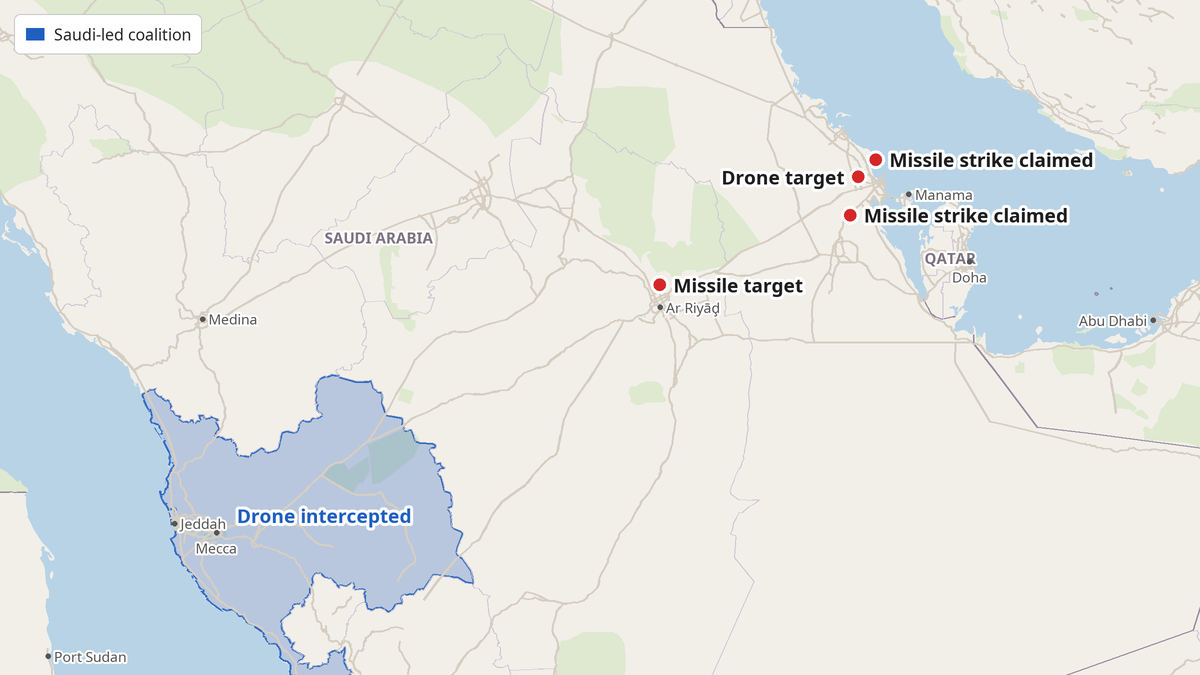
Saudi Civil Defence said shrapnel from an intercepted missile wounded one citizen in Riyadh and damaged a house and a vehicle, as Saudi and Houthi forces issued sharply conflicting accounts of attacks across the region. The coalition said it destroyed a drone over the Mecca region; Houthi military spokesperson Yahya Saree denied any operation toward Saudi territory that morning. The people near the targets and falling debris get no say in the decisions made by rival military commands.
Claims, interceptions and civilian harm
Houthi military spokesman Yahya Saree said the group carried out six operations against Saudi oil facilities, airports and a military position. He named the Ras Tanura refinery and Saudi Aramco facilities in Abqaiq, both in the Eastern Province, and the Rabigh refinery on the Red Sea coast. He said missiles targeted King Khalid International Airport in Riyadh, while a drone targeted King Fahd International Airport in Dammam, disrupting air traffic.
Saree also said an operation struck a command center for Saudi military forces in the southern border region of Najran, causing casualties among soldiers and officers. He said the attacks responded to recent Saudi strikes on Houthi-held areas in Yemen. There was no independent corroboration of the Houthi claims, and Saudi authorities hadn’t immediately confirmed the reported attacks on oil facilities and airports. The claims remain claims; the military targets and infrastructure named in them sit within a widening exchange of force.
The Saudi-led coalition said its air defences intercepted two Houthi ballistic missiles fired toward Riyadh on Thursday evening. Earlier on Thursday, it said it intercepted three ballistic missiles, two headed toward Riyadh and one toward the Eastern Province. Warning alerts for possible incoming threats went out in Riyadh and al-Kharj governorates and in Najran city. Saudi Arabia’s Civil Defence provided its account of the wounded citizen and damaged property to the state-run news agency.
Gulf News reported that the Houthis said 27 people were killed in Saudi airstrikes on Houthi-held areas in Yemen. The base report provides no independent confirmation of that toll. Each side’s statements describe military operations and their consequences; residents face the danger whether the next warning comes from one command or another.
Mecca denial and diplomatic language
The coalition’s account of a drone interception over the Mecca region was reported Friday. Saree said in a post on X that the Houthis had not carried out any operation toward Saudi territory and that their operations targeted Saudi oil facilities and military bases. The group has repeatedly denied targeting Mecca and Medina, Islam’s two holiest cities. Those denials and the coalition’s interception statement stand in direct conflict; the report doesn’t independently resolve it.
The attacks came amid diplomatic discussions in Tehran involving Iran, Saudi Arabia, Turkiye and Pakistan, described by Al Jazeera as members of the Mecca defence alliance. Saudi Arabia, Turkiye and Pakistan sent high-level representatives. Iran’s security chief Mohsen Rezaei hosted the meeting on Monday, attended by Saudi Defence Minister Khalid bin Salman, Pakistan’s army chief Asim Munir and Turkish intelligence chief Ibrahim Kalin.
An official Iranian press release carried by Fars news agency said participants “agreed to continue discussions to strengthen cooperation between the four regional countries.” The statement said the meeting focused on “peace and security in the region.” Saudi Arabia’s foreign ministry stressed “the importance of opening channels of negotiation to prevent a return to military escalation.” Al Jazeera reported that Houthi attacks continued despite the positive statements and agreement to resolve regional differences through dialogue. The language of cooperation has not stopped the exchange of missiles and drones.
A conflict managed by armed authorities
Gulf News reported that the Houthis and Saudi Arabia had exchanged cross-border attacks in recent weeks. Yemen has been in conflict since late 2014, when the Houthis seized Sanaa and much of northern Yemen. The Saudi-led coalition intervened in 2015 in support of the Yemeni government. The internationally recognised Yemeni government called on the UN Security Council to take “deterrent and punitive measures” to stop Houthi attacks on Aden International Airport.
The report describes no grassroots initiatives or mutual-aid response, and offers no account of what protection residents can organize outside the armed forces and official alerts. It records instead the statements of military spokespeople, a state agency, governments and a call to the Security Council. Their announcements compete; civilian exposure to the consequences remains part of the same record.
- houthi forces
- saudi arabia
- drone interception
- missile attacks
- saudi oil facilities
- riyadh
- mecca region
- yemen conflict