
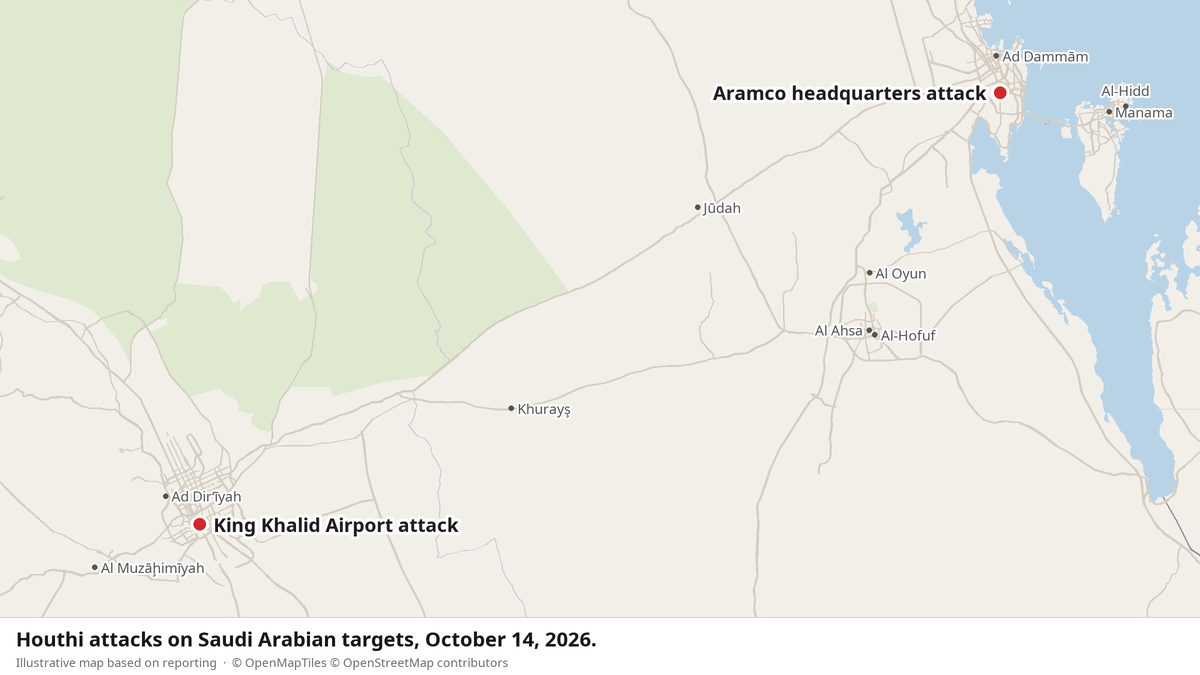
Thirteen people died at Riyadh's King Khalid International Airport on Saturday when a missile struck an area with passenger terminals 3 and 4, which serve domestic flights. One account put the number of wounded at 309. The Saudi aviation authority said the dead included citizens of the United States, Egypt, Jordan, Syria, the Palestinian territories, Sudan and Bangladesh, as well as Saudi citizens. Maids, drivers, laborers, travelers. They wanted a flight, not a war.
Saudi authorities deployed heavy security around the airport and warned the public not to distribute footage of the Houthi attacks. The dead got a cordon. The cameras got a warning.
Ministries Count Fires, Not Bodies
On Tuesday night, an administrative building belonging to Saudi Aramco in Dhahran came under attack. Saudi Arabia's Energy Ministry described the damage on Wednesday as a "limited fire." Three people with direct knowledge told Reuters a different story: extensive damage, flames across several floors, and a fire that started on the ninth floor of the south wing before spreading between the sixth and 10th floors. The top three floors, where CEO Amin Nasser's office sits, suffered severe damage. Part of the ceiling caved in, and windows and doors blew out. A fourth person said the fire still burned into the early hours of Wednesday.
The building houses an operations center that oversees onshore and offshore oil rigs, refineries, export terminals and thousands of kilometers of pipeline. Two sources said operations "continued normally," though some employees got instructions to work from home and some functions moved to global offices. Employees in Riyadh's financial district received the same instruction on Wednesday. Aramco didn't immediately answer Reuters' request for comment.
The Houthis vowed to keep striking airports and oil facilities, called them legitimate military targets, and urged "international shipping companies," civilians and workers to evacuate. Before the Dhahran strike, they published warnings to Aramco employees that named the Dhahran headquarters, the Riyadh airport and the Riyadh refinery, along with precise locations. Riyadh had staged its own choreography: Saudi authorities warned people to evacuate Yemeni Oil Company facilities, particularly the al-Sabaha station in Sanaa, before Saudi airstrikes hit oil facilities in Houthi-controlled areas. Both sides send notice to the people who work the pipes. Neither asks them.
The Pipeline of Parts
A Wall Street Journal report, based on findings by Conflict Armament Research, says the Houthis are trying to build advanced medium-range ballistic missiles themselves with components supplied from China. They want a version of Iran's Kheibar Shekan, with a range of up to 1,200 miles—enough to put all of Saudi Arabia and Israel within reach. Yemeni authorities intercepted two shipments in 2025, one year ago, with missile equipment hidden among other goods: metal components for missile bodies and engines, stabilizing fins, solid-fuel rocket motor components and heat-resistant materials.
UN reports cited by the Journal say Chinese companies have become the largest source of goods destined for the Houthis. Beijing says it complies with restrictions on arms sales to the group. An Israeli defense official offered his own reading: the Houthis "have long since ceased to be regarded as proxies of the Iranians, and they are demonstrating operational independence with an inexplicable determination against the Saudis." Suppliers, patrons and spokesmen across the state system deny the supply chain exists while it keeps delivering.
Everyone Prepares, Nobody Stops
Israeli defense officials are bracing for a possible surprise Houthi attack by land or sea. The IDF is expected to establish a fire coordination center within the Edom Division, with reserve and rapid-response troops in the Eilat area, weapons deployments, shorter response times, and joint exercises with the Israel Police and Border Police. They aren't ruling out a chain reaction: more Houthi strikes, a tougher Saudi response, the US military pulled in, American interests on Israeli territory targeted, and the IDF forced to answer. Operational and intelligence coordination with CENTCOM aims to sharpen early warning.
US Secretary of State Marco Rubio confirmed an American citizen died in the attack and called for an immediate end to strikes that endanger innocent civilians. The Houthis say they're retaliating for the kingdom's support of Yemeni government forces in a Yemen war that restarted last month, reignited by the US-Iran confrontation in the Gulf.
Who Pays
The economic wound hits the crown prince's brand. Saudi Arabia's real GDP is projected to contract 3.6% this year. The Future Investment Initiative, nicknamed "Davos in the Desert," is going hybrid, with executives able to attend remotely. In a statement sent before Saturday's attacks, organizers said delegates' safety and well-being "remain our highest priority." Oil bosses dropped out of a conference in Riyadh on Monday, and several senior executives reportedly canceled plans to attend the World Petroleum Council's energy congress.
The executives get a video link. The 13 got a terminal.