
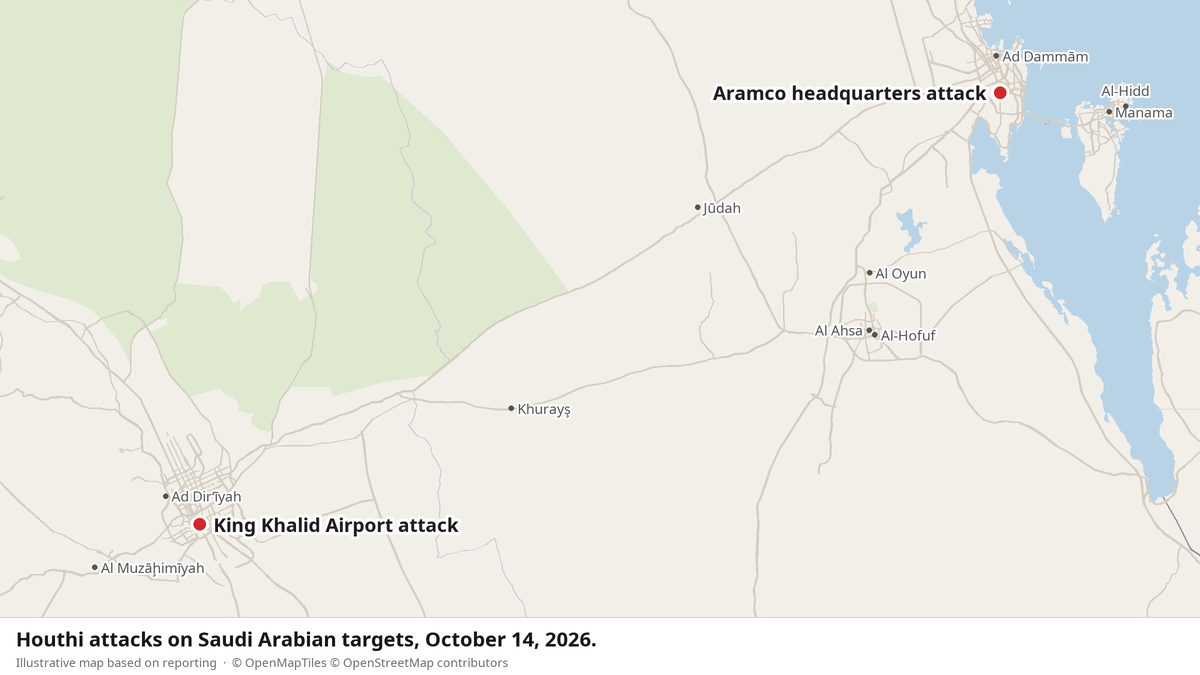
Yemen’s Houthis vowed Wednesday to continue attacking airports and oil facilities in Saudi Arabia, claiming they struck the headquarters of oil giant Saudi Aramco, hit the day before. The Iran-aligned group said it had launched ballistic missiles, cruise missiles and drones at Aramco facilities in the eastern city of Dhahran, King Khalid International Airport in Riyadh and an Aramco refinery in Riyadh, but didn’t say when.
The damage in Dhahran was serious. Three people with direct knowledge told Reuters that Tuesday’s attack caused extensive damage to the headquarters, as fire spread across several floors. One source said the top three floors, where Aramco CEO Amin Nasser’s office is located, suffered severe damage. Part of the ceiling caved in, and windows and doors blew out. Saudi Arabia’s Energy Ministry described the fire as limited and reported no casualties. International media said it remained unclear whether a missile struck the building directly or interception debris damaged it. Operations at the complex have continued normally, although some employees were asked to work from home.
The Strike on Civilians
The Aramco attack followed a week of widening Houthi strikes. An attack on Riyadh airport on Saturday killed 13 people; another account says at least 13 died and 309 were wounded. A regional official told the Associated Press that the missile hit an area containing passenger terminals 3 and 4, which serve domestic flights. Saudi Arabia’s aviation authority said the dead included foreign nationals from the United States, Egypt, Jordan, Syria, the Palestinian territories, Sudan and Bangladesh, along with Saudi citizens. US Secretary of State Marco Rubio confirmed an American citizen was among those killed and called for an immediate end to strikes that endanger innocent civilians.
That airport had already come under attack. Two days earlier, another assault damaged at least one passenger aircraft, reportedly empty, and killed three Saudi citizens, including a pilot. Earlier attacks on airports in Riyadh and Abha last week killed three more people.
The Houthis say they’re retaliating for Saudi backing of Yemeni government forces in the war that restarted last month. They also urged "international shipping companies," civilians and workers to evacuate airports and oil facilities, which they declared legitimate military targets. In other words, airports full of passengers from a dozen nations went on a target list. The Aramco strike followed Saudi airstrikes on oil facilities in Houthi-controlled areas of Yemen. Before those strikes, Saudi authorities issued an evacuation warning for Yemeni Oil Company facilities, including the al-Sabaha station in Sanaa.
The Missile Pipeline
A Wall Street Journal report published Wednesday, based on research by Conflict Armament Research, said the Houthis are trying to manufacture advanced medium-range ballistic missiles independently, using components supplied from China. The parts could help the group build its own version of Iran’s Kheibar Shekan missile, with a range of up to 1,200 miles, putting all of Saudi Arabia and Israel in range. The Iranian missile has reportedly been used against US military targets during the war with Iran. US assessments cited in the report say certain versions carry a warhead that separates in the final phase of flight and adjusts its trajectory, potentially evading air defenses.
The report described two shipments intercepted by Yemeni authorities in 2025, one year ago, with missile equipment hidden among other goods. The seized material reportedly included metal components for missile bodies and engines, stabilizing fins, solid-fuel rocket motor components and heat-resistant launch materials. UN reports cited by the Journal say Chinese companies have become the largest source of goods destined for the Houthis. Beijing says it complies with restrictions on arms sales to the group.
Israel Prepares
Israeli defense officials assess that the Houthi threat has intensified, leading to heightened preparations for a possible surprise attack on Israel by land or sea. The IDF is expected to establish a fire coordination center within the Edom Division. Over the past two years, the Houthis have released numerous videos of training exercises simulating ground raids on Israel, including mock military outposts and fortified guard towers. Officials say the group has increasingly warned of ground attacks in recent weeks and months, describing the threat as unpredictable.
Preparations include reserve and rapid-response troops in the Eilat area, training exercises, weapons deployments, tighter coordination among ground, naval and air units, shorter response times, and joint exercises with the Israel Police and Border Police. Intelligence coordination with the US military’s Central Command aims to refine early-warning mechanisms.
Officials aren’t ruling out a chain reaction. If the Houthis sharply escalate against the Saudi home front, Riyadh could intensify its response, potentially drawing in the US military. The Houthis could then target American interests on Israeli territory, which might require the IDF to respond. One defense official offered a blunt assessment: "The Houthis have long since ceased to be regarded as proxies of the Iranians, and they are demonstrating operational independence with an inexplicable determination against the Saudis."
Economic Fallout
The damage reaches beyond the battlefield. Saudi Arabia’s real GDP is projected to contract by 3.6% this year, a blow to Crown Prince Mohammed bin Salman’s plans to diversify the economy. The kingdom plans to turn its flagship Future Investment Initiative, nicknamed "Davos in the Desert," into a hybrid event with remote attendance, two people familiar with the matter said. On Monday, major oil bosses dropped out of an international conference in Riyadh, and several senior executives have reportedly canceled plans to attend the World Petroleum Council’s energy congress this month. Repeated missile attacks have also severely disrupted international aviation, effectively restricting access to Saudi airspace.
Why This Matters: The Houthis are attacking a sovereign state’s airports and energy infrastructure, killing civilians from the US, Arab and Asian nations, and openly threatening shipping companies, while seeking missiles that could reach Israel from Yemen. That’s the picture from this week’s reporting. Chinese-sourced components flowing to a militia aligned with Iran show how non-state armed groups are acquiring state-level weaponry. Israeli officials now plan for scenarios that once seemed remote, from missile fire to ground raids near Eilat. For Gulf states, Israel and Washington alike, the cost of underestimating a group that treats civilian airports as military targets is rising by the day.