
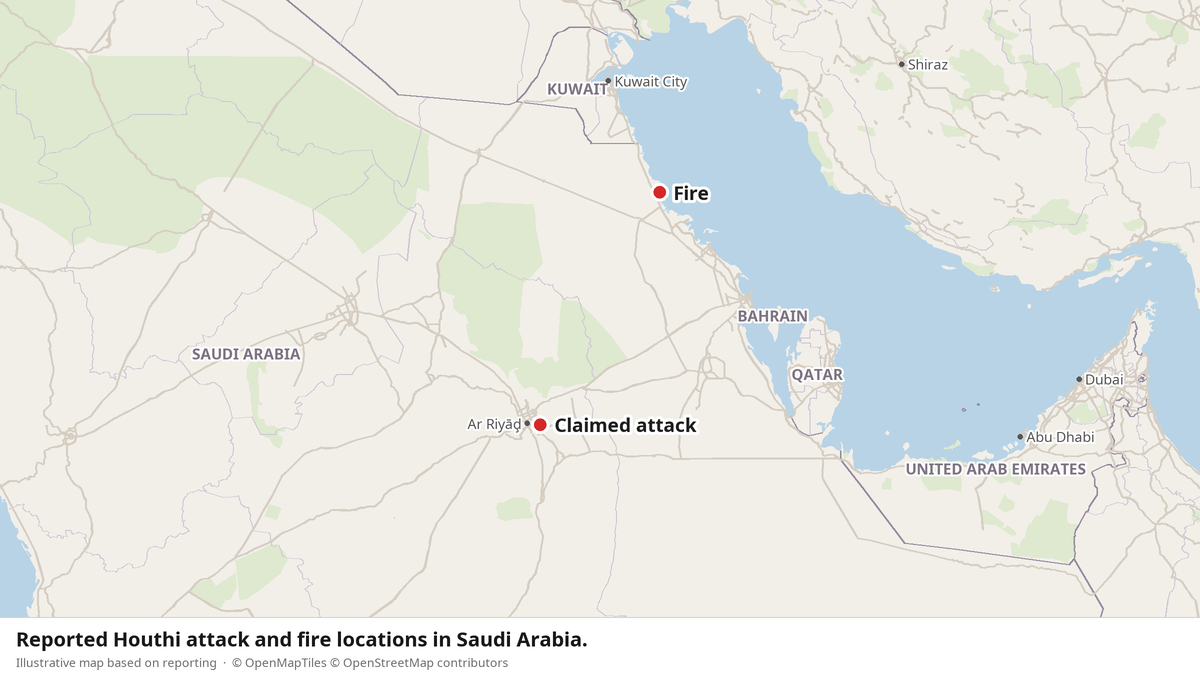
Yemen’s Houthis attacked King Khalid International Airport in Riyadh with a ballistic missile on Wednesday, renewing pressure on Saudi Arabia’s years-long effort to contain the group through war and an uneasy truce. The airport will remain closed until October 17. The Houthis said the strikes retaliated for Saudi actions in Yemen.
A fire spread across several floors of an Aramco complex in Dhahran after the Houthis struck the Saudi state oil giant’s headquarters on Tuesday. The group has vowed to keep targeting Saudi airports and oil facilities.
The war returns to Saudi Arabia
Saudi Arabia entered the war a decade ago, with Crown Prince Mohammed bin Salman leading an effort to oust the Houthis. The conflict became a quagmire, drained Saudi resources and triggered widespread backlash over the kingdom’s devastating bombing campaign. Saudi Arabia later cut its losses and has maintained an uneasy truce with the Houthis since 2022.
“This is the collapse of Saudi Arabia’s containment strategy,” said Rob Geist Pinfold, an international security expert at King's College London. He said Saudi policy in recent years resembled Israel’s treatment of Hamas in Gaza before 7 October 2023: Saudi leaders believed they’d disincentivized escalation but weren’t ready for a political solution.
The conflict resumed after Saudi Arabia bombed Sanaa airport in July to prevent a plane carrying Houthi officials from landing. Iranian, Syrian and Hezbollah military advisers and weapons systems were on board, Middle East Eye reported. The Houthis answered by declaring a blockade against Saudi shipping and launching an offensive down the Red Sea coast last month. Saudi Arabia and its Yemeni allies haven’t managed to counter it.
In the week before the report, the Houthis struck Riyadh’s international airport three days in a row. A Saturday strike killed at least 13 people and injured 300. Video from the attack showed Umrah pilgrims absorbing the blast, prompting widespread condemnation of the Houthis.
Missiles, oil and the cost of war
Saudi Arabia is a major buyer of American weapons, including Patriot and Thaad air-defence systems. The Stockholm International Peace Research Institute said the kingdom spends 6.5 percent of its gross domestic product on military equipment, one of the world’s highest ratios.
“It’s quite striking, literally, that the Houthis can hit, at will, these incredibly important facilities in Saudi Arabia and the Saudis can’t defend them,” said Gregory Gause, an expert on the Gulf at the Middle East Institute. He said the Houthis now had better missiles and targeting technology than in the previous round of fighting.
A western defence official in Riyadh said Saudi Arabia intercepts the vast majority of missiles and drones, probably in the low 90 percent range, but the Houthis have grown more skilled at penetrating its air defences. “It is a combination of innovation, rapid speed and the latest intelligence,” the official said, speaking anonymously.
The Houthis honed their targeting skills after 7 October 2023, attacking Red Sea vessels in what they said was solidarity with Palestinians under siege in Gaza. A four-year ceasefire gave the group time to establish itself in Yemen’s rugged northwestern mountains. Middle East Eye reported that the Houthis had also received more assistance from Iran and even Russia.
Saudi Arabia expects its economy to shrink by 3.6 percent this year and has scaled back megaprojects under its Vision 2030 economic plan. Its East-West oil pipeline was temporarily disabled in a strike last month that the kingdom blamed on Iran-aligned militias in Iraq. Experts said the kingdom didn’t want to close Riyadh airport for an extended period as it prepared to host a flagship investment conference at the end of the month.
A fractured counteroffensive
Saudi Arabia is reluctant to send its own ground forces into Yemen and relies on local allies. It is the biggest backer of Yemen’s internationally recognised government, whose forces remain deeply fractured. The government announced earlier this month a full-scale offensive to retake all territory the Houthis have held since 2014.
A western official in the Gulf tracking the offensive said he was “disappointed” by its performance. “One force showed up to fight without food and water. Other units have just melted away, leaving the flanks exposed,” he said.
The most effective fighters against the Houthis are Yemeni factions aligned with the UAE, but Saudi Arabia has clashed with its Gulf neighbour over support for their secessionist ambitions. The disagreement has made it harder to build a cohesive military.
The US, Saudi Arabia’s closest ally, has declined to get publicly involved, though it has provided defensive support and intelligence, experts said. Saudi Arabia activated the Mecca Pact, a joint defence agreement with Pakistan and Turkey, earlier this month. Islamabad has sent military aid to Saudi Arabia, and Turkey is expected to do so.
- houthis
- riyadh airport
- saudi arabia
- crown prince mohammed bin salman
- aramco
- red sea
- ballistic missile
- military conflict