
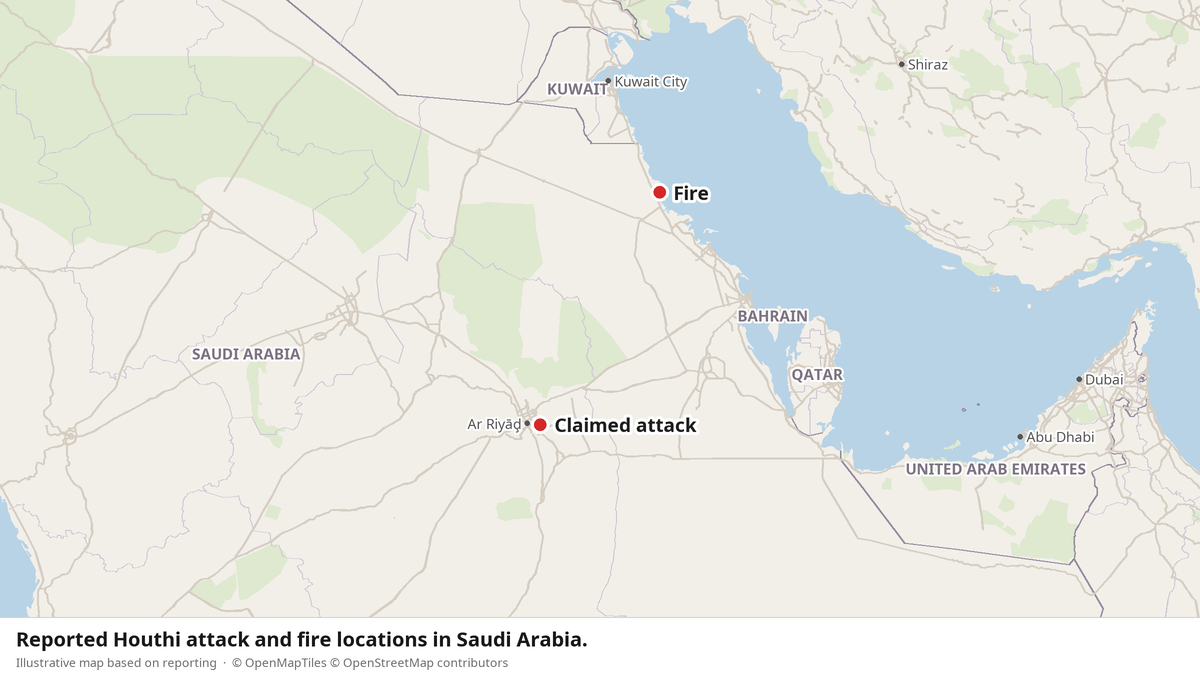
Yemen’s Houthis struck King Khalid International Airport in Riyadh with a ballistic missile on Wednesday and vowed to keep hitting Saudi airports and oil facilities, the group’s military spokesperson said. The airport was to remain closed until October 17. A fire at an Aramco complex in Dhahran spread across several floors.
Airport and Oil Targets Under Fire
The attacks have exposed the security risks Saudi Arabia faces as it tries to contain the Houthis and pursue economic growth. Analysts and diplomats called the strategy a collapse, creating one of the most serious tests for Crown Prince Mohammed bin Salman since he rose to power.
The Houthis said the strikes were retaliation for Saudi actions in Yemen. Saudi Arabia bombed Sanaa airport in July to stop a plane carrying Houthi officials from landing. Iranian, Syrian and Hezbollah military advisers and weapons systems were on board, Middle East Eye reported. The Houthis then declared a blockade against Saudi shipping and launched a lightning offensive down the Red Sea coast last month. Saudi Arabia and its Yemeni allies haven't managed to counter it.
“This is the collapse of Saudi Arabia’s containment strategy,” said Rob Geist Pinfold, an international security expert at King’s College London. He said Saudi leaders had considered the Houthis contained, weren't prepared for a political solution and believed they had discouraged further escalation.
The Houthis struck Riyadh’s international airport three days running in the week before the report. A Saturday strike killed at least 13 people and injured 300. On Tuesday, the group hit the headquarters of Saudi state oil giant Aramco in Dhahran, in the kingdom’s east.
Missile Capability and Regional Support
Saudi Arabia ranks among the biggest buyers of American weapons, including Patriot and Thaad air-defence systems. The Stockholm International Peace Research Institute said the kingdom spends 6.5 percent of its gross domestic product on military equipment, one of the world’s highest ratios.
“It’s quite striking, literally, that the Houthis can hit, at will, these incredibly important facilities in Saudi Arabia and the Saudis can’t defend them,” said Gregory Gause, an expert on the Gulf at the Middle East Institute. He said the Houthis now had better missiles and targeting technology than before.
A western defence official in Riyadh said Saudi Arabia intercepted the vast majority of missiles and drones, probably in the low 90 percent range, but the Houthis had become more skilled at penetrating its air defences. “The Houthis are a lot more effective than Iran was back in February. They learned from earlier this year,” the official said. “It is a combination of innovation, rapid speed and the latest intelligence.”
The Houthis built their targeting skills after 7 October 2023, when they began attacking Red Sea vessels, saying they acted in solidarity with Palestinians under siege in Gaza. A four-year ceasefire gave the group time to establish itself in Yemen’s rugged northwestern mountains. The Houthis have also received more help from Iran and even Russia, Middle East Eye reported.
Saudi Arabia’s Constraints
A strike last month temporarily disabled Saudi Arabia’s East-West oil pipeline; the kingdom blamed Iran-aligned militias in Iraq. Saudi Arabia expects its economy to shrink by 3.6 percent this year and has scaled back megaprojects under its Vision 2030 economic plan. A wider war could put further pressure on its finances.
Saudi Arabia has generally responded with restraint, diplomats and analysts said. Video from Saturday’s Riyadh airport strike showed Umrah pilgrims absorbing the blast, prompting widespread condemnation of the Houthis. “The Saudis have upped their game when it comes to more precise air raids,” said Bader al-Saif, an expert at Kuwait University.
The kingdom activated the Mecca Pact, a joint defence agreement with Pakistan and Turkey, earlier this month. Islamabad has sent military aid to Saudi Arabia, and Turkey is expected to do so. The US has provided defensive support and intelligence but has declined to become publicly involved, experts said.
Saudi Arabia is reluctant to send its own ground forces into Yemen and depends on local allies. The Yemeni government, whose forces are deeply fractured, announced a full-scale offensive to retake territory the Houthis have held since 2014. A western official in the Gulf tracking the offensive said some forces lacked food and water, while other units had “just melted away, leaving the flanks exposed.”
Gause said the Houthis’ offensive couldn't be separated from the stalled ceasefire between Iran and the US. “The only way the Houthis get restrained here is if the Iranians tell them to. That can only come from a US-Iran political deal,” he said.
- houthis
- riyadh airport
- saudi arabia
- crown prince mohammed bin salman
- aramco
- red sea
- ballistic missile
- military conflict