
Six people have died in Florida after Hurricane Isaias, and Gov. Ron DeSantis is already explaining which deaths count. At a Tuesday news conference, he said two newly reported deaths came “a little bit more post-storm” and were “attenuated from the storm.” One victim was a woman killed when a tree fell on her home in Escambia County. The other was a man who died of carbon monoxide poisoning after improperly using a generator.
Both deaths made the list. DeSantis just wanted everyone to know how far from the storm they happened.
Who Gets Crushed
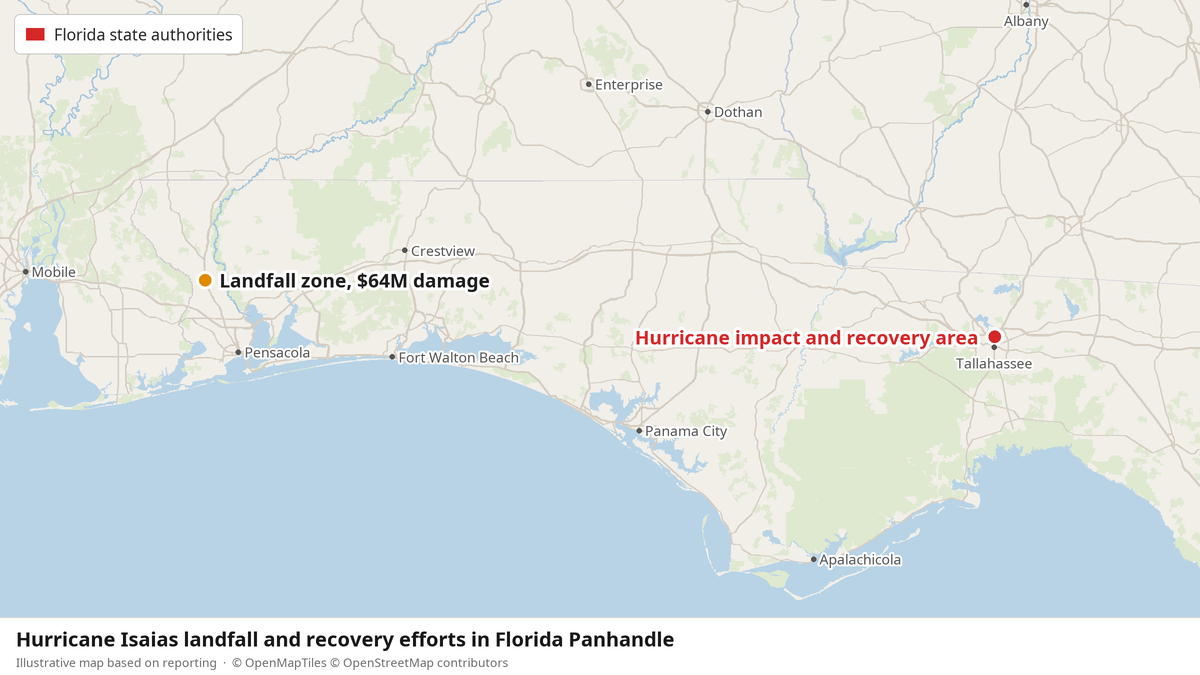
The Category 2 hurricane made landfall near Destin around 9:30 p.m. ET Friday, five days ago as of today. Gusts reached 118 mph, while heavy rain and dramatic storm surge battered the area. Communities along the Panhandle lay, in the article’s words, “in shambles.” More than 400,000 Florida customers lost power at the peak of landfall on Oct. 9. By Wednesday morning, over 20,000 customers were still in the dark, mostly in Escambia and Santa Rosa counties, according to PowerOutage.com.
The death toll tells its own story. DeSantis described four storm-related deaths: a “tragic accident” involving a falling tree during cleanup, one death in a car accident, and two deaths caused by interruptions to medical treatment. People died because the machinery that keeps them alive—medical care and electricity—stopped working when the storm hit. Add the man poisoned by a generator he used improperly, and you’ve got a picture of what happens when people must improvise their own survival. Alabama reported two more storm-related deaths, including a person killed when a tree fell onto a Birmingham home. Officials hadn’t made details about the second death available.
What They’re Calling “Order”
DeSantis explained how the state counts storm deaths. “The way Florida has typically done this is it’s not just if the storm knocks over your house and somebody gets killed, they kind of link anything that is even a fallout of the storm,” he said. Notice the framing: Florida “has typically done” it this way, and the number stays at six only because the governor drew a line between deaths “post-storm” and deaths in the storm. The state decides where that line sits. The dead don’t get a vote.
He also said crews had restored power to about 95% of customers who lost it. That’s the utility restoration timeline presented as a success. For the 20,000-plus customers still waiting, it’s a percentage that leaves them out.
The Bill Comes Due
In Escambia County alone, initial damage assessments put the cost of county repairs, emergency response and recovery at roughly $64 million. The state-led effort is shifting from immediate response to debris removal, damage assessments and aid distribution across the Panhandle. Assessments first, then distribution. Paperwork before relief. Anyone who’s waited on an aid application with a tarp for a roof knows how that sequence feels.
The base reporting names no neighbors clearing roads, no mutual aid networks feeding people without power, no community kitchens. That silence says plenty about whose actions get recorded: governors hold press conferences, while people hauling branches and checking on the elderly down the block don’t make the wire. In a storm zone, the folks closest to the wreckage are always the first responders, whether officials acknowledge them or not.
Six dead, a $64 million bill in one county, and a governor focused on the semantics of who counts.