
Six people in Florida are dead after Hurricane Isaias tore through the Panhandle, Gov. Ron DeSantis announced Tuesday at a news conference. Two more deaths in Alabama bring the known toll across the states to eight.
The latest Florida victims include a woman killed when a tree fell on her home in Escambia County and a man who died of carbon monoxide poisoning after using a generator improperly. Both died after the storm passed. That’s why DeSantis called them “a little bit more post-storm” and “attenuated from the storm.”
DeSantis explained how Florida counts such cases. “The way Florida has typically done this is it's not just if the storm knocks over your house and somebody gets killed, they kind of link anything that is even a fallout of the storm,” he said. He described the four earlier storm-related deaths as a “tragic accident” involving a falling tree during cleanup, one death in a car accident and two deaths resulting from disruptions to medical treatment.
Who Was Hit Hardest
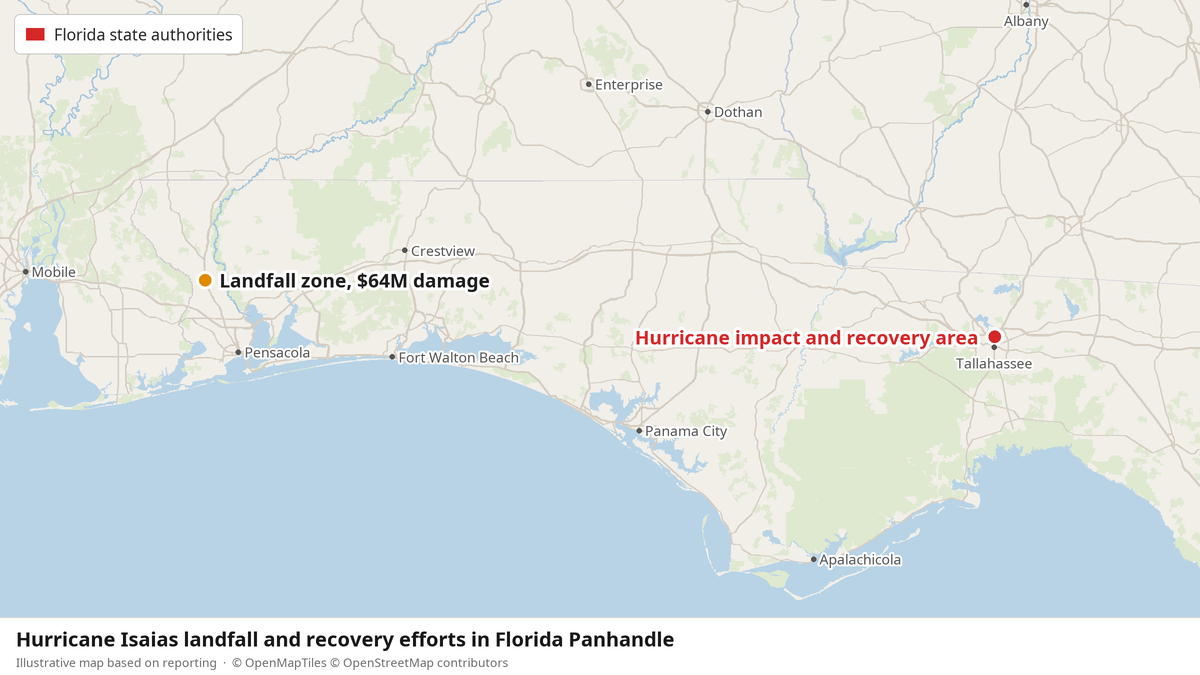
The Category 2 hurricane made landfall near Destin on the Gulf Coast around 9:30 p.m. ET Friday, five days ago. Florida took the worst of it. Wind gusts reached 118 mph, while heavy rain and dramatic storm surge left Panhandle communities in shambles.
The damage is concentrated. Recovery efforts center on a tight stretch of northwest Florida, where the communities still waiting for basic services also took the heaviest blows. More than 20,000 customers remained without power Wednesday morning, mainly in Escambia and Santa Rosa counties, according to PowerOutage.com. At landfall’s peak on Oct. 9, more than 400,000 Florida customers had lost electricity.
DeSantis said crews had restored power to about 95% of customers who lost it. That offers little comfort to the remaining 5%. Days without electricity can mean spoiled food and lost wages. They can also prompt dangerous improvisation with generators, as the carbon monoxide death shows.
Counting the Cost
Deaths linked to disruptions in medical treatment show that a hurricane’s toll doesn’t end when the wind dies down. Two Floridians died after their care was interrupted. The base reporting doesn’t explain how that happened, but the governor’s tally counts those deaths as part of the storm’s human cost.
In Escambia County alone, initial damage assessments put the cost of county repairs, emergency response and recovery at approximately $64 million. That’s one county’s preliminary figure, landing on local budgets already stretched by disaster demands.
Alabama also lost lives. Officials reported two storm-related deaths there, including a person killed when a tree fell onto a Birmingham home. Details about the second death weren’t immediately available.
From Response to Recovery
Florida’s state-led effort is shifting from immediate response to aftermath impacts, including debris removal, damage assessments and aid distribution across the Panhandle. This phase is often slower and less visible than the rescues and power restoration that dominate the first days. It’s also when residents depend most on public agencies to deliver aid quickly and fairly.
The governor’s remarks about how deaths get counted matter. A broad accounting that includes cleanup accidents and interrupted medical care gives a fuller picture of what the storm cost people.
Why This Matters:
The Isaias toll shows that a hurricane’s danger lasts beyond landfall. Two of Florida’s six deaths came after the storm passed: one from an improperly used generator and one from a falling tree. Two more followed interruptions to medical care. Each points to the weeks of recovery, when households without power, dry homes or reliable access to treatment face the greatest exposure. The roughly $64 million estimate in Escambia County alone signals how much public money recovery will demand, and how heavily the burden falls on the hardest-hit Panhandle communities. How quickly the state moves from debris removal and damage assessment to delivering aid will determine how long those communities remain in crisis.