
Six people have died in Florida from Hurricane Isaias, Gov. Ron DeSantis said at a Tuesday news conference. He also explained how the state decides which deaths count.
“Florida has typically counted more than people killed when a storm knocks over a house,” DeSantis said. “They kind of link anything that is even a fallout of the storm.” He described the two newest deaths as occurring “a little bit more post-storm” and being “attenuated from the storm.”
The two deaths involved a woman killed when a tree fell on her home in Escambia County and a man who died of carbon monoxide poisoning after improperly using a generator. DeSantis listed the four earlier deaths: a “tragic accident” involving a falling tree during cleanup, one death in a car accident, and two deaths resulting from disruptions to medical treatment.
Who Pays
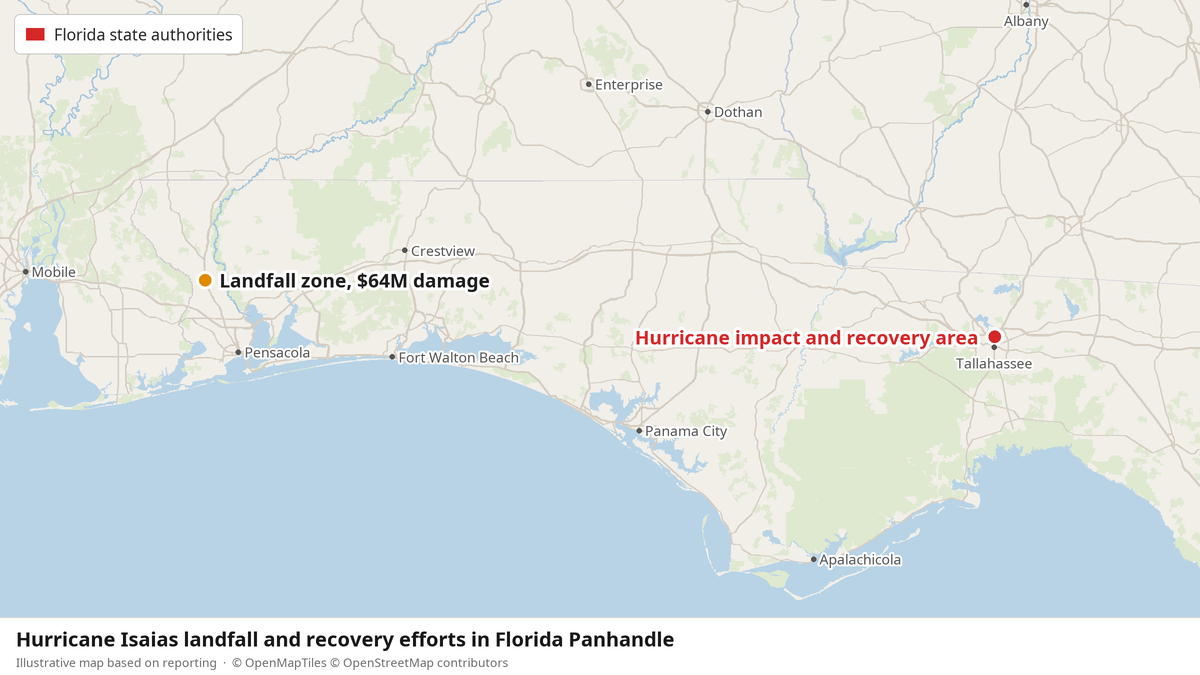
The Category 2 hurricane made landfall near Destin on the Gulf Coast around 9:30 p.m. ET on Friday, Oct. 9, five days ago. Gusts reached 118 mph. Heavy rain and storm surge left Panhandle communities, as the article put it, “in shambles.”
More than 400,000 Florida customers lost power at the height of landfall. By Wednesday morning, over 20,000 remained in the dark, primarily in Escambia and Santa Rosa counties, according to PowerOutage.com. DeSantis said crews had restored power to about 95% of customers who lost it.
The deaths extend beyond the state line. Alabama reported two storm-related deaths, including one person killed when a tree fell onto a Birmingham home. Officials had not immediately provided details on the second death.
Two Florida deaths followed disruptions to medical treatment. Another involved a generator, the stopgap people turn to when the grid goes down. The base reporting offers no further detail on who these people were, what treatment they’d lost access to, or what equipment they were using.
The State’s Role
The tally is an administrative product. DeSantis called the newest two deaths “attenuated from the storm,” and his account shows that the count depends on what the state chooses to link to it. At the same news conference, he put a figure on the cost side: initial damage assessments estimate roughly $64 million in county repairs, emergency response and recovery in Escambia County alone.
The state’s recovery effort is shifting, according to the report, “from immediate response to aftermath impacts like debris removal, damage assessments and aid distribution across the Panhandle.” Households find out what reaches them, and when, during aid distribution.
What Comes Next
Recovery remains concentrated in northwest Florida. Escambia and Santa Rosa counties still account for most outages. Escambia is also where officials calculated the first cost estimate: $64 million, from one county’s early assessment.
Neither the governor nor the source reporting says who will carry that bill beyond the damage assessments themselves, or how long the remaining 20,000-plus customers will wait for power. The article names no utility, insurer or contractor. It names a governor, a toll, a dollar figure and people crushed, poisoned and cut off from care.