
Six Floridians are dead after Hurricane Isaias, though the toll could look different depending on who's counting. Gov. Ron DeSantis announced the updated number Tuesday, adding two deaths: a woman killed when a tree fell on her home in Escambia County and a man who died from carbon monoxide poisoning after using a generator improperly.
DeSantis spoke plainly about how officials assemble the count. “The way Florida has typically done this is it's not just if the storm knocks over your house and somebody gets killed, they kind of link anything that is even a fallout of the storm,” Gov. DeSantis said. He said the latest deaths happened “a little bit more post-storm” and were “attenuated from the storm.”
The governor listed four earlier storm-related deaths: one “tragic accident” involving a falling tree during cleanup, one car accident and two deaths after disruptions to medical treatment. Two other people died in Alabama, including one killed when a tree fell onto a Birmingham home. Officials hadn't immediately released details about the second Alabama death.
What the Storm Did to the Panhandle
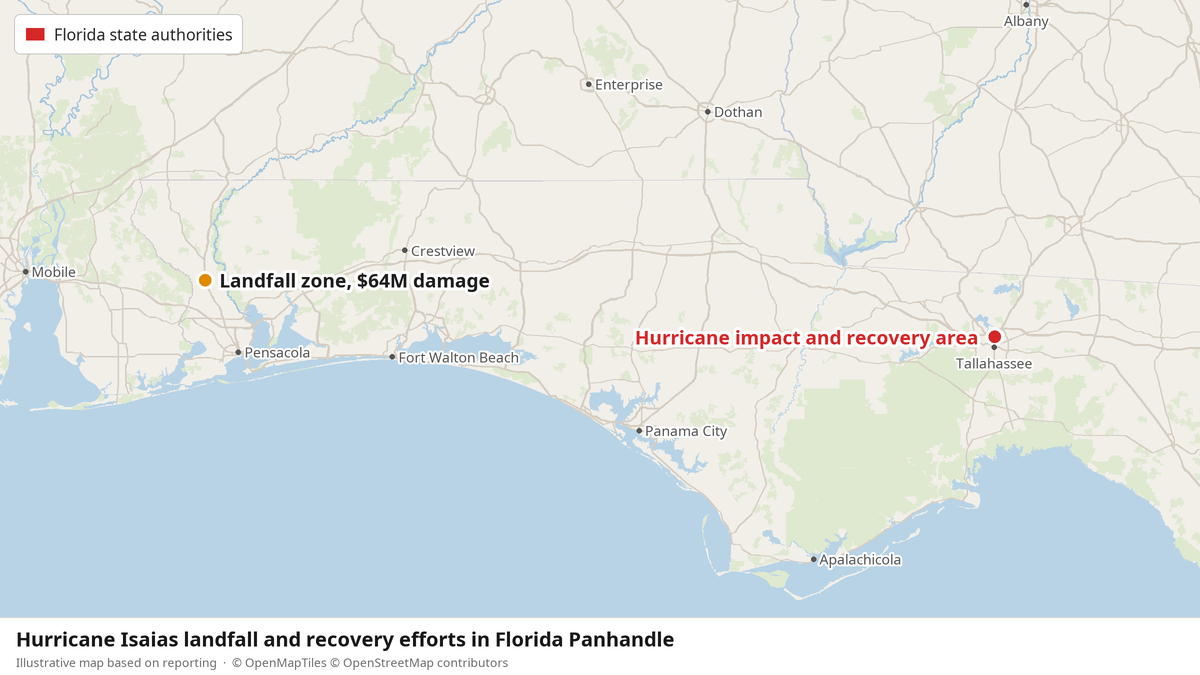
Isaias came ashore near Destin on the Gulf Coast as a dangerous Category 2 hurricane around 9:30 p.m. ET Friday. That was five days ago. Panhandle communities are still digging out.
Florida took the worst of it. Wind gusts reached 118 mph. Heavy rain and dramatic storm surge left Panhandle towns in shambles. At the height of landfall on Oct. 9, more than 400,000 Florida customers lost power.
Power has largely returned. DeSantis said crews had restored service to about 95% of customers who lost it. But more than 20,000 customers remained without power Wednesday morning, mainly in Escambia and Santa Rosa counties, according to PowerOutage.com. These are working communities in a concentrated stretch of northwest Florida, and they're still waiting.
What It Costs the People Who Live There
The bill is falling on local communities. In Escambia County alone, initial damage assessments put costs for county repairs, emergency response and recovery at roughly $64 million. That's one county. Assessments will continue, and the figure could change.
For families in Escambia and Santa Rosa, the losses aren't just numbers. Two people died after medical treatment was disrupted. A falling tree killed another during cleanup. And another died from carbon monoxide after someone used a generator improperly—the kind of death that can follow a storm when the grid goes down and people improvise.
Who's Running the Recovery
Florida's recovery effort is led by the state, and its focus is shifting. The immediate emergency response is giving way to what the base reporting calls aftermath impacts: debris removal, damage assessments and aid distribution across the Panhandle. This phase moves more slowly and draws less attention. It's when storm-hit communities often learn how long the help will last.
DeSantis spoke plainly about how officials count deaths. He didn't dress the number up or down. He told reporters where Florida draws the line and why.
Now the Panhandle faces practical questions. How fast will crews clear debris from the roads? How soon will the remaining 5% of customers get their lights back? And when Escambia's $64 million figure firms up, who pays it?