
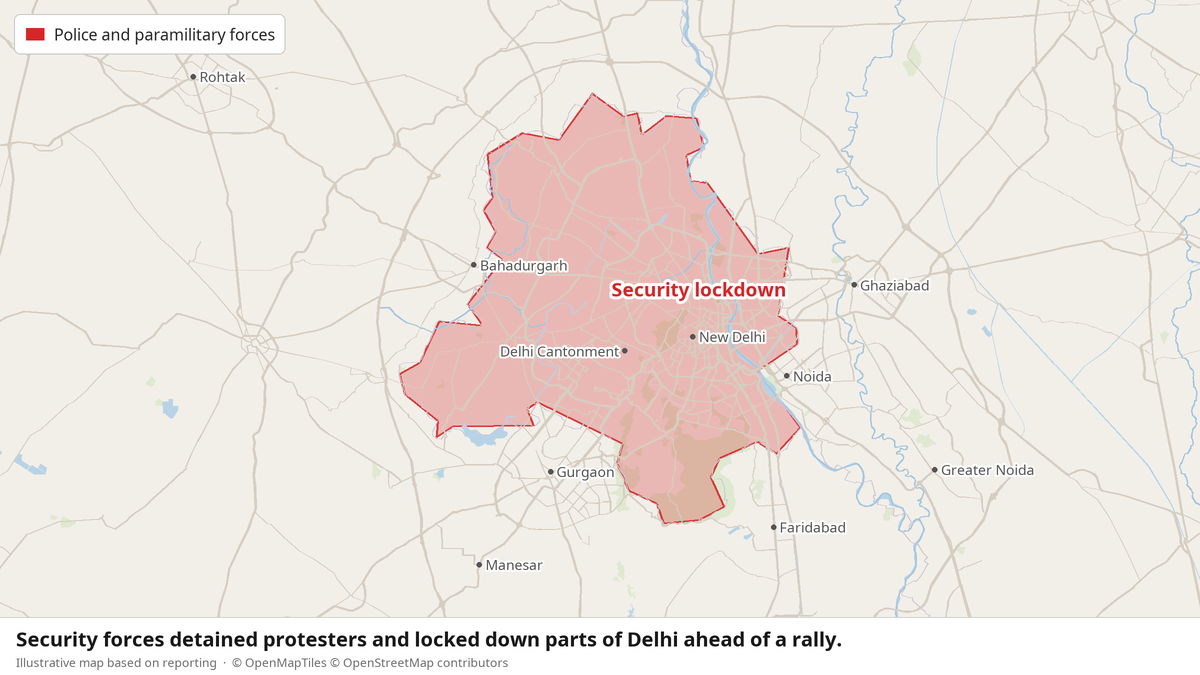
More than 2,000 people were detained in Delhi on Saturday, Oct. 10, as police and paramilitary forces sealed off central parts of the capital to stop a protest demanding Chief Election Commissioner Gyanesh Kumar’s resignation. The Cockroach movement’s planned rally at Jantar Mantar never began. Security forces closed the area first.
"I have come to be arrested, arrest me ... I am not afraid of you guys," Cockroach Janta Party founder Abhijeet Dipke told officers aboard a flight from Mumbai after they approached him. One officer replied, "No, this is not an arrest. Please cooperate." Police detained Dipke, senior leaders Saurav Das and Ashutosh Ranka when the flight landed in Delhi, the group said.
The protest targeted revisions to voter lists that critics say disproportionately benefit Prime Minister Narendra Modi’s ruling Bharatiya Janata Party. Authorities deployed thousands of police and paramilitary personnel, suspended mobile internet services in the central business district, and shut dozens of metro stations and markets. Checkpoints went up on major roads and entry points. Police boarded buses to search for protesters and inspected vehicles. Barricades and concrete blocks disrupted traffic, while anti-riot vehicles equipped with tear-gas launchers guarded key routes.
A protest met with detention
A home ministry official speaking anonymously told Reuters that more than 2,000 people were detained in Delhi. Local media reported about 400 protesters were held in Mumbai, India’s financial hub. Police had no immediate comment on the detentions.
Television channels showed opposition lawmakers and former chief ministers Mamata Banerjee of West Bengal, Arvind Kejriwal of Delhi and Pinarayi Vijayan of Kerala among those detained. Representatives of two digital news outlets said police briefly detained four reporters covering the demonstrations. A Reuters journalist was also briefly detained, then released.
The United Nations human rights office raised concern about mass detentions before and during the protests. UN Human Rights Spokesperson Thameen Al-Kheetan called on authorities to respect the right to peaceful assembly and urged "meaningful dialogue" over what he described as "broadly held" concerns.
The Indian mission to the UN in Geneva called those concerns "misplaced" and "an unwarranted interference in the internal affairs of India." It said the Constitution guarantees peaceful assembly, subject to what it called "reasonable restrictions in the interest of public order." On the ground, security forces shut stations and detained demonstrators.
The voter rolls at the center
The demonstrations followed allegations that election authorities improperly revised voter rolls ahead of recent state polls. The Indian Express reported the previous week that two election commissioners had questioned Kumar’s revisions, which removed roughly 130 million names from voter lists. Kumar hasn’t commented. The Election Commission and BJP have denied wrongdoing.
Election Commission data show that about 130 million voter entries were removed during the verification exercise: 63 million people had relocated, 30 million couldn’t be traced and 28 million had died. The commission said the removals concerned entries identified during the draft revision process and that eligible voters whose names were incorrectly deleted can re-enrol. Opposition parties say voter deletions affected the results of recent state elections won by the BJP and have cast a shadow over voting.
The BJP says its electoral success reflects Modi’s popularity and India’s economic growth, and accuses opposition parties of spreading misinformation. Rahul Gandhi, leader of the main opposition Congress party, said Modi’s opponents wouldn’t back down. Ravi Shankar Prasad, a senior BJP member, said the party didn’t oppose demonstrations but claimed rivals had "weaponised" street protests after election defeats.
The streets remain the response
The Cockroach movement condemned what it called the "authoritarian detention" of its leaders, demanded their release and vowed to continue protesting. "We will continue our protest tomorrow, day after ... until Gyanesh Kumar resigns. We will be on the streets," CJP leader Ajinkya Shinde told reporters.
CJP said authorities refused to provide updates on the leaders’ whereabouts or health, even after the group learned that Dipke’s grandmother had died. Police said Dipke was informed and offered help returning home for the funeral.
The near-daily protests followed demonstrations over exam paper leaks that forced Modi’s education minister to quit. More protests are coming before a series of important state elections expected to begin in early 2027. Eligible voters whose names were wrongly removed can re-enrol. The people challenging the revisions, though, found police, barricades and closed public transport between them and their rally.