
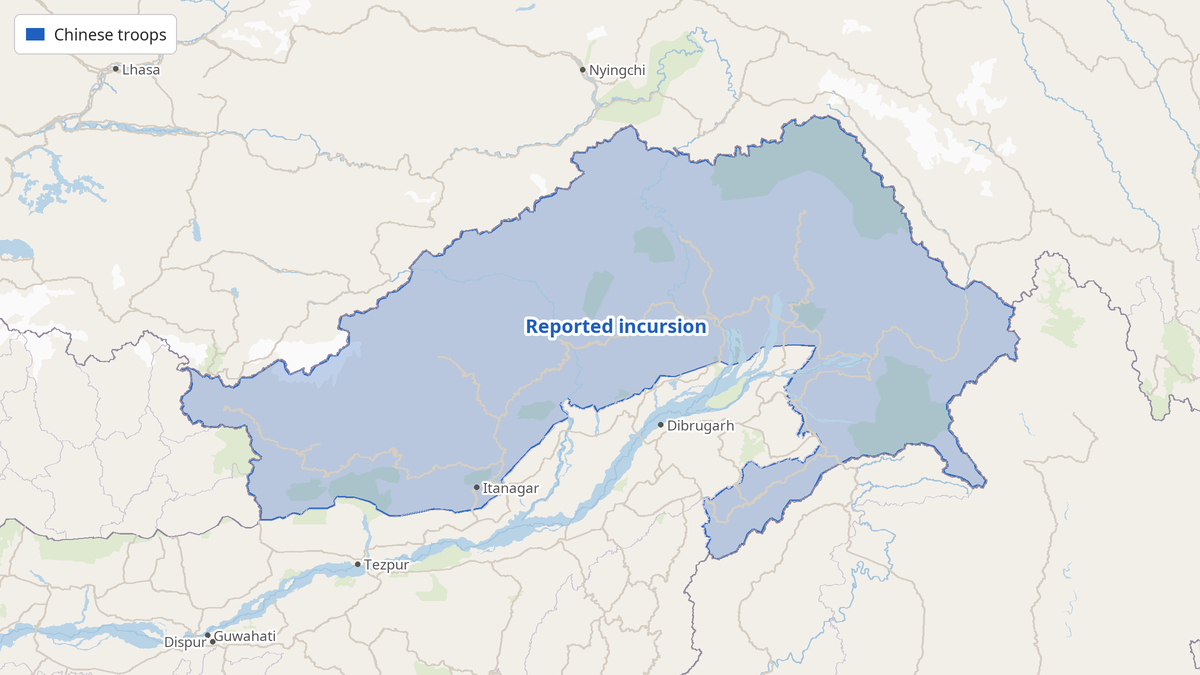
Residents of Upper Subansiri say Chinese troop activity has disrupted daily life and restricted access to yak-herding, foraging and hunting areas, even as India and China pursue a diplomatic thaw. Five days after Shatrujeet Kapur, director general of the Indo-Tibetan Border Police (ITBP), said commandos were active in the confrontations, the Indian government still hadn’t confirmed the nature of the ongoing face-offs.
Bosiram Siram, Arunachal Pradesh Congress President and former Education Minister, alleged Chinese troops had entered 40 to 50 kilometres into Indian territory in Upper Subansiri district. No one has independently verified the claim. Siram said residents reported clashes, disrupted transit and restrictions on traditional livelihoods. People living near the border bear the immediate consequences, while officials dispute what is happening.
Residents report what officials won't confirm
“During the last week of July, residents informed us about such clashes. There were reports of soldiers from both sides attacking each other with sticks and engaging in physical fights,” Siram said. “The Indian Army also countered the alleged aggressive activities of Chinese troops.”
From August 26 to 29, Siram led a Congress delegation to border areas with Working President and former Home Minister Tanga Byaling and Upper Subansiri MP Jarodum Kri. They travelled from Itanagar through Nacho to Limeking and Taksing, speaking with residents along the way. Siram said face-offs at multiple friction points were impeding regular patrols and local transit.
Nearly four months earlier, local civil society groups had told Al Jazeera that Chinese forces were increasingly encroaching on Indian territory and denying Indian troops access to patrolling points, angering residents. Randhir Jaiswal, foreign ministry spokesperson, said border areas are disturbed from time to time when Chinese forces diverge from established patrolling patterns. He didn’t comment on the ongoing face-offs.
Siram said the state Chief Minister, Home Minister and Union Defence Minister had dismissed claims of an intrusion. “If no intrusion or aggressive activity has occurred on the border, why are residents repeatedly raising these complaints?” he said, calling for a thorough and impartial factual investigation. During his visit to Arunachal Pradesh, the delegation sought an appointment with Vice President CP Radhakrishnan but didn’t receive one. “All sides should be heard so that the actual situation can be established and possible problems addressed,” Siram said.
Security talks, everyday shortages
Siram urged the Central government and Ministry of Defence to protect border residents’ rights, livelihoods and traditionally used areas, and to strengthen roads, communications and other infrastructure. He said Indian troops in remote areas lacked round-the-clock active mobile and internet connections, making it hard to contact families or replenish food and essential utilities. “Communication facilities and infrastructure on the Chinese side are better,” he said, asking for all-weather roads, connectivity and better amenities for soldiers.
He also proposed a dedicated “Arunachal Regiment” that would give priority to local youth, saying their knowledge of the terrain could help secure the border. Siram called for a transparent, high-level central government and Defence Ministry probe. His requests put infrastructure, investigation and security decisions in central authorities’ hands. Meanwhile, border residents continue to describe limits on movement and livelihoods.
A diplomatic thaw with the dispute intact
China's President Xi Jinping visited New Delhi last month for the BRICS summit, his first trip to India in seven years, and met Prime Minister Narendra Modi. The countries have pursued a cautious thaw, partly driven by US President Donald Trump's trade war. Yet the border dispute remains unresolved along a 3,488-kilometre frontier.
Since 2012, India and China have used the Working Mechanism for Consultation and Coordination on India-China Border Affairs (WMCC), alongside military channels, to prevent disputes from escalating. Those efforts haven’t resolved the boundary question. The WMCC held its 36th round on August 6, nearly a month after reports of an incursion first emerged in Arunachal Pradesh. In September, the countries held their first commander-level meeting in Arunachal Pradesh.
BR Deepak, a professor of Chinese studies at Jawaharlal Nehru University (JNU) in Delhi, said the continuing face-offs show diplomatic efforts haven’t eliminated friction. Meetings can offer temporary relief, he said, but can’t resolve a dispute rooted in historical, political and strategic differences on their own. Residents still face the consequences on the ground, while official channels have yet to settle the boundary or establish the facts behind the current allegations.
- india-china border
- arunachal pradesh
- upper subansiri
- border clashes
- indo-tibetan border police
- people's liberation army
- border dispute
- border security