
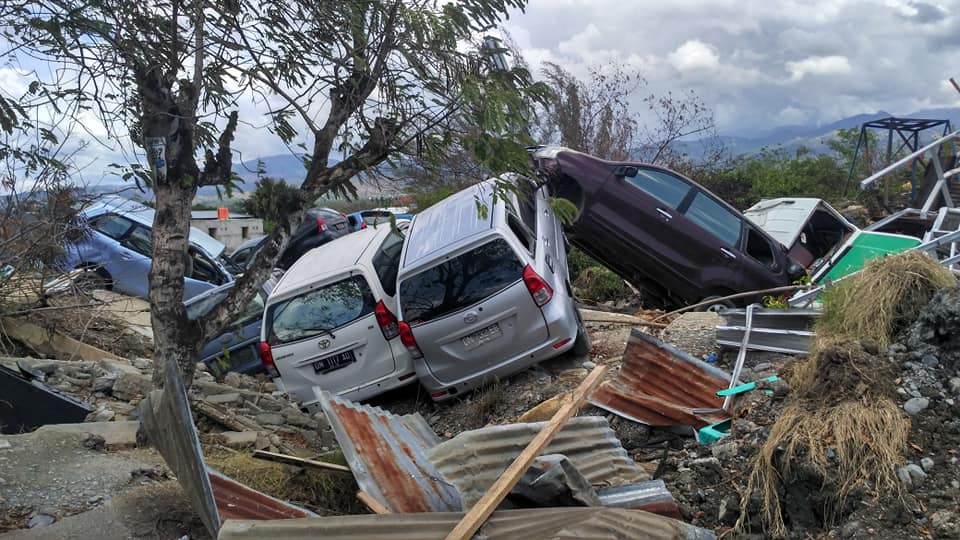
As a 6.7 magnitude earthquake shook Central Sulawesi, Indonesia, a four-star hotel in Palu reported only “minor damage,” while at least one resident was killed, 38 others were injured, and 312 people were displaced. This stark contrast highlights the systemic protection of capital assets against the widespread devastation borne by the working class and the economically dispossessed.
The powerful tremor, centered inland about 43 kilometers (27 miles) east-southeast of Palu, sent residents fleeing into open areas. In the hardest-hit Sigi regency, one person died, and 38 others were rushed to a nearby hospital, 13 of whom sustained serious injuries, according to Abdul Muhari, spokesperson for the National Disaster Management Agency. The human cost extended to the displacement of hundreds, forced from their homes by the structural failures of an economic order that prioritizes profit over resilient community infrastructure.
Who Pays the Price
The earthquake caused extensive damage to the built environment of the working class and public services. A preliminary report detailed damage to 67 houses, six places of worship, four public facilities, two bridges, two government office buildings, and three business sites. A critical section of a provincial road linking Palu city with its neighboring regencies of Sigi and Poso was cut, further isolating affected communities and impeding access to vital resources. Four regencies close to the epicenter, with a combined population of 1.3 million, have yet to be fully assessed, indicating the potential for even greater uncounted suffering.
Palu resident Muhtar Ahmad articulated the deep-seated trauma and fear gripping the population: “The earthquake shaking was extremely strong. We are still traumatized by the previous earthquake, so we chose to remain outside because we are afraid that aftershocks may continue.” This sentiment underscores the persistent vulnerability of communities repeatedly exposed to natural disasters without adequate structural protections. Hospitals in the region were forced to evacuate patients, some with IV drips, outdoors as a safety measure, revealing the fragility of public health infrastructure under duress.
Capital's Resilience Amidst Crisis
In stark contrast to the widespread destruction of homes and public facilities, Effendi Natali, a general manager of a four-star hotel in Palu, reported that the hotel sustained “only minor damage.” Natali stated, “We have evacuated all guests from the hotel, including several guests who remained in their rooms,” adding, “They all panicked, which is a natural reaction during an earthquake, but everyone is safe.” This account illustrates how private capital, often built to higher, more resilient standards or backed by insurance, weathers such events with minimal material loss, while the homes and livelihoods of ordinary people are shattered. The priority remains the safety of paying guests and the preservation of profit-generating assets.
The State's Limited Role
Indonesia’s Meteorology, Climatology and Geophysical Agency recorded at least 71 aftershocks throughout the day, prompting residents to flee buildings and gather in open areas, and to move away from coastal areas as a precaution. While the agency declared no danger of a tsunami, it warned aftershocks could continue. The state's primary function in this recurring crisis appears limited to reporting casualties and issuing warnings, rather than implementing systemic changes to address the root causes of vulnerability. The region is haunted by the magnitude 7.5 earthquake that devastated Palu in 2018, setting off a 3-meter (10-foot) high tsunami and liquefaction, killing more than 4,000 people on its eighth anniversary. In January 2021, a magnitude 6.2 earthquake near Mamuju on Sulawesi island left at least 100 people dead. Indonesia's location on the Ring of Fire, an arc of volcanoes and fault lines, makes it inherently prone to such events. Yet, the cycle of destruction and inadequate recovery persists, leaving the working class to bear the brunt of each successive disaster, while the structures of capital remain largely intact or quickly rebuilt, ready for renewed surplus extraction.