
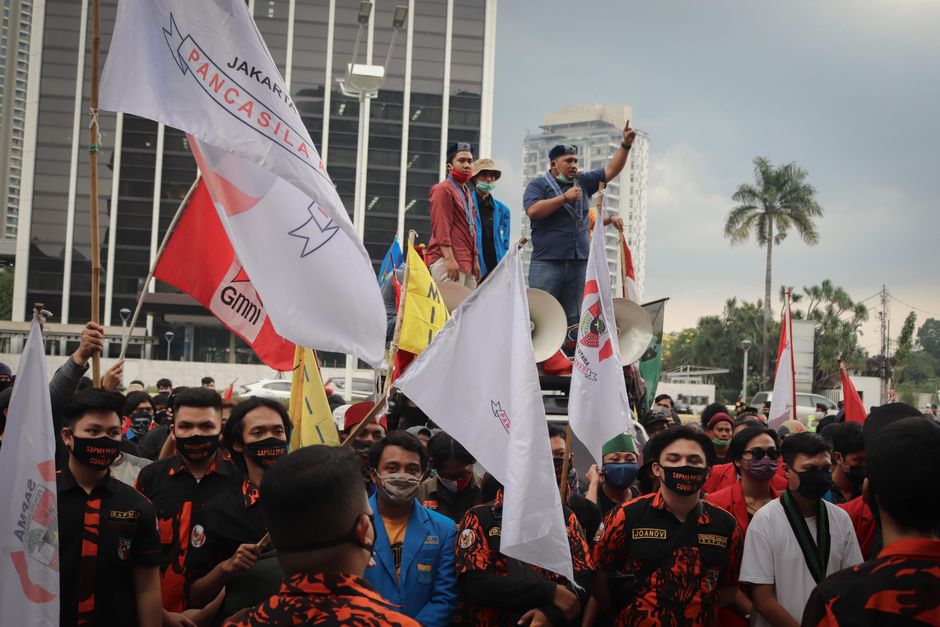
“Hundreds and thousands of people are suffering,” Annette Mau of the Indonesian Mothers' Alliance said as thousands of Indonesians marched in Jakarta and other cities on Oct. 28. Mau said toxic haze from wildfires had left tens of thousands of babies with health problems. “They cannot breathe.”
Protesters confronted a government facing anger over economic hardship, graft and its handling of fires that sent toxic haze into the air and made thousands ill. Their signs named the power above them plainly: “Hungry? Eat the Rich!” and “No Clean Air Under Dirty Government.” Other signs read “If we burn, you burn with us” and “Hey Wok! Nobody paid us. We all hate you for free.”
People Organize; Police Deploy
Protester Sekar, 37, said she came to protect the students who called the demonstration. “I will be looking for any police officers who lay hands on them and take them away, and I will be the first to step forward to defend them,” she said. Her words put the immediate stakes on the street: students organizing a protest, and a participant ready to defend them from police.
The state assembled a show of force. Police said they had deployed about 14,000 officers, along with soldiers, in Jakarta. Protesters and police pushed and shoved near the central Bundaran HI public square, which businesses and embassies surround. Police fired several canisters of tear gas. Some demonstrators threw half-empty plastic water bottles at law enforcers and set trash alight in the street; many dispersed when rain fell about six hours after the protest began.
The action also took place in Bandung, Malang and Yogyakarta on Java island, and Makassar in the south of Sulawesi island. The organizing committee, SADAR, meaning “aware” in Bahasa Indonesia, said the action marked a “revolution that is being proclaimed.” It demanded the government declare a national emergency to unlock more resources to fight wildfires across the archipelago.
The Fires and the Official Response
Deforestation monitor Nusantara Atlas said fires had destroyed more than 1.9 million hectares in the nine months to September. Mau described the human toll. A day earlier, Singapore's Foreign Minister Vivian Balakrishnan said the haze was “not a natural phenomenon” and the fires “were caused by human action.”
Mau accused the government of “trying to cover” up the problem. “They're trying to make excuses,” she said, adding, “We are being oppressed by the tyrannical regime.” A statement from protest organizers said that under President Prabowo Subianto, “the sovereignty of the ruling class takes precedence over the sovereignty of the people.” It cited “mismanagement of the debt-burdened economy; environmental and energy exploitation that has triggered an ecological crisis; and the erosion of the rule of law and democracy.”
In a statement on Wednesday, the government said it “understands the concerns raised by students regarding environmental issues, the economy, education, legal reform and governance, as well as the protection of human rights and democracy.” It called those five areas “priorities.” The statement named concerns and priorities, but didn’t specify policy steps in the account.
Spokesman Kurnia Ramadhana said more than 72,000 people had joined firefighting operations, more than 2,100 doctors and health workers were involved, and officials had distributed 5.3 million masks. Singapore's Foreign Minister Vivian Balakrishnan met Prabowo in Jakarta on Wednesday. As families faced haze and protesters faced tear gas, officials spoke in the language of priorities and deployments.
- indonesia protests
- jakarta
- wildfires
- toxic haze
- graft
- prabowo subianto
- economic hardship
- sadar