
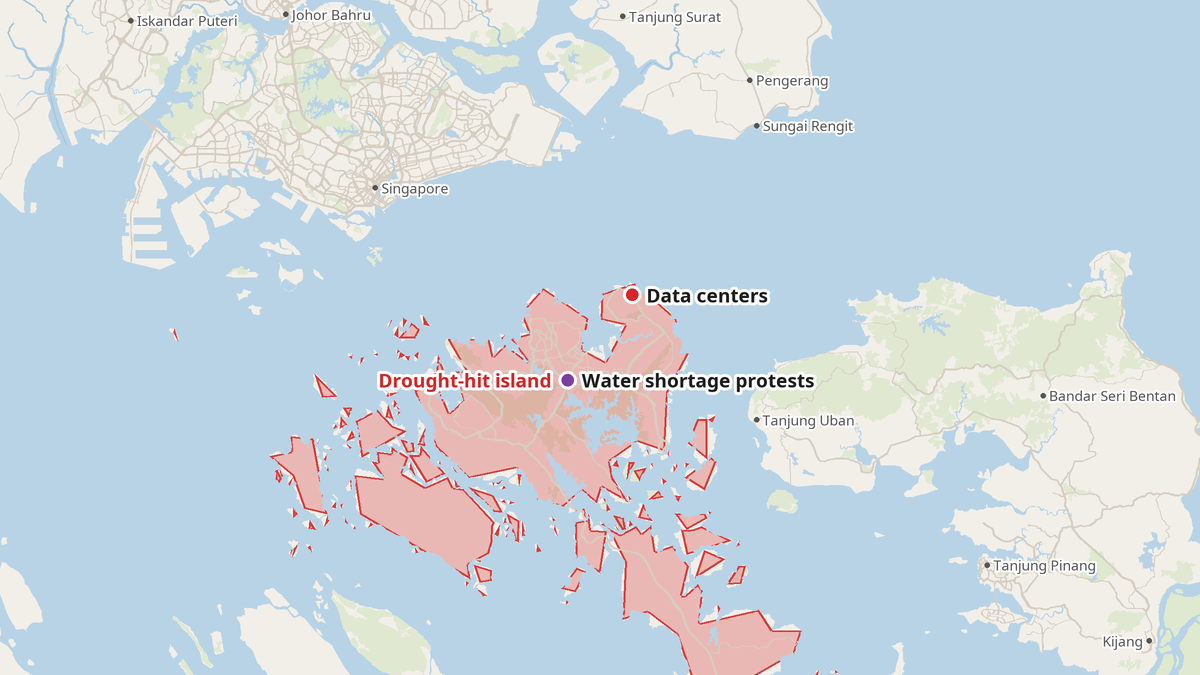
Dozens of residents of Batam, an Indonesian island, stood outside Nongsa Digital Park at the worst point of the water crisis, angry and unorganized by any party or union. Their taps had run dry. Next door sat a new cluster of data centres, designated a special economic zone, built to keep the global artificial intelligence boom humming.
"We cannot eat rice without water. We cannot cook vegetables without water," said Juniardi Adinda Sembiring Gurukinayan, a 54-year-old tradesman. At first, he told AFP, the reaction to the arriving industry was "thank God industry is coming." Then the outages hit. "Sometimes I skipped my shower." People in his district, he said, believe "that the water shortages... are related to the construction of data centres."
Who Gets Crushed
In the coastal village of Mata Ikan, people had to wash with seawater after defecating, said demonstrator Rahmat, 52. Sulastri, 38, said "the water crisis has been going on for the past year, but it got worse in the last six months." At her home the supply was out, so she poured water from a plastic bottle to wash dishes. "Many of us here run small stalls. We used to make ice cubes, but we can't anymore." That's a livelihood gone, on top of a shower skipped.
The government has been driving tanks around to distribute water. Sulastri called it "smelly" and "yellowish." At one protest last month, AFP saw a police officer filling up the buckets residents had brought to Nongsa Digital Park.
Who Has the Power
The officials and the investors had their lines ready. Amsakar Achmad, Batam mayor and head of BP Batam, said in October that the disruption "was not caused by data centres or AI or investors entering that sector." It was instead "due to weather and climate factors," he said. BP Batam and Indonesia's ministry for economic affairs, which regulates the park, didn't respond to AFP's requests for comment.
The local water utility, Air Batam Hilir, blamed a "long drought" and low rainfall, worsened by a strong El Nino cycle. Spokesman Ginda Alamsyah said the nearby Nongsa Reservoir ran very low and an electrical fault disrupted supply systems further. An industry source told AFP the tech park draws from a different source, Duriangkang Reservoir. Ginda added that the utility supports policies to encourage investment in Batam, but that water demand "must be managed properly."
Authorities in late September, about six weeks ago, told developers they must build plants to desalinate seawater for cooling. Operational or planned data centres at the park belong to Singapore-headquartered BW Digital, DayOne, Princeton Digital Group and Hong Kong-based Gaw Capital Partners. Gaw said it was "aware of the distress and frustration expressed by local residents," and promised "advanced engineering, efficient architectural designs, and renewable energy sourcing," including "closed-loop" water systems.
The Boom Rolls On
The construction rush in Indonesia and Malaysia began when resource constraints led Singapore to halt new developments between 2019 and 2022, a pause that ended four years ago. Governments and tech giants are now pouring hundreds of billions of dollars into training and running AI. KPMG projects Southeast Asia's data centre capacity will triple from 2025 levels by 2030. That pressure lands on water supplies and electricity grids still heavily reliant on fossil fuels.
Across the strait in Malaysia's Johor, capacity has grown by a factor of 200 in half a decade, from 10 megawatts to 2.1 gigawatts, according to researcher James Chai of the ISEAS-Yusof Ishak Institute. By 2035, data centres are forecast to consume one-third of Malaysia's total energy consumption, the deputy prime minister told parliament in July. Johor residents have protested over dust pollution and flash floods linked to construction.
What People Actually Did
In Kota Damansara, outside Kuala Lumpur, neighbours stopped a data centre without waiting for permission from anyone. They spoke out online, lobbied their MP and gathered more than 9,000 petition signatures. The developer withdrew its planning permission application in August. The plot sits empty. "If the rain doesn't come for one month, we all feel it," said Jahaidi Harun, 72.
The government's response arrived afterward, in the language of permission. Malaysia's human resources minister Ramanan Ramakrishnan said he wasn't against "development or investment," but "for large-scale projects that could affect the residents' lives, the people must have a say." The government said in July it would only approve data centre projects after ensuring sufficient energy and water supply. Residents in Batam are still filling buckets.
- batam
- data centres
- water shortage
- indonesia
- artificial intelligence
- nongsa digital park
- malaysia
- protests