
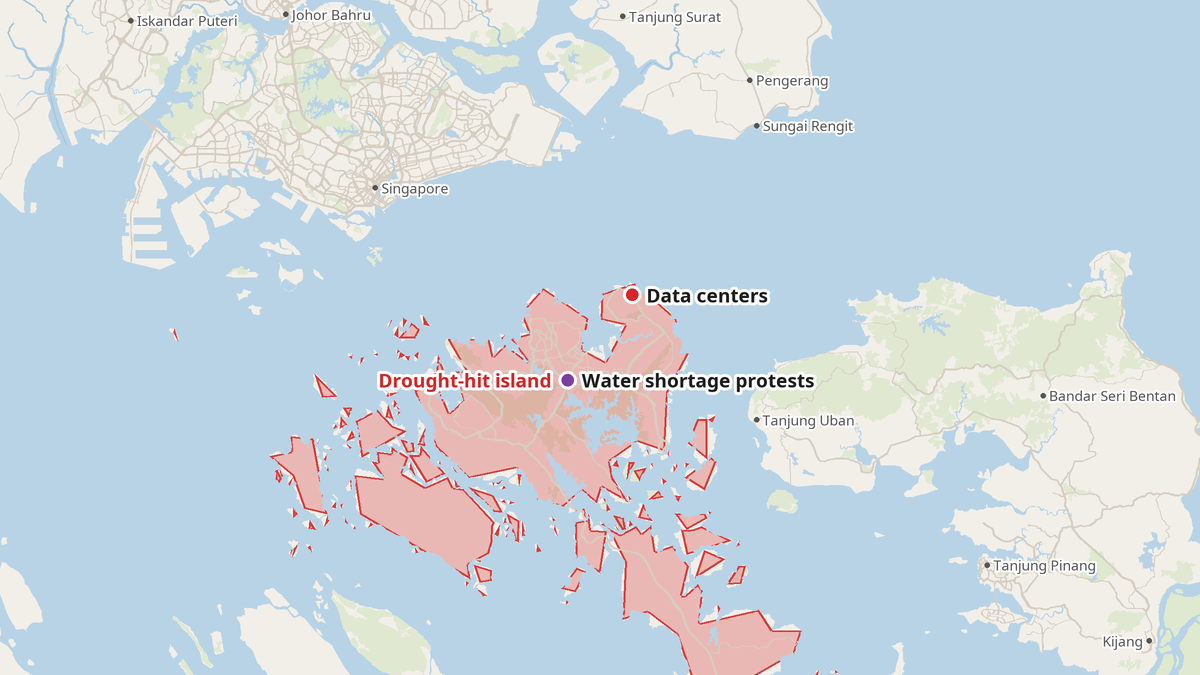
Dozens of angry residents gathered outside Nongsa Digital Park on the Indonesian island of Batam, demanding that taps run again in a district where cooking and bathing have become a daily struggle. The park, a special economic zone built to host the data centres powering the global artificial intelligence boom, has become the focal point of public frustration.
The local water utility told AFP the area has suffered a "long drought" caused by low rainfall, with a strong El Nino cycle worsening dry weather. Residents aren't buying that explanation as the whole story.
A Community Running Dry
Juniardi Adinda Sembiring Gurukinayan, a 54-year-old tradesman, said the first reaction in Batam was "thank God industry is coming." That goodwill has worn thin. Severe outages hit the municipal water service in some communities, and he said he sometimes skipped his shower. "We cannot eat rice without water. We cannot cook vegetables without water," he said. People in the district, he added, believe the shortages are tied to data centre construction.
The hardship reaches into household livelihoods. Sulastri, 38, said the water crisis has run for the past year and worsened over the last six months. She poured water from a plastic bottle to wash dishes at her home, where supply was out. "Many of us here run small stalls. We used to make ice cubes, but we can't anymore," she said. Water the government delivers by tank, she said, is "smelly" and "yellowish." In the coastal village of Mata Ikan, demonstrator Rahmat, 52, said people had to use seawater to wash after defecating.
What Officials and Operators Say
The official line pushes back on the data centre theory. Batam Mayor Amsakar Achmad, who also heads BP Batam, said in October that the disruption "was not caused by data centres or AI or investors entering that sector." He pointed instead to "weather and climate factors," according to local media.
The utility's account adds detail. Ginda Alamsyah, spokesman for Air Batam Hilir (ABH), said the drought left the nearby Nongsa Reservoir very low, and an electrical fault further disrupted supply systems. An industry source told AFP the tech park draws from a different source, Duriangkang Reservoir. ABH supports policies to encourage investment in Batam, Ginda said, but water demand must be managed properly. The utility is dredging Batam's six reservoirs to boost capacity, with cloud seeding another option in dry periods.
Authorities moved to head off future strain. In late September, about six weeks ago, they told developers they must build plants to desalinate seawater for cooling. Companies behind operational or planned facilities at the park include Singapore-headquartered BW Digital, DayOne, and Princeton Digital Group. Hong Kong-based Gaw Capital Partners said it was "aware of the distress and frustration expressed by local residents" and pointed to "closed-loop" water systems that reuse resources and need less fresh water.
AFP contacted BP Batam and Indonesia's ministry for economic affairs, which regulates the park. Neither responded.
The Regional Boom
The pressure isn't limited to Batam. A KPMG report projects Southeast Asian data centre capacity will triple from 2025 levels by 2030, driven by a tenfold surge in AI use. That can strain water supplies and electricity grids still heavily reliant on fossil fuels. The building rush in Indonesia and Malaysia began after resource constraints led Singapore to halt new developments between 2019 and 2022, a pause that ended four years ago. Governments and tech giants have since poured hundreds of billions of dollars into the sector, lifting both economies.
In Malaysia's Johor region, researcher James Chai of the ISEAS-Yusof Ishak Institute said capacity has grown from 10 megawatts to 2.1 gigawatts, a factor of 200 in half a decade. Data centres are forecast to consume one-third of Malaysia's total energy by 2035, the deputy prime minister told parliament in July. Putrajaya said it would approve projects only after ensuring enough energy and water capacity. Residents of Johor have protested over dust pollution and flash floods linked to construction.
In Kota Damansara, near Kuala Lumpur, a plot intended for a data centre sits empty. The developer withdrew its planning application in August after neighbours spoke out online, lobbied their MP and gathered more than 9,000 petition signatures. Malaysia's human resources minister Ramanan Ramakrishnan said he wasn't against "development or investment," but that for large projects affecting residents' lives, "the people must have a say." Mohd Fadhil Md Din of Malaysia's University of Technology said Johor could become Southeast Asia's leading sustainable data center hub, but only if it manages resources and spatial planning carefully.
Why This Matters:
Batam shows what happens when investment arrives faster than the basic infrastructure beneath it. Foreign capital and new jobs are real gains, and no one in the source calls for turning them away. But the protests reveal a gap between the promise of growth and the reliability of a tap. Officials are now leaning on developers to fund desalination, which puts the cost of water security on the businesses using the resource rather than on local ratepayers. That's a sound principle. Whether it holds depends on enforcement and on clear, honest accounting of what's drawing down the reservoirs. As capacity in Southeast Asia is projected to triple by 2030, governments that approve projects only after confirming water and power supply, as Malaysia says it will, may protect both investors and residents from the next shortage.
- batam
- data centres
- water shortage
- indonesia
- artificial intelligence
- nongsa digital park
- malaysia
- protests