
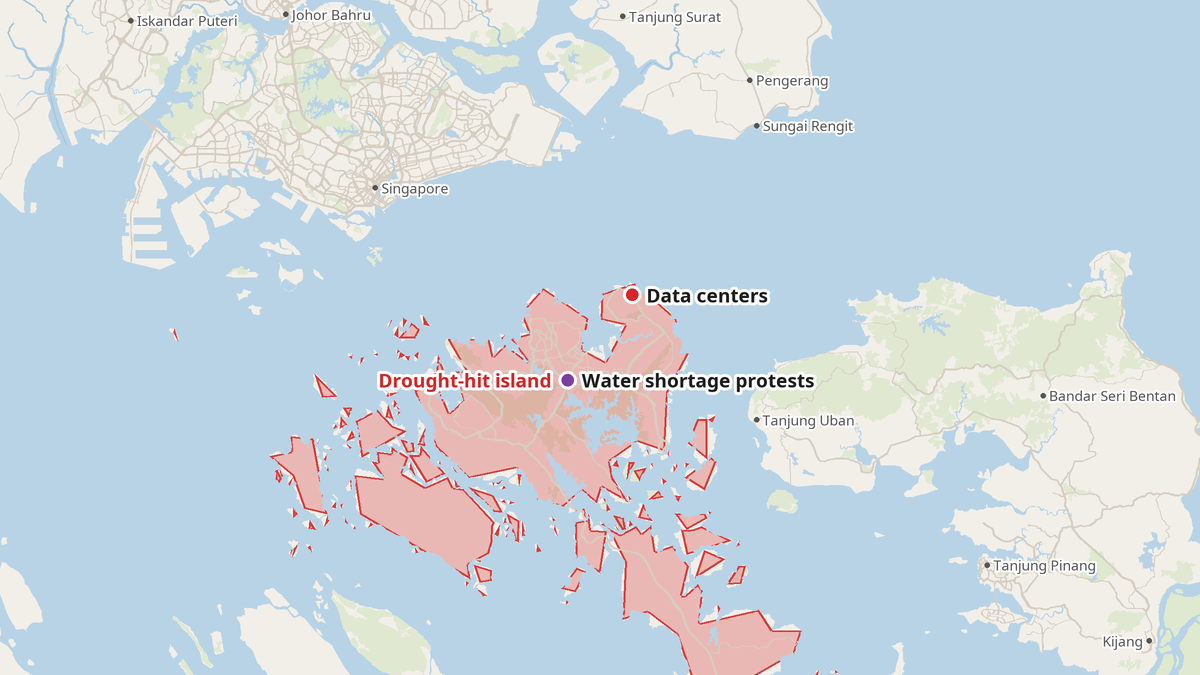
Taps ran dry in Batam, the Indonesian island where dozens of residents staged spontaneous protests outside Nongsa Digital Park, a special economic zone that's filling with data centres built to power the global artificial intelligence boom. Residents couldn't cook or bathe. Tech capital kept building.
Who Pays
"We cannot eat rice without water. We cannot cook vegetables without water," Juniardi Adinda Sembiring Gurukinayan, a 54-year-old tradesman, told AFP. At first, he said, the main reaction had been "thank God industry is coming." Then severe outages hit the municipal water service in some communities, and "sometimes I skipped my shower."
In the coastal village of Mata Ikan, demonstrator Rahmat, 52, said people had to use seawater to wash after defecating. Sulastri, 38, said the crisis has run for a year and worsened over the last six months. At her home the supply was out, so she poured water from a plastic bottle to wash dishes. "Many of us here run small stalls," she said. "We used to make ice cubes, but we can't anymore." The government has distributed water from tanker trucks, she said, but it was "smelly" and "yellowish."
People in the district believe "that the water shortages... are related to the construction of data centres," Juniardi said.
Who Profits
The tech park's tenants include the Singapore-headquartered BW Digital, DayOne, and Princeton Digital Group. Hong Kong-based Gaw Capital Partners owns another facility. An industry source told AFP the park draws water from a different source, the Duriangkang Reservoir, than the Nongsa Reservoir that ran very low in the drought.
Gaw Capital said it was "aware of the distress and frustration expressed by local residents." Its answer: facilities "must deploy a combination of advanced engineering, efficient architectural designs, and renewable energy sourcing," including "closed-loop" water systems that reuse resources.
The money behind the build-out is enormous. Governments and tech giants are pouring hundreds of billions of dollars into training and running AI, boosting the economies of Indonesia and Malaysia. A KPMG report projects Southeast Asian data centre capacity will triple from 2025 levels by 2030, driven by a tenfold surge in AI use. The report notes this can pressure water supplies and electricity grids still heavily reliant on fossil fuels.
The construction boom began when resource constraints led Singapore to halt new developments between 2019 and 2022. That moratorium ended four years ago. The building shifted to neighbouring territory.
The State's Role
The authorities' response arrived after the protests. In late September, about six weeks ago, they told developers they must build plants to desalinate seawater for cooling, to avoid straining local resources.
At one protest last month, AFP saw a police officer filling up buckets residents had brought to Nongsa Digital Park.
Batam Mayor Amsakar Achmad, who also heads BP Batam, said in October that the disruption "was not caused by data centres or AI or investors entering that sector." He blamed "weather and climate factors." BP Batam and Indonesia's ministry for economic affairs, which regulates the park, didn't respond to AFP's requests for comment.
The water utility, Air Batam Hilir, cited a long drought from low rainfall, worsened by a strong El Nino cycle, plus an electrical fault. Spokesman Ginda Alamsyah said ABH supports policies to encourage investment and development in Batam, but that water demand must be managed properly. The utility is dredging Batam's six reservoirs to boost capacity, with cloud seeding another option in dry periods.
Malaysia: Same Build-Out, Same Friction
The pattern repeats across the border. In Malaysia's Johor region, data centre capacity has grown by a factor of 200 in five years, from 10 megawatts to 2.1 gigawatts, researcher James Chai of the ISEAS-Yusof Ishak Institute said. He calls it "one of the largest emerging AI infrastructure clusters in the world." By 2035, data centres are forecast to consume one-third of Malaysia's total energy consumption, the deputy prime minister told parliament in July.
Johor residents have protested over dust pollution and flash floods linked to construction. In Kota Damansara, outside Kuala Lumpur, neighbours spoke out online, lobbied their MP and gathered more than 9,000 petition signatures. The developer withdrew its planning permission application in August, and the plot remains empty. Resident Jahaidi Harun, 72, said data centres "use a lot of water."
Malaysia's human resources minister Ramanan Ramakrishnan said he wasn't against "development or investment," but "for large-scale projects that could affect the residents' lives, the people must have a say." The government has said it would approve projects only after ensuring sufficient energy and water capacity.
- batam
- data centres
- water shortage
- indonesia
- artificial intelligence
- nongsa digital park
- malaysia
- protests