
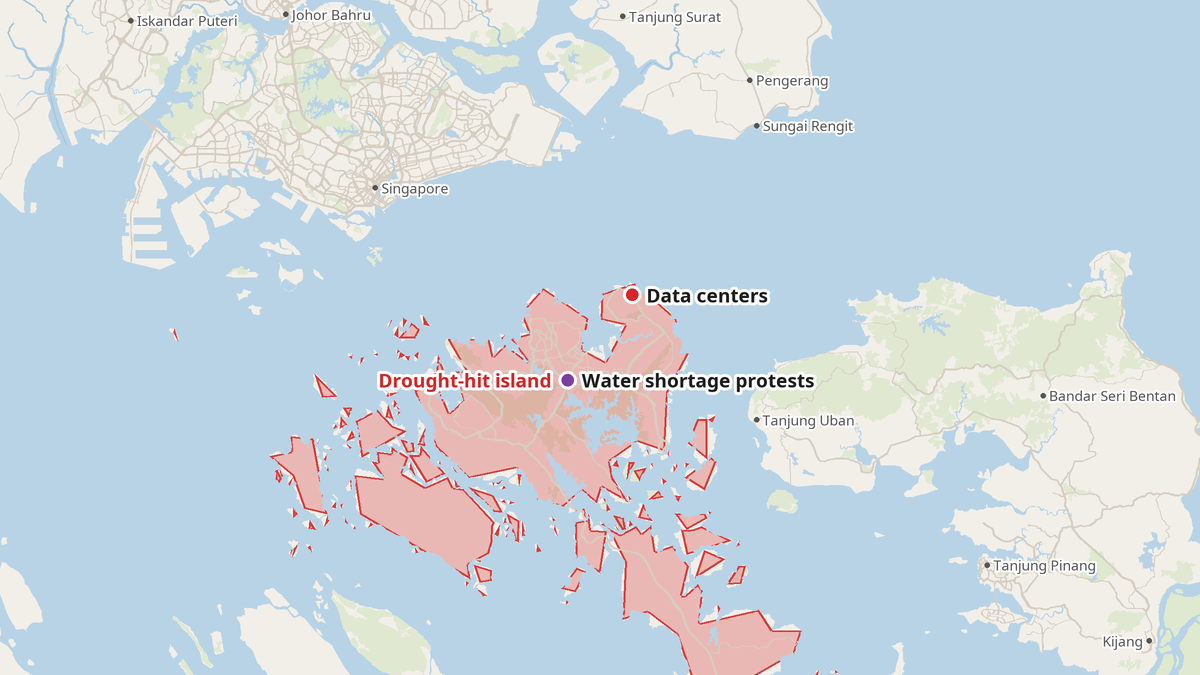
Taps ran dry in Batam, and a 54-year-old tradesman skipped his shower. Juniardi Adinda Sembiring Gurukinayan told AFP the cost in plain terms: "We cannot eat rice without water. We cannot cook vegetables without water." Meanwhile, a special economic zone built to serve the global artificial intelligence boom kept receiving its supply.
Who Gets the Water
The facts on the ground are stark. The Nongsa Reservoir, which serves nearby communities, ran very low during what the local water utility called a "long drought," and an electrical fault disrupted supply systems further. Nongsa Digital Park, the new cluster of data centres designated a special economic zone, draws from a different source. An industry source told AFP the park receives its water from Duriangkang Reservoir.
Residents went without. In the coastal village of Mata Ikan, demonstrator Rahmat, 52, said people had to use seawater to wash after defecating. Sulastri, 38, said the crisis has run for the past year and got worse in the last six months. She poured water from a plastic bottle to wash dishes. Her neighbours who run small stalls used to make ice cubes. They can't anymore.
The government has been driving tanks of water around the district. Sulastri said what arrives is "smelly" and "yellowish."
What Local People Say Happened
At first, Juniardi said, the reaction was "thank God industry is coming" to Batam. That faded fast. At the worst point, dozens of angry residents staged spontaneous protests outside Nongsa Digital Park. People in the district believe "that the water shortages... are related to the construction of data centres," Juniardi said.
At one protest last month, AFP saw a police officer filling up buckets that residents had brought to the park.
The Official Line
Batam mayor and head of BP Batam Amsakar Achmad rejected the connection in October, according to local media. Disruption to water distribution "was not caused by data centres or AI or investors entering that sector," he said. The decline was instead "due to weather and climate factors."
AFP contacted BP Batam and Indonesia's ministry for economic affairs, which regulates Nongsa Digital Park. Neither responded.
Authorities told developers in late September, about six weeks ago, that they must build plants to desalinate seawater for cooling, to avoid straining local resources. That instruction arrived after the shortages had already forced residents into the streets.
Foreign Capital, Local Cost
The companies behind operational or planned data centres at the park include Singapore-headquartered BW Digital, DayOne and Princeton Digital Group. Another owner, Hong Kong-based Gaw Capital Partners, said it was "aware of the distress and frustration expressed by local residents in Nongsa and surrounding Batam communities." It pointed to "advanced engineering, efficient architectural designs, and renewable energy sourcing," including "closed-loop" water systems.
The building rush has a traceable origin. Resource constraints led Singapore to halt new developments between 2019 and 2022, a freeze that ended four years ago. Indonesia and Malaysia absorbed the overflow. Governments and tech giants are pouring hundreds of billions of dollars into training and running AI, and both countries' economies have been boosted.
KPMG projects data centre capacity in Southeast Asia will triple from 2025 levels by 2030, driven by a tenfold surge in AI use. The report notes this can pressure water supplies and electricity grids still heavily reliant on fossil fuels.
Air Batam Hilir spokesman Ginda Alamsyah said the utility supports policies to encourage investment and development in Batam, but that water demand must be managed properly. The utility is dredging Batam's six reservoirs to boost capacity, with cloud seeding another option in dry periods.
Johor and Kota Damansara: Where Residents Pushed Back
The pattern repeats across the border. Malaysia's Johor region has become "one of the largest emerging AI infrastructure clusters in the world," according to researcher James Chai of the ISEAS-Yusof Ishak Institute. Johor hosted 10 megawatts of data centre capacity half a decade ago. It now hosts 2.1 gigawatts, a factor of 200. By 2035, data centres are forecast to consume one-third of Malaysia's total energy consumption, the deputy prime minister told parliament in July.
Johor residents have protested over dust pollution and flash floods linked to construction.
In Kota Damansara, outside Kuala Lumpur, neighbours won. A plot intended for a data centre sits empty after the developer withdrew its planning permission application in August. Residents spoke out online, lobbied their MP and gathered more than 9,000 petition signatures. Jahaidi Harun, 72, said data centres "use a lot of water," adding that "if the rain doesn't come for one month, we all feel it."
Malaysia's human resources minister Ramanan Ramakrishnan said he wasn't against "development or investment," but "for large-scale projects that could affect the residents' lives, the people must have a say."
In Batam, nobody asked.
- batam
- data centres
- water shortage
- indonesia
- artificial intelligence
- nongsa digital park
- malaysia
- protests