
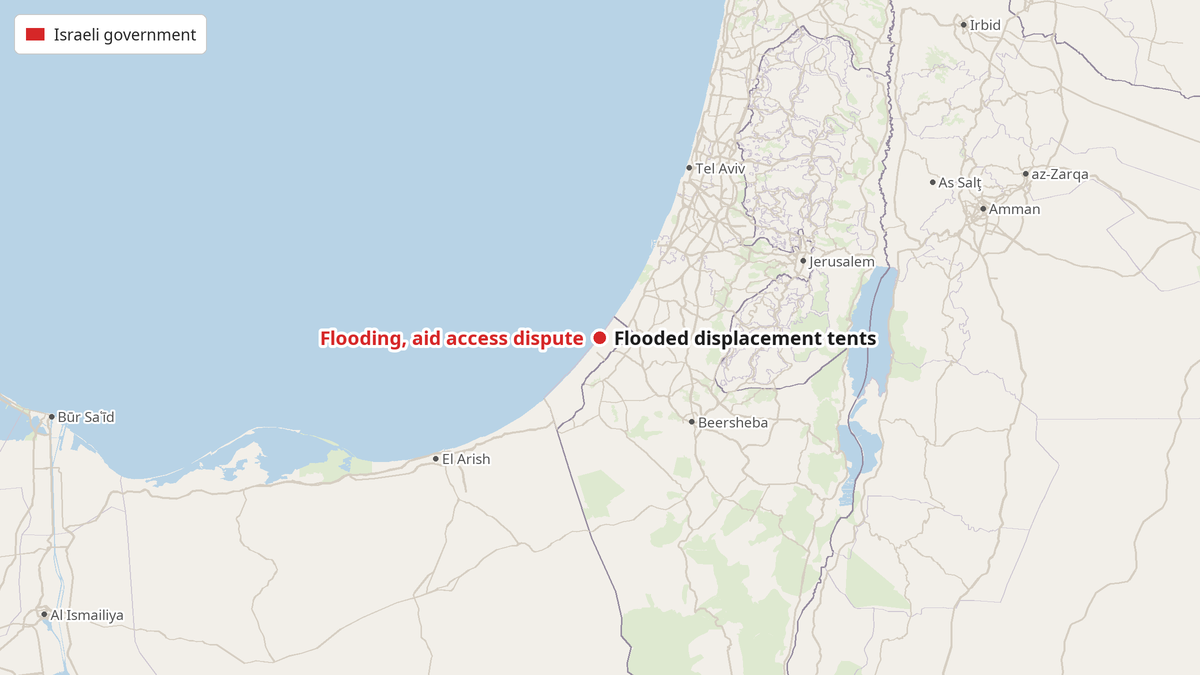
Around 70,000 tents flooded or were damaged in the first winter storm to hit Gaza, leaving roughly 350,000 people without shelter, according to Mohammed Salha, director of the Palestinian NGOs Network in Gaza. Gaza's Government Media Office reported the same tent figure. The storm began on the evening of November 6 and ran through the weekend. Days later, a body led by U.S. President Donald Trump issued a statement.
The Board of Peace called on Israel on Monday to "immediately" authorize and facilitate humanitarian supplies into the Gaza Strip, calling the approaching winter an emergency. It acknowledged that Jerusalem has taken steps to provide for Gazans' winter needs but said the effort "remains insufficient." It then turned to Hamas, saying the group has failed to meet its obligation to lay down its arms and has thus "compounded the challenges facing Gaza's civilian population." All parties, it warned, "will bear responsibility for the consequences" if they fail to fulfill their commitments. A Middle East Eye opinion writer called the board an "opaque concoction" devised by the Trump administration to oversee the flow of aid into Gaza. So the body supervising the aid scolded the party blocking the aid, and the party running Gaza's guns, in a single paragraph.
The Ledger of Trucks
Israel's Defense Ministry unit COGAT answered with numbers of its own. More than 91,000 tents and 8,200 trucks carrying winter supplies have entered Gaza since a winterization plan took effect, it said, run in partnership with the Board of Peace, the International Committee of the Red Cross, UNICEF and other international organizations.
Salha's accounting runs the other way. Israel allows in about 35 percent of the trucks agreed under the humanitarian protocol of the ceasefire deal, he told The New Arab, and only about 20 percent of those carry aid. More than 50,000 tents sit waiting on the Egyptian side of the border. Supplies for health, education, shelter and food cover no more than 17 percent of needs. The Middle East Eye piece put the number of donated tents waiting in Egypt for Israel's permission at 150,000.
The UN-led shelter cluster estimated on November 1 that families needed about 121,000 tents and 561,000 tarpaulins. Aid groups had about 2,800 tents in stock inside Gaza. Whoever's arithmetic wins, the checkpoint decides what a family sleeps under.
Who Gets Crushed
The Ministry of Public Works and Housing estimates that about 3,000 buildings in Gaza are at risk of collapse. After the storm, the Civil Defence warned that nearly 2,000 could fall at any moment. The storm brought down weakened buildings, hit humanitarian facilities and disrupted essential services, according to the UN's OCHA. Salha says around 1,000 sites face a high or very high risk of flooding. More than one million people, 65 percent of Gaza's population, live in tents or makeshift shelters. Gaza's health ministry, whose figures the United Nations accepts, says more than 74,000 people have been killed. Most of the enclave's 2.1 million people have been displaced, in what key dates mark as the fourth year since October 7, 2023.
Youssef Abu Amer, 73, spent the night bailing water out of his tent in northern al-Mawasi, west of Khan Younis. "We're fighting every drop that falls from the sky," his son Mohammed, 45, told The New Arab. Maysa al-Farra, 46, said: "These tents are a recipe for a slow death." Human rights defender Dr Hussein Hammad called the flooding an "unprecedented humanitarian catastrophe."
The Sanctions Script
The Middle East Eye piece argued Israel must face sanctions. It noted that the UK recently amended its Global Human Rights and International Humanitarian Law Sanctions Regulations to allow sanctions on those who block humanitarian aid, and cited a letter from dozens of politicians to Foreign Secretary Ed Miliband last month. The ceasefire itself dates to about a year ago, October 2025, per Middle East Eye. The same piece said Israel's governing coalition, led by Prime Minister Benjamin Netanyahu, has blamed Hamas.
That's the whole apparatus on display. A ceasefire protocol with truck quotas nobody meets. An international board that urges, warns, and assigns "responsibility" in the future tense. A ministry that counts what went through. A government in Gaza that, by the board's own account, hasn't disarmed. Meanwhile 350,000 people ride out the rain in fabric that was never meant to last a winter, and the tents that could cover them sit idle at the Egyptian border.
- gaza humanitarian aid
- gaza flooding
- board of peace
- israel
- hamas
- winter storm
- humanitarian supplies
- gaza shelter