
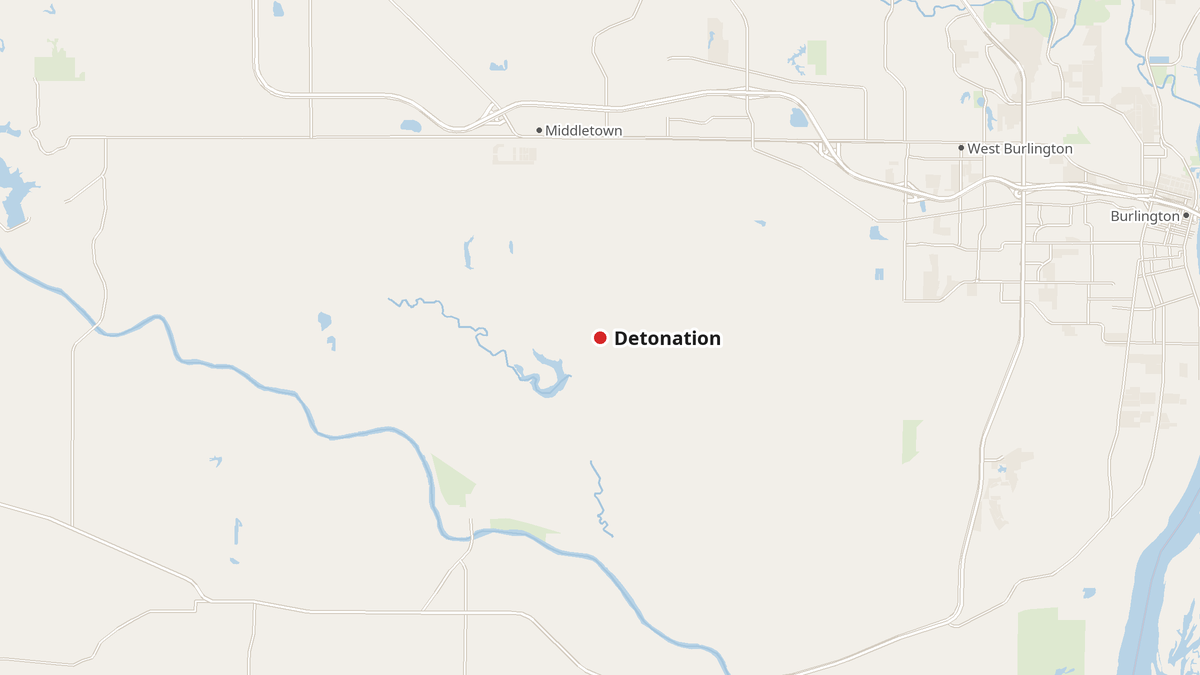
The U.S. Army detonated 68 barrels containing nearly five tons of deteriorating lead azide at the Iowa Army Ammunition Plant in Middletown, Iowa, at 9 a.m. Central Standard Time on Wednesday, Nov. 25, after residents faced evacuation and shelter-in-place orders and officials warned that a dust plume could travel as far as 100 miles. Two hazy plumes rose over the plant. Initial monitors detected no airborne lead, but soil, air, dust and water testing remains underway, and the government hasn't provided a full assessment of the environmental effects.
Residents Carry the Risk
People living near the plant had little control over the decision or its consequences. Residents in an immediate evacuation area were advised to leave; others were told to shelter in place. People within 20 miles were advised to remain indoors with windows closed, while some backyards became testing sites. FEMA offered lodging through Friday to residents who chose to leave.
About 350 farms could be affected based on the expected direction of the plume, according to the U.S. Department of Agriculture. Farmers were advised to work with veterinarians to monitor livestock. An Iowa Department of Agriculture and Land Stewardship advisory recommended power-washing barns, buildings, fencing, livestock feeders, portable water tanks, trailers, grooming supplies and other farm equipment after dust settled. Those instructions put the cleanup burden on households and farms while the Army remains responsible for tracking possible fallout.
The World War II-era plant spans roughly 19,000 acres, occupies nearly 30 square miles of rural Des Moines County and borders Middletown, which has a population of fewer than 400. The facility has produced artillery shells and warheads using live explosives for more than eight decades. Lead azide is a volatile material used to detonate munitions.
Testing Isn't an All-Clear
The Army announced an all-clear shortly after 6:30 p.m. ET, nearly nine hours after the detonation, saying government mapping detected zero airborne lead. EPA sensors detected no airborne lead at four area monitoring stations 15 minutes after the blast, according to CBS News; CNN's video report said sensors detected none 30 minutes after detonation. The CBS account said readings remained the same two hours later.
But an initial lack of airborne lead doesn't settle whether lead remains in soil or dust. Dr. Dan McCabe, medical director of the Iowa Poison Control Center, said there is no safe amount of lead in the human body. “So even small amounts in children or patients or pregnant individuals can cause long-term health effects, and they can be mild long-term health effects or severe,” he said. McCabe said surface and soil testing needed to happen in the coming days to weeks.
Dave Cwiertny, an engineering professor at the University of Iowa, said questions remained about where and how widely federal agencies were testing, the radius for soil samples and the timeline for results. He and colleagues were independently monitoring air and soil and planned to send soil and dust samples to an independent certified laboratory. Shannon Bartelt-Hunt, professor and department chair of the engineering department at University of Nebraska, said government support for “community-based science” could help. Her lab planned to analyze topsoil from before and after the detonation; she told citizen scientists not to collect samples until officials issued the all-clear.
The Environmental Protection Agency said it would conduct air monitoring and field sampling and offer those services to people in the affected area. EPA Administrator Lee Zeldin said about 300 EPA personnel and contractors had collected 1,200 land, air, dust and water samples before the detonation and continued sampling Wednesday afternoon. He said the agency would keep working over the coming days and provide updates.
Who Knew, and When?
Court filings said the Army activated a multi-agency working group in January to consider alternatives to detonation. The Army notified the EPA on or about March 12 that the material was degraded, according to court filings. The EPA issued a permit effective Nov. 13 allowing continued storage and authorizing a controlled detonation to manage the explosive hazard and mitigate an imminent threat to the surrounding community and environment. Environmental groups and elected officials challenged the plan; a federal appeals court cleared the way on Monday, and the government said it would proceed under an emergency exemption.
The internal chain of information is still contested. CBS News reported that the Army had known since spring that the lead azide posed public and environmental risks. Then-Army Secretary Dan Driscoll did not raise the issue to Defense Secretary Pete Hegseth or other senior officials, according to several U.S. officials; another source said the Army notified Hegseth's office early, but the notification didn't reach Hegseth directly. Acting Army Secretary Adam Telle learned about the stored chemicals and risks in September but did not brief superiors, officials told CBS News.
Iowa's governor-elect, Democrat Rob Sand, said, “The lead-up to the detonation should never have been so chaotic and unclear. Iowans across the state are understandably alarmed and scared. There must be immediate transparency to understand how and why this situation became what it did.” Lindsay James, recently elected to Iowa's 2nd Congressional District, told CNN's Erin Burnett, “I need answers, we all need answers, Iowans deserve answers,” and asked, “How did we get here in the first place? And how are we going to make sure this will never happen again?”
Officials and Acting Army Secretary Adam Telle called the preliminary results a “zero release.” Telle described the operation as a “mitigated detonation” that “exceeded all expectations and was a HUGE success,” and said the threat of an uncontrolled spontaneous detonation had been eliminated. The Army said it barricaded the concrete bunkers holding the munitions and used aqueous foam to absorb toxic dust. President Donald Trump praised the operation in a Truth Social post about five hours after the blast: “Great job by the Army, and others, in Iowa!!! President DJT,” CBS News reported. The Army acknowledged responsibility for tracking possible fallout. The samples—and the answers residents are waiting for—are still pending.
- iowa army ammunition plant
- lead azide
- controlled detonation
- environmental monitoring
- lead contamination
- middletown iowa
- u.s. army
- environmental protection agency