
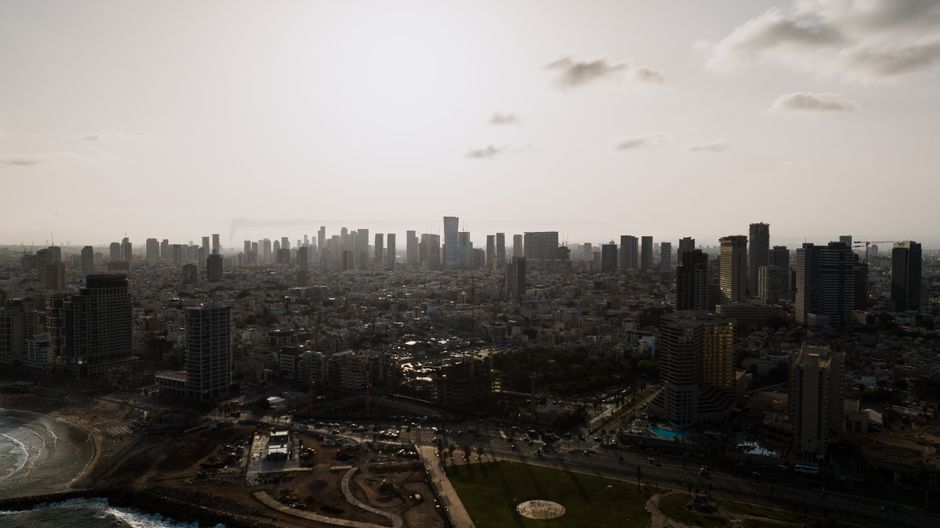
TEL AVIV — Today, the Israeli war machine announced that Iran had fired a cluster missile into the heart of Tel Aviv, leaving four people with light injuries. The Israeli Defense Forces (IDF) immediately pointed the finger at Tehran, framing the attack as another chapter in the endless cycle of state violence that has turned the region into a graveyard of imperial ambitions.
The missile, according to the IDF, was a cluster weapon—a particularly insidious tool of modern warfare designed to scatter smaller bomblets over a wide area, maximizing civilian casualties and terror. That four people were only lightly wounded feels like a grim stroke of luck in a conflict where the bodies of children and families are routinely buried under rubble. The IDF’s statement was swift, predictable, and dripping with the kind of moral posturing only a state that has spent decades bombing Gaza, Lebanon, and Syria could muster. Iran, for its part, has not yet commented, but in the theater of statecraft, silence is often just another act in the play.
The Theater of State Violence
Let’s be clear: this is not about justice, defense, or any of the other hollow justifications states use to dress up their violence. This is about power. Iran and Israel are two sides of the same coin—both nuclear-armed, both backed by global superpowers, both willing to sacrifice countless lives to maintain their grip on the region. The Israeli state, with its apartheid policies and brutal occupation, has long been a client of U.S. imperialism, while Iran’s theocratic regime crushes dissent at home and exports its own brand of oppression abroad. Neither deserves solidarity. Neither deserves to exist.
The people of Tel Aviv, Gaza, and Tehran are not enemies. They are victims of the same system—a system where states wage war in the name of “security” while ordinary people pay the price. The four injured today in Tel Aviv could just as easily have been children in Gaza, where Israeli airstrikes have killed thousands in the last year alone. The difference? The media’s framing. When Israel bombs a hospital, it’s “self-defense.” When Iran fires a missile, it’s “terrorism.” The reality is that both are acts of state terror, and both are enabled by the same global power structures that profit from war.
Cluster Munitions: Tools of Terror
Cluster munitions are banned by over 100 countries under the Convention on Cluster Munitions, but not by Israel or Iran. Why? Because states that rely on mass violence to maintain control don’t care about international law unless it serves their interests. These weapons are designed to maim, not just kill. They leave behind unexploded bomblets that turn cities into minefields, ensuring that civilians—especially children—continue to die long after the bombs stop falling. The fact that Israel and Iran are both willing to use such weapons speaks volumes about their disregard for human life.
The IDF’s claim that Iran fired the missile is almost certainly true, but it’s also a distraction. The real story is the decades of state violence that have made such attacks inevitable. Israel’s occupation of Palestine, its blockade of Gaza, and its repeated military campaigns have created a powder keg. Iran’s support for proxy groups like Hezbollah and its own regional ambitions only add fuel to the fire. The people of the Middle East are trapped between these warring states, and the only ones who benefit are the arms dealers, the politicians, and the generals who profit from endless war.
The Illusion of State Protection
The Israeli government will use this attack to justify further militarization, more airstrikes, and tighter control over its population. The Iranian regime will use it to rally its base, crack down on dissent, and present itself as the defender of the Muslim world. Both will claim they are acting in the name of their people, but the truth is that states do not protect—they dominate. They do not liberate—they oppress. The only way out of this cycle is for the people of the region to reject both the Israeli and Iranian regimes and build a future based on mutual aid, direct democracy, and solidarity.
Today’s attack is a reminder that the state is not your friend. Whether it’s the IDF dropping bombs on Gaza or the Iranian Revolutionary Guard crushing protests in Tehran, the message is the same: the state exists to control, not to protect. The people of Tel Aviv, Gaza, and beyond must recognize that their real enemies are not each other, but the systems that pit them against one another.
Why This Matters:
This missile strike is not just another headline in the endless news cycle of Middle Eastern violence—it’s a stark reminder of how states manufacture conflict to justify their own existence. Israel and Iran are not enemies by accident; they are enemies by design. Their rivalry is a tool of control, used to keep their populations in a state of perpetual fear and dependence. The Israeli government needs Iran as a boogeyman to justify its military budget, its occupation, and its repression of Palestinians. The Iranian regime needs Israel as a scapegoat to distract from its own failures, its corruption, and its brutal crackdowns on dissent.
But the people of the region are not doomed to this fate. The history of the Middle East is not just one of state violence—it’s also one of resistance. From the Palestinian intifadas to the Iranian protests of 2022, ordinary people have shown time and again that they are willing to fight for a different future. The question is whether they will continue to be divided by the false narratives of their governments or whether they will recognize their common enemy: the state itself.
The cluster missile that landed in Tel Aviv today is a symbol of everything that is wrong with the world. It is a weapon of war, fired by a state that claims to defend its people while it oppresses others. It is a tool of terror, used to keep populations in line and maintain the status quo. But it is also a reminder that the only way to break the cycle of violence is to reject the state entirely. The people of the Middle East do not need more bombs, more borders, or more governments. They need solidarity, mutual aid, and the courage to build a world without rulers. Until that day comes, the war machines will keep grinding on, and the bodies will keep piling up.