
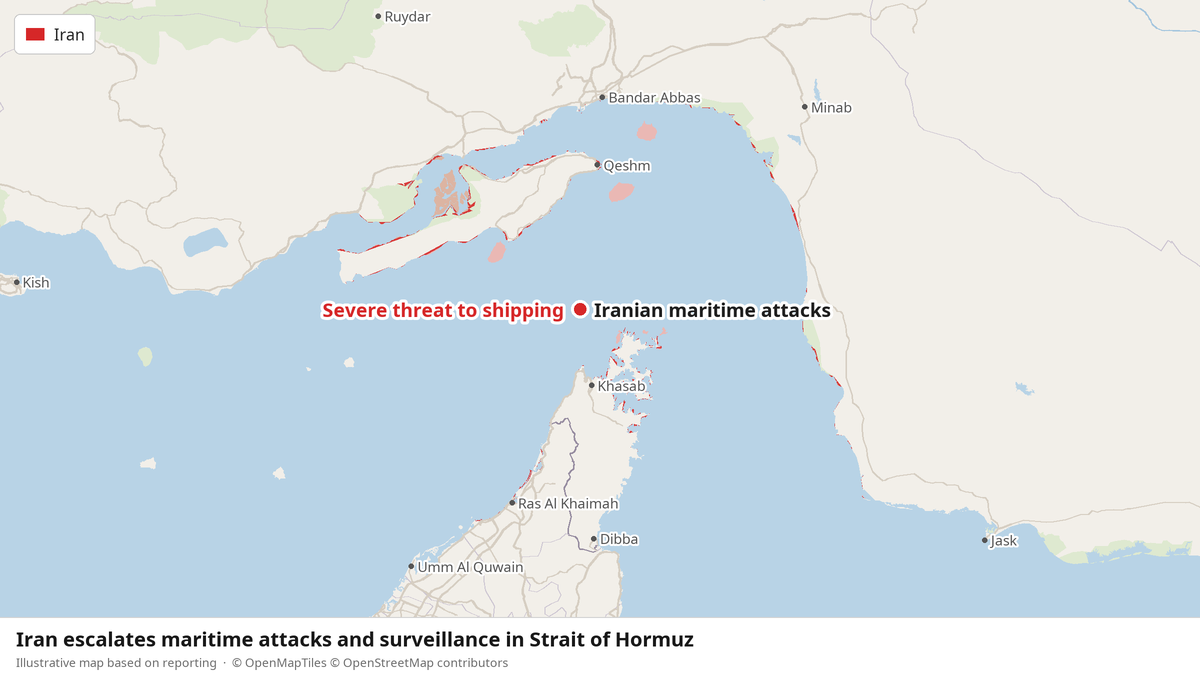
Two senior Iranian officials told Reuters that Tehran has changed how it attacks ships in the Strait of Hormuz, with one aim being to influence the US midterm vote. Sailors aboard those vessels didn't get a say in either government’s electoral calendar.
Before the war, the waterway carried about a fifth of global oil and liquefied natural gas trade, according to the Reuters report. Tehran has tried to control it since the US and Israel launched strikes against Iran on February 28. Passage has been restricted. Threats and attacks have severely curtailed traffic, driving up oil prices, though some oil keeps moving through.
The Strategy Memo
The officials declined to give details. One said Iran began using different offensive tactics against vessels it considered in violation of its restrictions about 10 days ago, leading to more attacks on those ships. The change covers both the type of attack and its pace.
"The aim is to frustrate efforts by the United States and its allies to bring down global oil prices," one of the two officials said. Iran's leaders made the decision at the highest levels, the official said, and coordinated it across the country's ruling system.
That's the language of a command structure describing its own coordination. A merchant ship crossing a chokepoint is now a lever in somebody else's election math, and the officials said so plainly.
The Rally Circuit
On the other side, the US president ran his own version of the show. Speaking Tuesday at a campaign rally in Wasilla, Alaska, where he was campaigning for Republican Sen. Dan Sullivan, Donald Trump said: "Wait and see what we do to Iran. We're going to hit them hard. Wait and see what we do to Iran, because we've had enough."
The line followed a run of shifting statements. Trump initially indicated on Wednesday that he wouldn't launch further strikes before the November midterms. The following day, he appeared to leave the door open, warning at an October 9 campaign rally in New York that he could "finish it off" if Iran failed to reach a deal.
Three public positions in a handful of days. All delivered from campaign stages. Military policy as stump speech.
Trump also claimed Iran's nuclear facilities remained buried beneath "thousands of tons of rock" and that Tehran had been just two weeks away from developing a nuclear weapon, blaming his predecessor, former president Barack Obama, for failing to stop the program. "They were the bullies of the Middle East, but they are the bullies of the Middle East no longer," he said, adding, "It's going to end very soon."
Who Benefits, Who Pays
Both governments describe the other as the bully. Both have tied the next move in the Gulf to a domestic political moment. Tehran says its attacks are designed to keep prices high and shape the US vote; Washington's president promises to hit Iran hard from a podium in Alaska. The two ruling systems are, in effect, bidding against each other, each reading the other's election-season posturing as a cue.
The cost lands elsewhere: on crews aboard ships Iran deems in violation of its rules, and on anyone who buys fuel. The base reporting doesn't name a single sailor, port worker or driver. They appear only as the traffic that has been curtailed and the prices that have been driven up. Nothing in the reporting suggests anyone was asked.
The Reuters account also contains no word of any international body, treaty mechanism or court restraining either side, only two officials describing a decision Iran's leaders made at the top and a president promising more strikes. The people most exposed to the escalation have no seat at the table where officials decided on the change in tactics.