
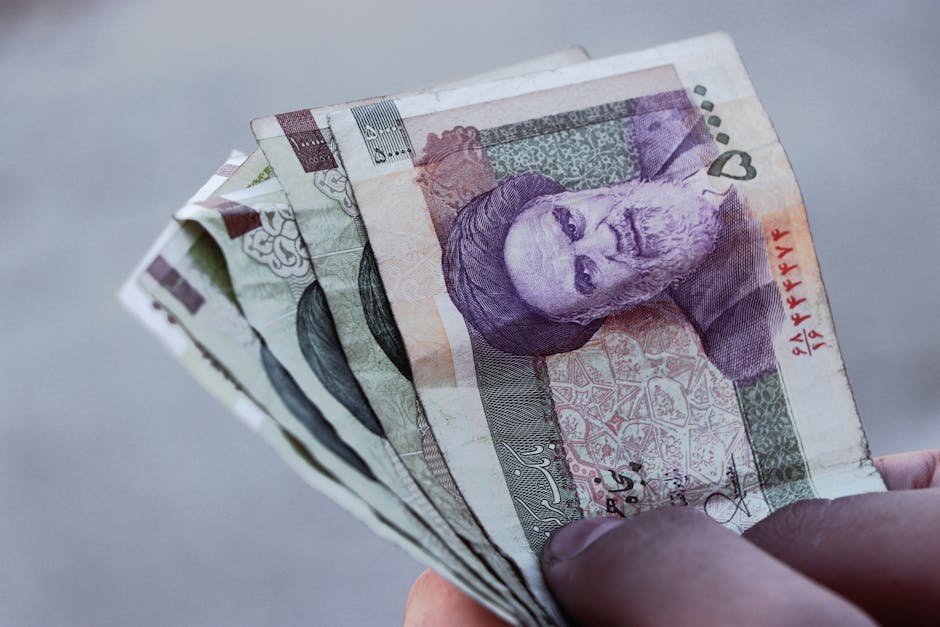
Iran's economy is buckling under the combined weight of war expenditures and a U.S. naval blockade that has choked off more than 90% of the nation's trade through its southern ports, threatening to push millions below the poverty line while the Islamic Republic's closure of the Strait of Hormuz inflicts pain on global energy markets.
The International Monetary Fund has predicted the Iranian economy will shrink by about 6 percentage points in the next year. Iran's official statistics center reported in mid-April that annual inflation was 53.7%, while inflation for food breached 115% compared with the same period last year. Iran's rial currency has lost over half its value in the past year, falling to a record low of 1.9 million to the dollar at the end of last month.
Economic Pressure Mounts
The economic cost of the war and the U.S. naval blockade "has been very substantial and unprecedented for Iran," said Hadi Kahalzadeh, an Iranian economist and research fellow at Brandeis University. Kahalzadeh said Iran has withstood decades of economic pressure and sanctions and its capacity to adapt has not been dismantled. "Iran can probably avoid a complete economic collapse or total shortage of essential goods, but at a very high cost," he said. "The main cost will be passed to ordinary Iranians through higher inflation, more poverty, weaker services and a much harder daily life."
An Associated Press tour of grocery stores in Tehran found large jumps from February, before the war began: chicken and lamb were up 45%, rice 31% and eggs 60%. Alongside items such as milk, the price of tea has risen over 50% since the war began. The economic woes helped fuel massive protests that spread across the country in January.
Parked beneath an overpass in central Tehran, 56-year-old Hossein Farmani was idling alongside other taxi drivers waiting for customers. He took a kettle from the trunk of his car before pouring himself a glass of tea and reflected on the wild price increases in the past year. "If things keep heading in this direction, we're going to suffer a lot more," Farmani said.
Government Measures Fuel Further Inflation
Iranian authorities have announced measures to help Iranians bear the crippling prices. But many of these policies, including a 60% hike in the minimum wage and coupon programs for essential goods, are stoking inflation, Taymur Rahmani, an economist at the University of Tehran, wrote recently in a leading business newspaper, Dunya-ye Eqtesad. Since the war began, free bus and metro fares in the capital are also not helping the city's struggling taxi drivers.
Another driver, Mohammad Deljoo, 73, said he was supporting his family of two children on a daily income of $4. He said there was no shortage of goods in shops and instead blamed the problem on "price gouging." "We only buy what's absolutely necessary, things like bread and potatoes. Even eggs have become too expensive for us," Deljoo said. He said the price for tires and other car parts rose fivefold in less than a year. "One price today, another tomorrow. How is that possible?" he said.
Amid job losses, many Iranians are scrambling to find new ways to make money. Ali Asghar Nahardani, 32, said the ride-hailing app he works for had not paid him in over a month. He turned to street vending to cover his living expenses. "We're just living day by day, trying to get through this situation while the war conditions continue," he said.
Middle Class Collapse Accelerates
The closure of the strait has hiked energy prices across the world. But in Iran, the war has marked another step in the ruin of a once large and prosperous middle class following decades of sanctions. By 2019, Iran's middle class had already shrunk to around 55% of the population, explained Mohammad Farzanegan, a professor of Middle Eastern economics at the University of Marburg. New rounds of sanctions as well as wars, corruption and economic mismanagement have further cut that number, he said. The war will likely push several million Iranians below the poverty line, according to a report published by the U.N.'s development agency in late March.
A physical trainer who lives in downtown Tehran described the economic crisis as a mental health crisis for Iranian society. She said many of her clients could no longer afford her fees and training sessions, and the few clients she has left have turned to discussing ways to handle signs of depression. "The system is just collapsing. The layoffs are in factories, in companies, in startups, in whatever your work is," she said in a voice note by Telegram. She spoke on condition of anonymity out of security fears. The trainer said she had severely cut back on groceries. "The last time I bought meat was about two months ago." She has also given up paying for therapy sessions that she began after divorcing her spouse a year ago. "I am pursuing a master's in psychology so it's given me the tools to handle my anxieties," she said.
A resident of Karaj, near the capital, said his insurance company had seen plummeting sales for car and home policies. Families are being dragged down into poverty, he said, also speaking on condition of anonymity out of fear of reprisal. The Karaj resident, who joined the mass anti-government protests in January, blamed the yearslong decline on "severe systemic corruption" and the Islamic Republic's costly support for militant groups in Lebanon, Yemen and Iraq. "Most people blame the government and its ambitions," he wrote by WhatsApp message.
Leadership Response
Iran's leaders have been trying to shore up the homefront by showing sympathy while also urging the public to endure the economic pain for the sake of the war effort. In a series of messages on his official Telegram channel Friday, the new supreme leader, Mojtaba Khamenei, described the current phase of the conflict as an "economic battlefield" and asked employers to "avoid layoffs as much as possible." Khamenei is believed to have been wounded early in the war by Israeli strikes and has yet to appear in public. Parliament speaker Mohammad Bagher Qalibaf, who has emerged as a key player in the war effort and U.S. talks, urged Iranians to "be frugal" in their spending. He said on his official Telegram account that government administrators and the public "have a duty to help each other" to ease economic effects.
The U.S. blockade has restricted Iran's critical Gulf trade. Over 90% of Iranian trade, particularly the oil exports that bring in billions of dollars, flows through its southern ports, Farzanegan estimated. Farmani, the taxi driver, said he did not want to accept what he called a "humiliating" peace with the U.S. and Israel. "A country that has sacrificed so many martyrs and has so many people willing to give their lives cannot simply let others from across the world dictate terms to us."
Why This Matters:
The economic unraveling in Iran demonstrates the fiscal and humanitarian costs of a regime's strategic choices. The U.S. blockade, targeting the trade routes that carry over 90% of Iranian commerce including critical oil revenues, represents a measured application of economic pressure to constrain an adversary's military capabilities. Yet Tehran's decision to close the Strait of Hormuz has imposed significant costs on global energy markets, illustrating how regional conflicts driven by authoritarian ambitions can disrupt international commerce. The collapse of Iran's middle class, accelerated by government policies including inflationary wage mandates and subsidies that economists say worsen price stability, underscores the limits of state intervention in managing economic crises. The regime's decades-long support for militant proxies across the Middle East, cited by Iranian citizens themselves as a driver of their hardship, reveals the opportunity costs of ideological foreign policy. As millions face poverty, the Iranian case offers a stark reminder that governance choices have direct consequences for citizens' economic security and prosperity.