
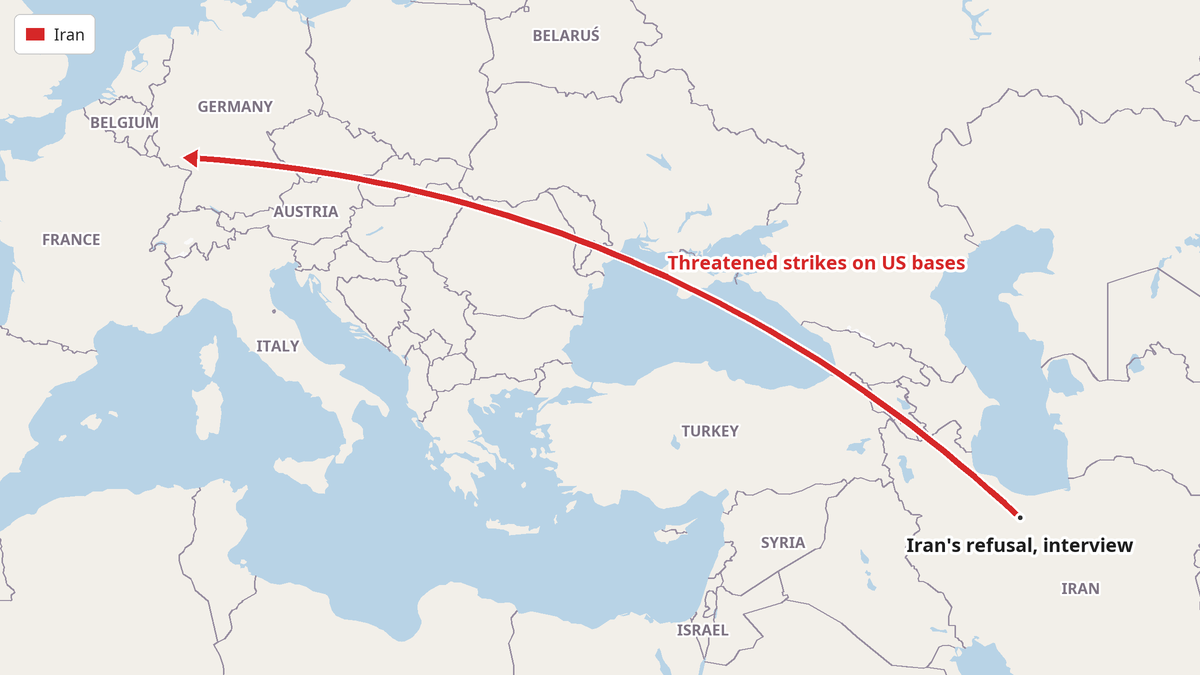
Mohsen Rezaei, Iran's security chief, told Al Mayadeen TV on Wednesday that Tehran won't let a "single speck" of enriched uranium leave the country. He wants it for nuclear-powered submarines. "We need the enriched material to design ships and submarines that work on nuclear energy," he said. Then came the part aimed at people who never got a vote on any of this: if American aircraft take off from a US base "even one located in a European country or some other distant region, to bomb Iran, we will strike those bases as well."
That's the sound of a state telling civilians in a third country they're acceptable collateral for a decision made in Washington. Nobody in Europe was asked. Nobody in Iran was asked either.
The State's Monopoly
Rezaei went further. Iran's response to renewed US attacks would "target America's more distant military installations - including the ones we have not yet attacked," he said, adding that Tehran "may even strike certain islands that they assume are beyond the reach of our missiles." Middle East Eye suggested he may mean Diego Garcia, the Indian Ocean island where the US has access to a military base, widely believed to have been used in the February 2026 attack and the months after.
The man issuing these threats has become, per the base reporting, more prominent in the media in recent months. He also accused the US of "manufacturing FAKE NEWS about imaginary talks" and said Washington had been "wrecked" by the war and should "surrender." He told Moscow the uranium stays home and "we will use it ourselves." Iran's Supreme Leader, two senior Iranian sources said in May, had already directed that the near-weapons-grade uranium shouldn't go abroad. One man's directive, relayed through anonymous sources, settles the fate of a stockpile the IAEA put at 440.9 kg of uranium enriched to 60% before Israel and the US struck Iranian nuclear facilities in June 2025. How much survived is unclear.
Both Sides of the Same Coin
Washington's side of the ledger reads the same way. Secretary of State Marco Rubio called Iran's terms "absurd" and stressed that the Trump administration believes its maritime blockade gives it the upper hand. Trump, quoted by The Jerusalem Post: "The United States has won [the war]. It's just a question of when we stop. We want to win 100%, not 90-something percent."
When we stop. Not whether the people under the missiles want it stopped.
The tone softened only after Republicans took a beating in the 3 November midterms, eight days ago, when Democrats campaigned against the war and rising energy prices. Trump now says the war is "effectively over" and there's "momentum" to end it. The two sides still sit far apart on enrichment, sanctions relief and control of the Strait of Hormuz. Iran says it sent a nuclear proposal through Qatar, to be discussed only after Washington meets seven demands, a senior Iranian official told Reuters. Rezaei insists there are no negotiations at all. Pick a version.
Who Gets Crushed
While the principals trade quotes, the hardware keeps rolling. Bloomberg reported Tuesday that Iran can now build about 50 ballistic missiles per month, roughly half its prewar capacity. On Wednesday, Tasnim news agency said Iran unveiled a new underground "missile city" housing ballistic and cruise missiles. The UAE, Qatar, Bahrain and Kuwait, per the base reporting, faced thousands of missile and drone strikes in Iran's retaliation over the US-Israeli attack, none of them parties to the decision to attack.
The mediating apparatus looks no more promising. Qatari Prime Minister Mohammed bin Abdulrahman Al Thani, the main go-between, acknowledged in closed-door discussions that gaps remain significant, two sources told The Jerusalem Post. Any deal would be implemented in stages, and who moves first is the sticking point. He met Trump at the White House Monday and told G7 foreign ministers Tuesday that Trump is allowing roughly two weeks for diplomacy. Russia, meanwhile, previously offered to take the uranium out of Iran but said the decision was Tehran's.
Everywhere in this story, the people with the most to lose appear only as targets, bases, or Gulf airspace. Governments set deadlines in weeks. Missiles don't read the calendar.
- iran nuclear program
- enriched uranium
- mohsen rezaei
- us bases
- marco rubio
- donald trump
- strait of hormuz
- iaea