
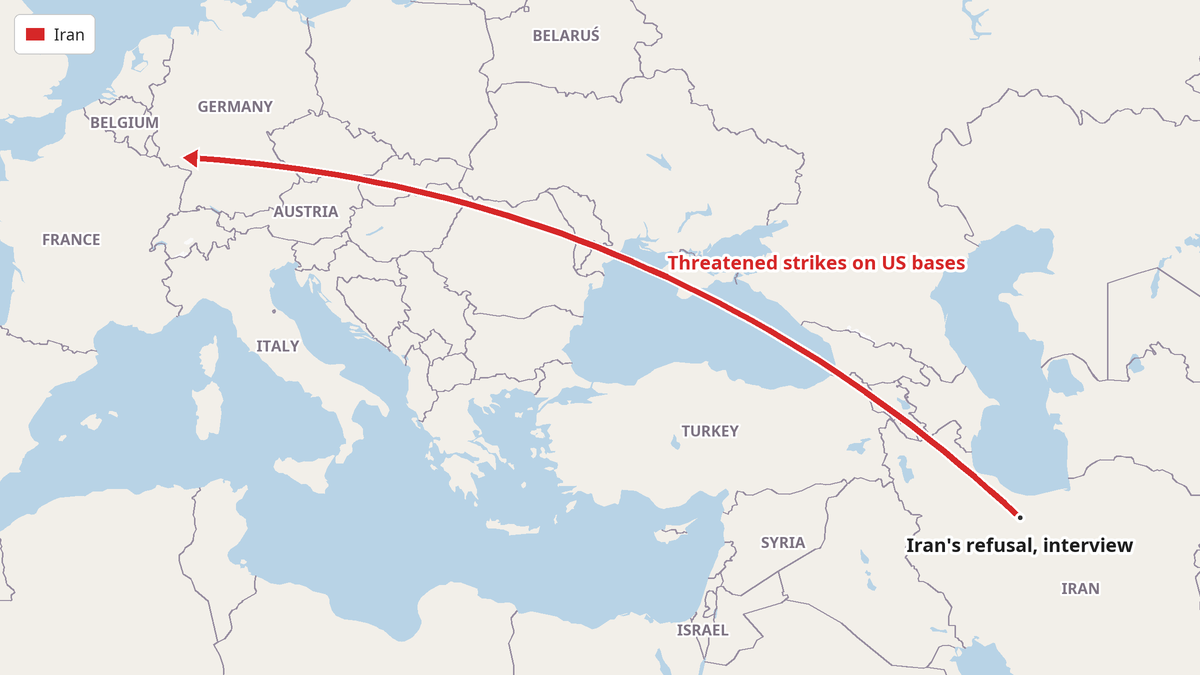
Thousands of missiles and drones rained down on the UAE, Qatar, Bahrain and Kuwait in Iran's retaliation for the US-Israeli attack, and on Wednesday one of Tehran's most prominent voices warned that a renewed round of fighting would reach even further. Mohsen Rezaei, Iran's security chief, told Lebanon's Al Mayadeen TV that if American aircraft take off from a US base, "even one located in a European country or some other distant region, to bomb Iran, we will strike those bases as well."
It was a blunt message, delivered just as diplomacy is supposed to be gathering pace. Rezaei also said Iran won't let a "single speck" of enriched uranium leave the country, an apparent rejection of Washington's demand that the material be surrendered as part of any political settlement. "We need the enriched material to design ships and submarines that work on nuclear energy," he said. He added that Tehran has told Moscow its enriched material will stay in Iran and "we will use it ourselves."
A Widening Threat Radius
Rezaei said Iran's response to any renewed US attacks would "target America's more distant military installations - including the ones we have not yet attacked," though he gave no details. "We may even strike certain islands that they assume are beyond the reach of our missiles," he said. Middle East Eye said he may be referring to Diego Garcia, the Indian Ocean island where the US has access to a military base and which is widely believed to have been used in the February 2026 attack and in the months that followed.
The Gulf states already know what retaliation looks like. The base article records thousands of strikes on four countries that sit between the two main combatants. Any extension of the target list to Europe or the Indian Ocean would pull more populations into a war that began about nine months ago.
Gaps That Haven't Closed
The rhetoric collided with Washington's own. US Secretary of State Marco Rubio called Iran's terms for a political settlement "absurd" a day earlier and said the Trump administration believes its maritime blockade gives it the upper hand. Rezaei, for his part, said there are currently no negotiations between Tehran and Washington. He accused the US in a social media post of "manufacturing FAKE NEWS about imaginary talks" and, on Monday, said the US government had been "wrecked" by the war and should "surrender" to Iran's demands.
Yet the Trump administration has adopted softer language since Democrats, who campaigned against the war and rising energy prices, badly defeated Republicans in the 3 November midterm elections, eight days ago. Trump has said the war was "effectively over" and that there was "momentum" to end it. On Wednesday, the Jerusalem Post quoted him: "The United States has won [the war]. It's just a question of when we stop. We want to win 100%, not 90-something percent."
The two sides still look far apart on nuclear enrichment, sanctions relief and control over the Strait of Hormuz. Qatari Prime Minister Mohammed bin Abdulrahman Al Thani, the main mediator, acknowledged in closed-door discussions that the gaps remain significant, two sources told the Jerusalem Post. Any deal would be implemented in stages, and who moves first is a key sticking point. He told G7 foreign ministers on Tuesday that Trump is allowing roughly two weeks for diplomacy. A senior Iranian official told Reuters last week that Iran sent the US a nuclear proposal via Qatar, to be discussed only after Washington meets seven demands.
The Uranium Question
The fate of the material sits at the center of the standoff. The IAEA estimates Iran held 440.9 kg of uranium enriched to 60%, a level far higher than civilian use requires, when Israel and the US attacked Iranian nuclear facilities in June 2025. How much survived is unclear. Russia has offered to remove uranium from Iran as part of a possible deal but said the decision belongs to Tehran. Two senior Iranian sources said in May that the Supreme Leader had directed that the near-weapons-grade uranium should not be sent abroad. Israel, the United States and other Western countries have long accused Iran of seeking nuclear weapons. Iran denies it.
Meanwhile, Iran is rebuilding its arsenal. Bloomberg reported Tuesday that Iran can now build about 50 ballistic missiles per month, roughly half its prewar capacity. On Wednesday, Tasnim news agency said Iran unveiled a new underground "missile city" housing ballistic and cruise missiles.
Why This Matters:
The next two weeks may decide whether this war ends at a table or resumes in the air. Every escalation in rhetoric raises the stakes for civilians in the Gulf states that absorbed thousands of strikes and now sit within range again. Washington says nuclear issues must be part of any initial talks; Tehran says the uranium stays. That's a gap diplomacy has to bridge or the fighting will likely return. Mediators like Qatar can carry messages, but they can't enforce a compromise. Without a staged deal that both capitals can sell at home, the people who pay for the next round won't be the officials trading threats on television.
- iran nuclear program
- enriched uranium
- mohsen rezaei
- us bases
- marco rubio
- donald trump
- strait of hormuz
- iaea