
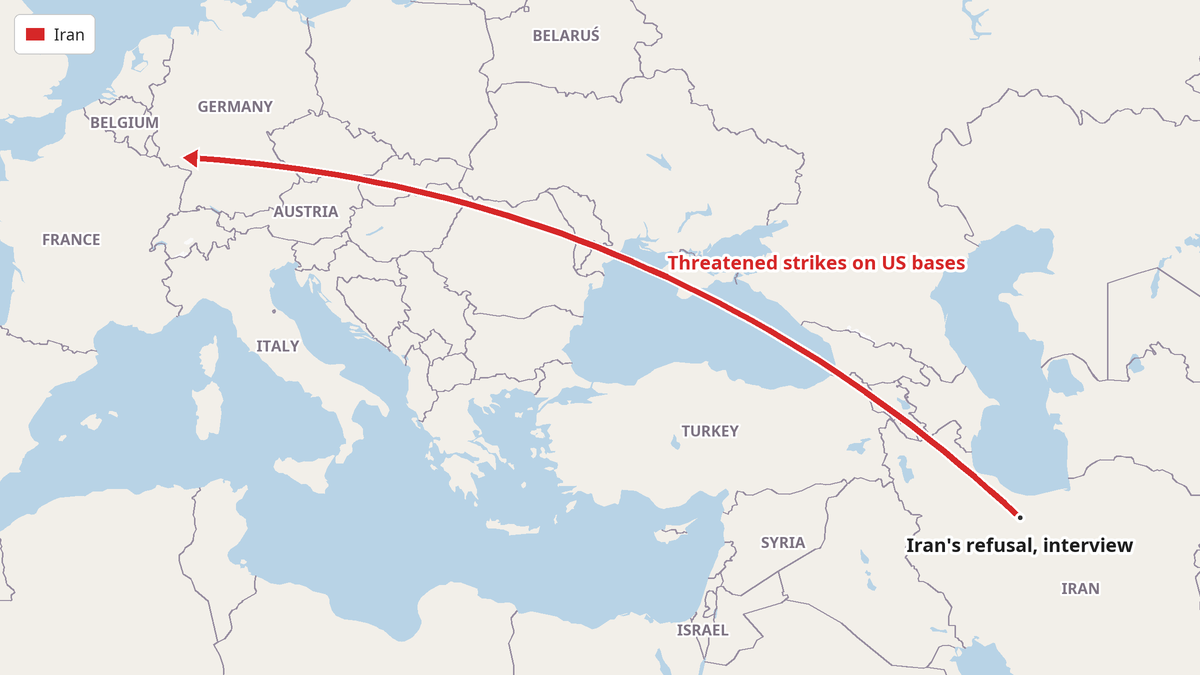
Iran won't give up its enriched nuclear material, security chief Mohsen Rezaei said on Wednesday. He wants to use it to build nuclear-powered submarines. Not a "single speck" of enriched uranium will leave the country, he told the Al Mayadeen TV network. It was an apparent rejection of US demands that Tehran surrender the stockpile as part of any political settlement.
"We need the enriched material to design ships and submarines that work on nuclear energy," Rezaei said. He added that Tehran has informed Moscow that its enriched nuclear material will remain in the country and "we will use it ourselves."
The Nuclear Stockpile
The numbers frame the stakes. The IAEA estimates that Iran held 440.9 kg of uranium enriched to 60% when Israel and the US struck Iranian nuclear facilities in June 2025. That level is far higher than anything needed for civilian use. How much of it survived is unclear.
Iran's Supreme Leader issued a directive in May that the country's near-weapons-grade uranium should not be sent abroad, two senior Iranian sources said. Russia has offered to remove uranium from Iran as part of a potential deal, though Moscow said the decision was Tehran's to make. Israel, the United States and other Western countries have long accused Iran of seeking nuclear weapons. Iran denies it.
Washington has said nuclear issues must be part of any initial negotiations aimed at ending the war. A senior Iranian official told Reuters last week that Iran sent the US a nuclear proposal via Qatar, to be discussed only after Washington meets seven demands.
Threats Against Western Bases
Rezaei didn't stop at the uranium. He threatened American installations far beyond the Middle East. "If American aircraft take off from an American military base, even one located in a European country or some other distant region, to bomb Iran, we will strike those bases as well," he said.
He said Iran's response to renewed US attacks would "target America's more distant military installations - including the ones we have not yet attacked," without giving details. "We may even strike certain islands that they assume are beyond the reach of our missiles," he added. Middle East Eye said he may be referring to Diego Garcia, the Indian Ocean island where the US has access to a military base. It is widely believed to have been used in the February 2026 attack and in the months that followed.
The Jerusalem Post, which described him as Iranian Security Chief, reported that Rezaei said there are currently no negotiations between Tehran and Washington. He said any new US attacks "will also be met with targeting US bases far away," meaning bases beyond the scope of the previous war. Al Jazeera reported that he accused the US in a social media post of "manufacturing FAKE NEWS about imaginary talks." On Monday he said the US government had been "wrecked" by the war and it was time for it to "surrender" to Iran's demands.
Rebuilding the Missile Arsenal
The rhetoric comes with hardware. Bloomberg reported Tuesday that Iran can now build about 50 ballistic missiles per month, roughly half its prewar capacity. On Wednesday, Iran unveiled what it called a new underground "missile city" housing ballistic and cruise missiles, according to Tasnim news agency.
The Gulf states know what that arsenal can do. The UAE, Qatar, Bahrain and Kuwait faced thousands of missile and drone strikes in Iran's retaliation over the US-Israeli attack.
Washington Signals Restraint
Secretary of State Marco Rubio called Iran's terms for a political settlement "absurd" a day earlier. He stressed that the Trump administration believes its maritime blockade gives it the upper hand in negotiations. Yet the tone from Washington has softened since the Republican Party was badly defeated in the 3 November midterms, held eight days ago. The Democrats campaigned against the war and rising energy prices.
Trump has said the war was "effectively over" and that there was "momentum" to end the conflict. The Jerusalem Post quoted him Wednesday: "The United States has won [the war]. It's just a question of when we stop. We want to win 100%, not 90-something percent."
The two sides still look far apart on nuclear enrichment, sanctions relief and control over the Strait of Hormuz. Qatari Prime Minister Mohammed bin Abdulrahman Al Thani, the main mediator, acknowledged in closed-door discussions that the gaps remain significant, two sources told The Jerusalem Post. Any agreement would be implemented in stages, with sequencing and who moves first as key points of contention. He told G7 foreign ministers on Tuesday that Trump is allowing roughly two weeks for diplomacy.
- iran nuclear program
- enriched uranium
- mohsen rezaei
- us bases
- marco rubio
- donald trump
- strait of hormuz
- iaea