
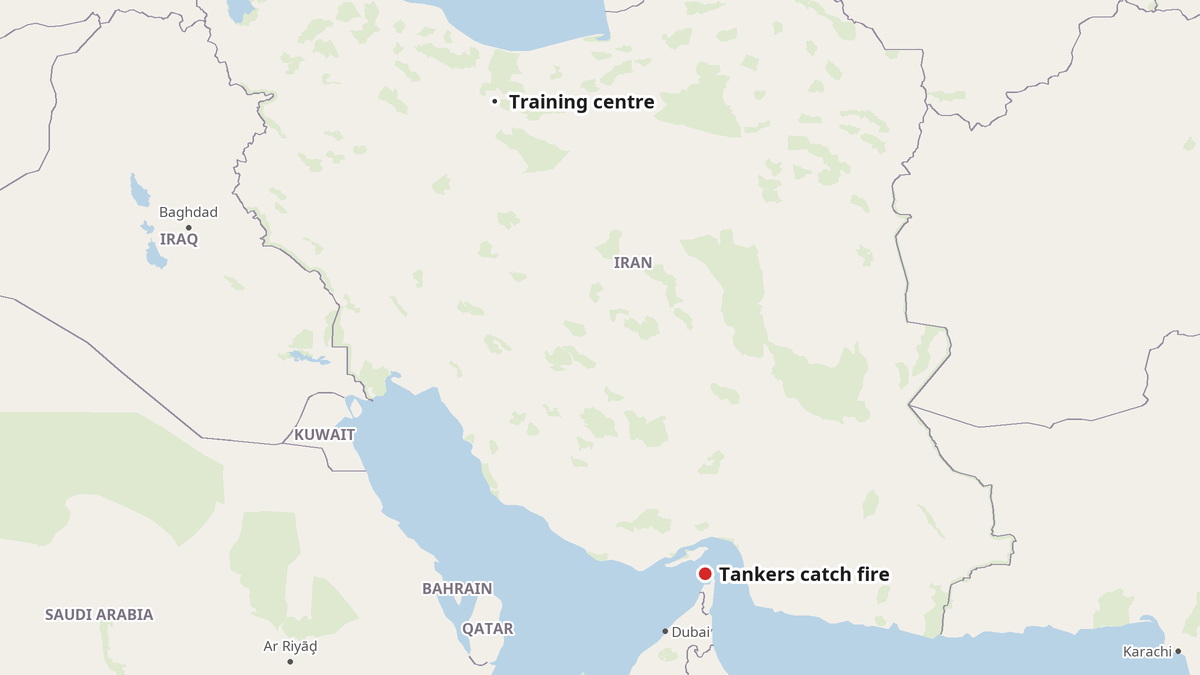
The United States struck an Iranian anti-aircraft facility on Qeshm Island near the Strait of Hormuz on Tuesday, as indirect talks over reopening the strategic waterway continued and Washington prepared military options for further action.
US President Donald Trump confirmed the strike in an interview with Fox News, describing it as a “minor attack” that “wasn't war.” He said the United States had watched Iran build the facility for about two months and hit it after construction was completed. US officials described the strike as “defensive” and said it followed Iranian fire at an American aircraft. Iranian media said the facility was on Qeshm Island, in the Gulf near the strait.
Iran called Washington's response to its conditions for reopening the waterway “unconvincing.” Tehran's proposal would reopen the strait over two days if the United States met seven demands, including lifting sanctions and ending a US naval blockade.
The strike and the negotiations
Mohsen Rezaei, secretary of Iran's Supreme National Security Council, said on X that the United States must “fully and explicitly address Iran's seven conditions and act upon them.” He added: “Only in this case will the Strait of Hormuz be reopened.”
Majed al-Ansari, a spokesperson for Qatar's Ministry of Foreign Affairs, said talks were continuing and both sides “remain committed to the negotiation process.” Qatar was facilitating the “real-time exchange of proposals between” Washington and Tehran.
Trump said he wasn't seeking to “kill lots of people,” but added, “If we have to, we'll have to.” In an interview with the Financial Times, he said, “We seem to be getting everything we want.” He also said the United States might carry out a major strike involving a “heavy hit,” and told Fox News: “We have to do something large.” He added: “They will never have a nuclear weapon.”
US media, citing officials, reported that Central Command had prepared strike plans that could begin as early as Wednesday, after the midterm elections, when three American aircraft carriers would be in the region. Reports described a possible campaign as short and intense. There was no US confirmation of an attack plan. The description of an “imminent” attack came from open-source accounts.
Shipping and military preparations
The Islamic Revolutionary Guard Corps said on Wednesday that four oil tankers were destroyed after striking naval mines while trying to pass through a prohibited shipping lane south of the strait. The vessels remained ablaze, according to a statement carried by the official IRNA news agency. The IRGC also said two other vessels had been detained for violating shipping restrictions. The reports said the incidents couldn't be independently verified.
The United Kingdom Maritime Trade Operations reported that two unidentified projectiles struck a tanker's engine room about 14 nautical miles northeast of Oman's coastal village of Limah on Tuesday. No casualties were reported. It wasn't independently verified whether that incident was connected to the IRGC's account.
Reports citing flight-tracking data described increased US military cargo flights landing at Ovda and Nevatim air bases in southern Israel. One report said at least 10 US military cargo planes landed there, most departing from Fort Bliss in Texas. The same airlift pattern was observed before the previous strike on Iran. The Wall Street Journal reported that the United States was sending a Patriot battery from Texas to bolster regional defenses. Flight data didn't show what the planes carried, and Walla reported “no unusual rise” in US aircraft arrivals over the past week.
Warnings of wider escalation
Iran's supreme leader, Mojtaba Khamenei, ordered the military at the weekend to respond immediately to any threat without geographical limits and to update its list of targets. Iranian officials suggested European countries and undersea cables in the Gulf could be targets.
Iran's chief negotiator, Mohammad Bagher Ghalibaf, said the Islamic republic was “ready for battle with its finger on the trigger.” Deputy Foreign Minister Kazem Gharibabadi said Tehran retained the right to “legitimate self-defence” after the US strikes. President Masoud Pezeshkian said his government was still seeking to resolve the crisis “through dialogue,” adding that “no one will benefit from this war” if it reignited.
Ghalibaf also said Americans voted “NO TO WAR” after Democrats' midterm gains. Trump acknowledged that rising petrol prices hurt Republicans, saying voters “didn't like it” when they paid more for fuel. US political scientist John Mearsheimer questioned whether a shorter renewed bombing campaign could achieve Washington's objectives, asking: “If the 40-day bombing campaign didn't work, how is the three-day bombing campaign going to work?”
- strait of hormuz
- iran
- united states
- donald trump
- military strikes
- qatar
- commercial shipping
- iran-us tensions