
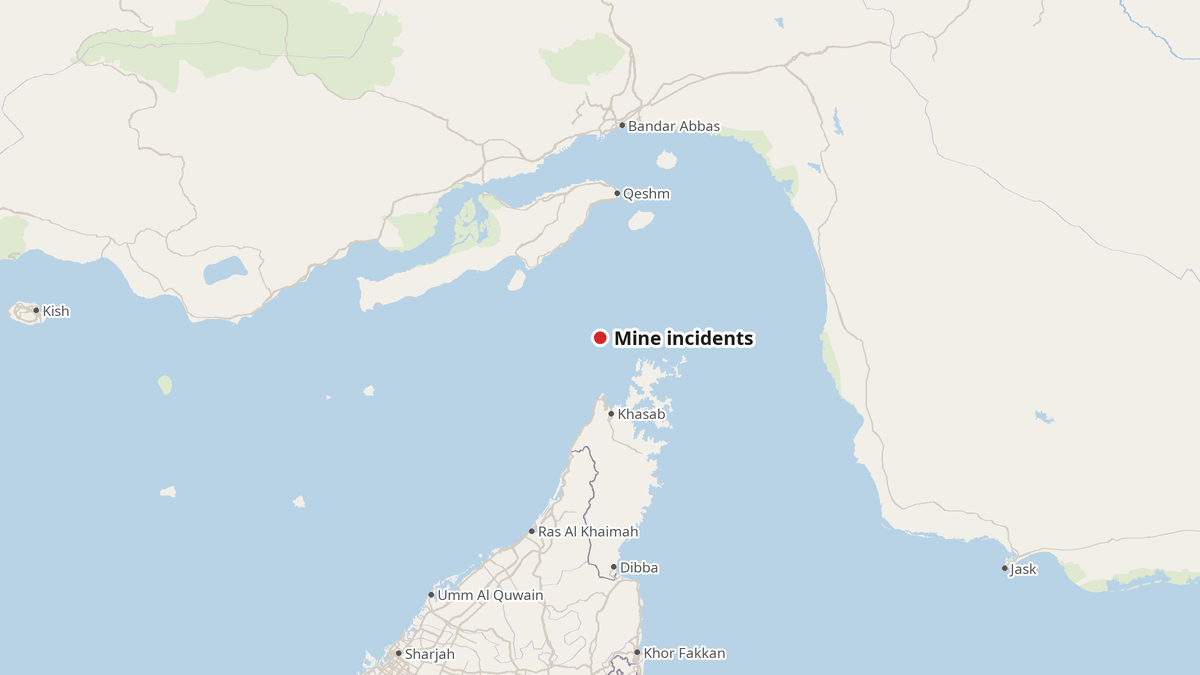
Three tankers caught fire after hitting mines in the Strait of Hormuz, Iran’s Islamic Revolutionary Guard Corps navy said, while another vessel struck naval mines in the waterway. The IRGC said the tankers had tried to cross an unauthorized route, switched off radar and navigation systems, and ignored naval warnings. The vessels were abandoned on the southern shores. Who laid the mines, and whether anyone was injured, remained unknown.
A separate report from the United Kingdom Maritime Trade Operations said a vessel was burning about 25 nautical miles northeast of Khasab, Oman, as it travelled outbound through the strait. Its cause, crew’s condition, damage and environmental impact hadn’t been established. UKMTO advised ships to proceed cautiously and report suspicious activity while authorities investigated. In a waterway where governments assert control through warnings, blockades and military deployments, the people aboard the burning vessels remain largely absent from official accounts.
Military Options, Civilian Exposure
The United States was considering military options concerning Iran. The Wall Street Journal reported that U.S. Central Command chief Adm. Brad Cooper presented options to President Donald Trump at the White House on Thursday. Defense Secretary Pete Hegseth and Joint Chiefs Chairman Dan Caine also attended. Reuters said it couldn’t immediately verify the report independently.
Washington and Jerusalem were reported the previous week to be considering a “short but intensive operation” of renewed strikes on Iran after the November 3 U.S. midterm elections. Military drills had ramped up, with Iranian energy sites, nuclear facilities, and missile and drone arsenals among the reported targets. Trump could still decide against military action.
Open-source flight-tracking analysts reported that more than 10 U.S. military transport aircraft landed at Israeli airbases in southern Israel over the previous week. Most recent cargo flights came from Biggs Army Airfield in El Paso, Texas, and went to the Israeli Air Force’s Nevatim and Ovda airbases. Other U.S. cargo flights travelled to American bases in Jordan, Saudi Arabia, Qatar and Kuwait. The aircraft’s contents were unknown, though they were thought to relate to efforts to strengthen regional air defences. The Wall Street Journal reported that the U.S. military was sending a Patriot battery from Texas.
Blockade Claims and the Negotiating Table
Iran’s UN ambassador, Amir-Saeid Iravani, told the UN Security Council that Washington and its supporters were responsible for insecurity in the strait and disruptions to regional shipping. He said the U.S. naval blockade violated the UN Charter and threatened Iranian civilians’ access to food, medicine, fuel and other essentials, calling it “collective punishment.” The United States said the blockade was effective and that no Iranian ship had crossed the strait. The rival statements describe a contest between governments; the threatened access Iravani named belongs to civilians.
Iran confirmed it had received a letter from U.S. Vice President JD Vance but hadn’t responded. The semi-official Tasnim news agency said Tehran still required the United States to meet seven conditions, without detailing them. Trump said the outreach concerned medical supplies, not restarting negotiations: “No,” he said when asked whether he had directed Vance to contact Iran to resume peace talks. He added that Vance had asked what he thought about helping Iran obtain supplies for people who were unwell.
A Washington Post report said U.S. intelligence viewed working with Iran’s Supreme National Security Council head Mohsen Rezaei as Washington’s best option to head off renewed fighting. An official familiar with the matter said Vance’s letter urged Iran to send negotiators “empowered” to resolve the nuclear issue. Rezaei hadn’t responded, and his longstanding hardline stance toward the United States cast doubt on whether he’d pursue a deal. Russia said it was ready to mediate if asked; Qatari mediators returned to Tehran on October 30 for talks coordinated with the United States.
Diplomacy Meets the G20
The war’s effects on energy supplies, maritime security and trade featured at the G20 foreign ministers’ meeting in Atlanta, hosted by U.S. Secretary of State Marco Rubio. The State Department said ministers would discuss threats to navigation, energy and food security, and supply chains. A department official said they would seek ways to address geopolitical tensions’ impact on economic security. No joint declaration was expected, according to French diplomatic sources.
The meeting also carried its own map of state priorities. Washington had uninvited South Africa amid tension over Pretoria’s policies, including its legal action against Israel, and invited Russia but not Ukraine. European Union foreign policy chief Kaja Kallas said she would press for support for Ukraine and accountability through a “Special Tribunal and Claims Commission.” Russia’s Foreign Minister Sergey Lavrov attended; Moscow said he would argue against international sanctions. The ministers discussed access, security and accountability while governments weighed military options, blockades and diplomatic leverage. The ordinary people exposed to those decisions had no seat at the table.
- strait of hormuz
- iran
- united states
- islamic revolutionary guard corps
- maritime mines
- military tensions
- peace negotiations
- mohsen rezaei