
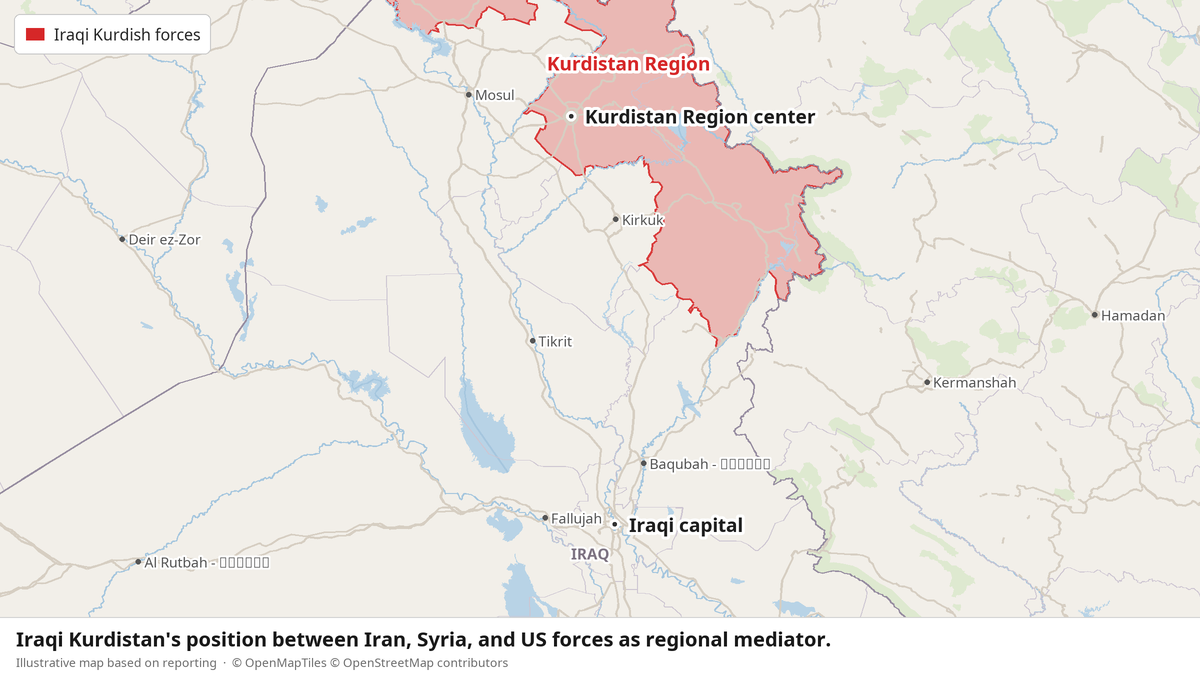
More than 1,000 Iranian missile and drone attacks have hit the Kurdistan Region of northern Iraq. Its leaders responded by gathering at a conference in Erbil, where they described themselves as part of the solution.
That was the mood at the 2026 Middle East Research Institute (MERI) Forum, where Kurdish officials explained what they’ve done behind the scenes to cool regional tensions. They reached out to Iran and the US. They worked to broker talks between Damascus and Kurds in eastern Syria. Kurdistan Region President Nechirvan Barzani and Prime Minister Masrour Barzani, who are related and lead the Kurdistan Democratic Party, played a major role. Bafel and Qubad Talibani of the rival Patriotic Union of Kurdistan (PUK) did, too.
“We are very pleased today to see that Kurds are part of the solution - whether in Syria, as marked by the presence of Comrade Mazloum [Abdi] here, or in Iraq, where we are part of the solution,” said Qubad Talabani, Deputy Prime Minister of the Kurdistan Regional Government (KRG). Rudaw reported that he told the forum: “As political forces in the Kurdistan Region, we stand ready for any coordination and role assigned to us.” Assigned by whom? He didn’t say.
The Mediator’s Ledger
Rudaw credited the Kurdistan Region with advancing the integration of the “now-dissolved” Syrian Democratic Forces (SDF) into the Syrian state system. Read that phrase twice. A Kurdish-led armed force, backed by the US, has joined the government in Damascus, and the people who brokered it are being applauded. SDF commander Mazloum Abdi praised the Kurdistan Region for its support. The base article notes that the US was leaving Syria in 2025, one year ago, and that the SDF was expected to integrate with the new government. The KRG, it says, sought to make sure Kurds wouldn’t be harmed in Syria.
The geography explains the rush. Northern Iraq borders Iran, Turkey and Syria. US forces concentrated in the KRG until they left on September 30, about two weeks ago. Turkey is in peace talks with the PKK, which also has forces in the KRG. Everybody’s army, it seems, needs a Kurdish address.
Who Gets Bombed
Iran says it has targeted the region roughly 1,000 times, mostly because Iranian Kurdish opposition groups are based in northern Iraq. Their facilities near Koya have frequently come under attack. Tehran has made clear that the attacks will continue until the KRG can assure it that these groups aren’t a threat.
At MERI, Nechirvan Barzani’s answer was to scold the groups. “Rojhelat’s [western Iran’s Kurdish region] opposition forces, unfortunately, behaved very irresponsibly,” he said. So the host government, under fire for hosting them, publicly chides its guests. Some groups are closer to the KDP or PUK. At least six exist, including the centrist KDPI and PAK and the more left-leaning Komala and PJAK, which many believe has close links to the PKK. Another, Khabat, belongs to the Kurdish Iranian opposition alliance, formed in January and February, right before the US and Israeli strikes began.
In March, media reports suggested the US was willing to arm them. Then the 39-day war came and went.
What the Ground Level Saw
The Amargi, a local grassroots media network, offered the account missing from the forum panels. According to accounts circulating within party ranks, former peshmerga fighters returned from abroad while party members acquired light weapons and vehicles. The Amargi said these preparations don’t substantiate Trump’s allegations that Kurds diverted or kept weapons intended for Iranian protesters. The parties rejected those accusations, which nobody has publicly substantiated.
For some Iranian Kurds, the Amargi reported, the war “appeared to offer a long-awaited opportunity after what they considered a missed chance during the Jin, Jiyan, Azadi (Women, Life Freedom) movement.” They hoped a weakened regime would pave the way for a ground operation. Events didn’t unfold that way. The parties pointed to the absence of international guarantees, air cover, external coordination and a broader uprising in Iran. They feared an operation would fail and leave civilians exposed to retaliation.
A recent KDPI statement indicated it won’t send its forces over the border. The party has lived in the KRG for decades, and Iran keeps hitting its facilities anyway.
The pattern is plain enough. Parties wait for guarantees from powers that leave on schedule. Governments trade assurances about whose armed guests are or aren’t a threat. The civilians who’d bear retaliation, the very people the parties feared leaving exposed, get no seat at the forum. Nobody in the base article says what they want.