
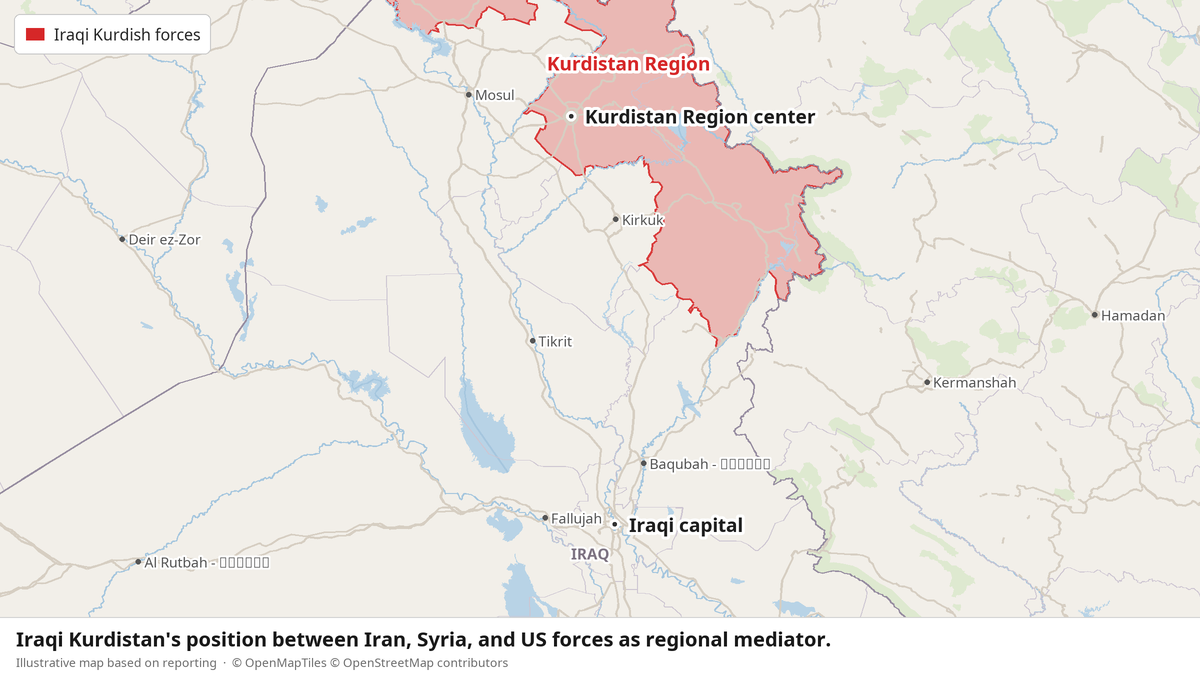
More than 1,000 Iranian missile and drone attacks have struck northern Iraq’s Kurdistan Region. Its leaders are still trying to cool tensions.
That was the picture at the 2026 Middle East Research Institute (MERI) Forum in Erbil. Kurdish officials described a quiet mediation effort while Tehran kept firing. The Kurds contacted both Iran and the United States, and helped broker talks between Damascus and Kurdish forces in eastern Syria.
The Security Picture
The attacks follow a pattern. Iran has targeted the region roughly 1,000 times, mostly because Tehran is pursuing Kurdish Iranian opposition groups based in northern Iraq. Tehran has made its position plain: the strikes will continue until the Kurdistan Regional Government assures Iran that these groups aren't a threat.
Nechirvan Barzani, the Kurdistan Region's president, addressed the issue directly. He sharply criticized the Iranian Kurdish opposition, which maintains bases and camps inside the KRG, some close to the KDP or PUK. “Rojhelat's [western Iran's Kurdish region] opposition forces, unfortunately, behaved very irresponsibly,” Barzani said at MERI.
At least six such groups operate there, including the centrist KDPI and PAK and the more left-leaning Komala and PJAK. Many believe PJAK has close links to the PKK. Another group, Khabat, belongs to the Kurdish Iranian opposition alliance. The groups formed the alliance in January and February, just before US and Israeli strikes began. In March, media reports suggested Washington was willing to arm them.
The Amargi, a local grassroots media network, reported that the parties had prepared, with former peshmerga fighters returning from abroad and light weapons and vehicles being acquired. It said those preparations “do not substantiate Trump's allegations that Kurds diverted or kept weapons intended for Iranian protesters,” accusations the parties rejected and that “have not been publicly substantiated.”
The Amargi also reported that some Iranian Kurds saw the 39-day war as a long-awaited opening. They hoped a weakened regime would clear the way for a ground operation. It didn't happen. The parties pointed to the lack of international guarantees and protection: without air cover, external coordination and a broader uprising in Iran, they feared an operation would fail and leave civilians exposed to retaliation. A recent KDPI statement said the group won't send its forces across the border. Its members have lived in the KRG for decades, and Iran has frequently hit its facilities near Koya.
A Crossroads Under Pressure
Geography drives much of this. Northern Iraq borders Iran, Turkey and Syria, and sits at the crossroads of major regional policies. US forces were concentrated in the KRG until they left on September 30, about two weeks before today's date. Turkey is conducting peace talks with the PKK, which also has forces in the KRG.
In Syria, the US was leaving in 2025, and the US-backed, Kurdish-led SDF was expected to integrate with the new government in Damascus. The KRG sought to make sure Kurds wouldn't be harmed. Rudaw reported that the Kurdistan Region “has significantly contributed to the advancement of the integration process of the now-dissolved Syrian Democratic Forces (SDF) into the Syrian state system.” Rudaw also noted that Nechirvan Barzani played a key role in talks in Syria and Turkey. SDF commander Mazloum Abdi praised the Kurdistan Region for its support.
Who's at the Table
President Nechirvan Barzani and Prime Minister Masrour Barzani, who are related and lead the Kurdistan Democratic Party, played a major role. Members of the Talibani family did too, primarily Bafel and Qubad Talibani of the rival Patriotic Union of Kurdistan (PUK).
“We are very pleased today to see that Kurds are part of the solution - whether in Syria, as marked by the presence of Comrade Mazloum [Abdi] here, or in Iraq, where we are part of the solution,” Qubad Talibani, the KRG's Deputy Prime Minister, said at the forum. Rudaw reported he added that Erbil was ready to facilitate discussions between Kurds and the countries where they live, including Iran. “As political forces in the Kurdistan Region, we stand ready for any coordination and role assigned to us,” he said.
Why This Matters: The Kurdistan Region shows how Iran's reach works in practice: Tehran fires at a neighbor over a thousand times and still expects assurances on its terms. With US forces gone from the KRG since September 30, Erbil has fewer outside guarantees and a longer list of armed actors on its soil, from Iranian Kurdish opposition groups to PKK forces. Its mediation between Damascus, Kurdish factions and Tehran depends on keeping those groups in check. That's a hard balance when the Iranian opposition itself says it lacked the protection to act. For any state facing hostile neighbors and armed groups on its territory, the lesson is plain: diplomacy works best when backed by security. Erbil's outreach carries weight only as long as it can answer Tehran's demands without inviting more fire.