
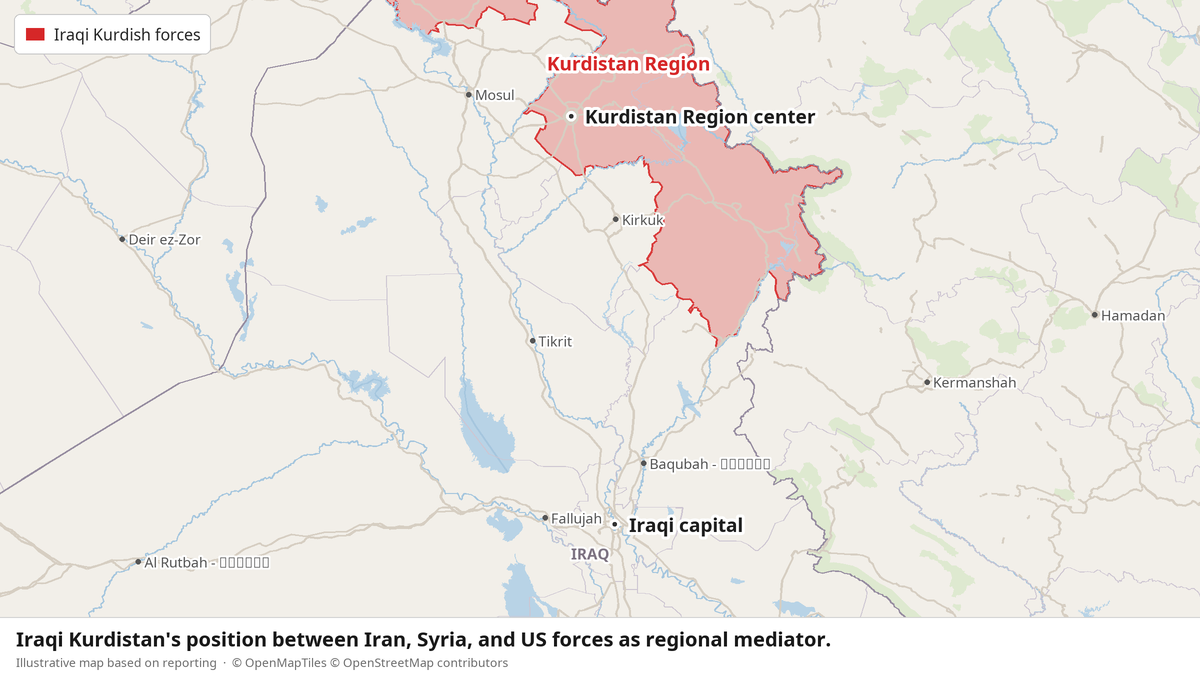
More than 1,000 Iranian missile and drone attacks have hit the Kurdistan Region of northern Iraq. Even so, Erbil reached out to Tehran and Washington.
That was the central fact at the 2026 Middle East Research Institute (MERI) Forum in Erbil, where Kurdish leaders described how the region has worked, often behind the scenes, to ease tensions. According to the base reporting, Kurdish officials sought channels to Iran and the US while also brokering talks between Damascus and Kurds in eastern Syria.
The Iranian Missile Campaign
Iran has targeted the region 1,000 times, mostly because Tehran is pursuing Kurdish Iranian opposition groups based in northern Iraq. Iranian strikes have repeatedly hit their facilities near Koya. KDPI members have lived in the Kurdistan Region for decades.
Tehran hasn't signaled a pause. Iran has made clear that it will keep attacking until the Kurdistan Regional Government assures Tehran these groups pose no threat. That demand leaves an Iraqi region under standing military pressure from a neighboring state, with no end date.
At least six Kurdish Iranian opposition groups operate from the region. They include the centrist KDPI and PAK, as well as the more left-leaning Komala and PJAK. Many believe PJAK has close links to the PKK. Khabat is another member of the Kurdish Iranian opposition alliance. The groups formed the alliance in January and February, just before the US and Israeli strikes began.
A War That Didn't Go as Planned
In March, media reports suggested the US was willing to arm the Kurdish Iranian groups. The parties concerned rejected President Trump's allegations that Kurds diverted or kept weapons intended for Iranian protesters. The Amargi, a local grassroots media network, reported that the accusations "have not been publicly substantiated."
For some Iranian Kurds, the 39-day war seemed to offer a long-awaited opportunity, Amargi reported. They hoped a weakened regime would open the way for a ground operation, but events didn't unfold as they expected. The parties said they chose not to intervene because they lacked international guarantees and protection. Without air cover, external coordination and a broader uprising in Iran, they feared an operation would fail and expose civilians to retaliation.
A recent KDPI statement said the party won't send its forces across the border.
Nechirvan Barzani, the Kurdistan Region President, spoke bluntly about the opposition camps on his territory. "Rojhelat's [western Iran's Kurdish region] opposition forces, unfortunately, behaved very irresponsibly," Barzani said at MERI. Some groups are closer to the KDP or PUK.
The Western Retreat
US forces had concentrated in the Kurdistan Region before leaving on September 30, about two weeks before this report. The base article notes that the US was leaving Syria in 2025, one year ago, while the US-backed, Kurdish-led SDF was expected to join the new government in Damascus.
The Kurdistan Regional Government worked to protect Kurds in Syria. Rudaw reported that the region played a significant role in integrating the now-dissolved Syrian Democratic Forces into the Syrian state system. Nechirvan Barzani took a key role in talks in Syria and Turkey. SDF commander Mazloum Abdi praised the Kurdistan Region for its support.
Turkey is handling peace talks with the PKK, which also has forces in the Kurdistan Region. Northern Iraq borders Iran, Turkey, and Syria, placing it at the crossroads of major regional policies.
Kurds as Part of the Solution
Nechirvan Barzani and Prime Minister Masrour Barzani, relatives who lead the Kurdistan Democratic Party, played major roles. Members of the Talibani family did too, primarily Bafel and Qubad Talibani, from the rival Patriotic Union of Kurdistan.
"We are very pleased today to see that Kurds are part of the solution - whether in Syria, as marked by the presence of Comrade Mazloum [Abdi] here, or in Iraq, where we are part of the solution," said Qubad Talabani, Deputy Prime Minister of the KRG. Rudaw reported that he told MERI, "Erbil expressed readiness to facilitate discussions between Kurds and the countries where they live in the Middle East, including in Iran."
He added: "As political forces in the Kurdistan Region, we stand ready for any coordination and role assigned to us."
The offer stands against a backdrop of more than 1,000 strikes by the very government Erbil is offering to talk to.