
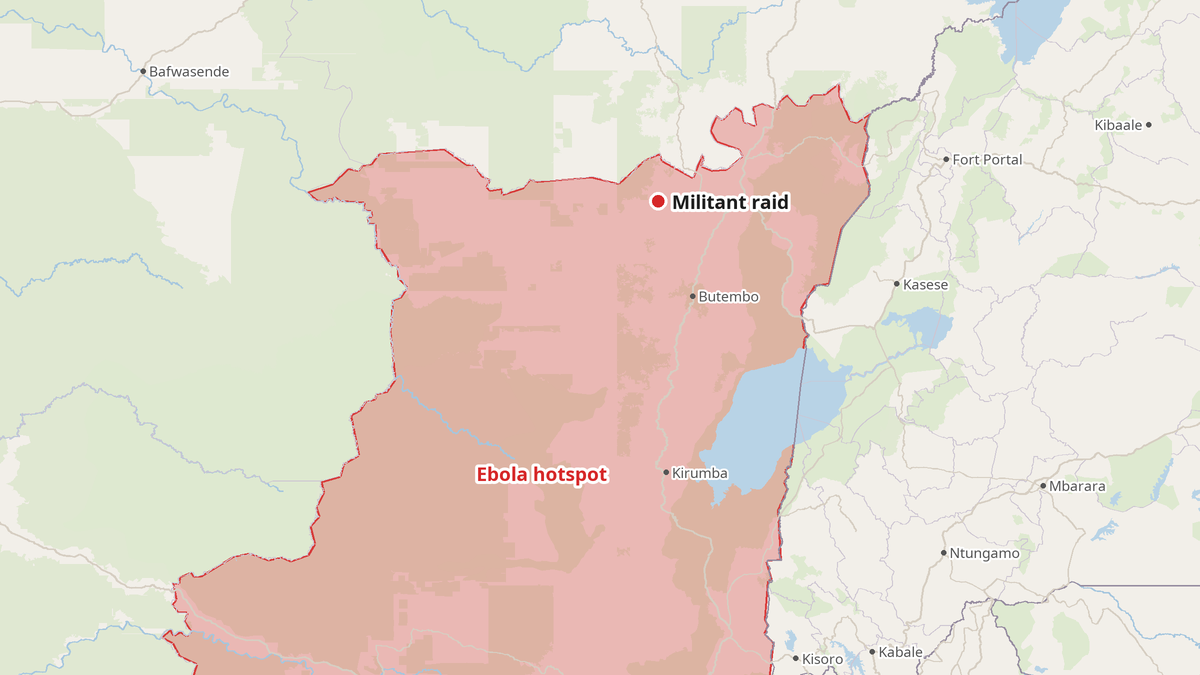
Islamic State-linked militants killed at least 33 civilians in a raid on a village in eastern Democratic Republic of the Congo, then torched a health post and sent Ebola patients running into the night, authorities said.
The attack on Cantine-Aloya, in North Kivu province, struck a region already straining under one of the most severe Ebola outbreaks the country has seen. North Kivu now accounts for half of all new infections in the DRC's outbreak. Authorities have recorded more than 10,000 cases and 5,000 deaths nationwide.
The Attack
The assault came at about 11pm local time on Thursday, in a village roughly 50km west of Beni, officials said. The attackers belong to the Allied Democratic Forces, a group recognised by Islamic State as an affiliate. They set fire to several houses and killed civilians, according to Beni territorial administrator Col Charles Omeonga.
The full toll isn't known. Heavy rain hampered army operations and investigations, Omeonga said, and a death count could not yet be established.
So far, 33 bodies have been recovered. Tchetche Aliamini, a local civil society leader, said most bore gunshot wounds. Others had been burnt or hacked with machetes.
Health Care Under Fire
The militants didn't spare the clinical infrastructure. They set fire to a health post during the raid, officials said. Patients from a nearby hospital then fled as well.
Among them were one confirmed Ebola patient and five suspected cases, three of whom are high-risk contacts, according to Christian Kakule Vulembera, the hospital's head doctor. Those are people who should be isolated and monitored. Instead, they're loose in a district where armed men have just shown they can strike at will.
That's the practical problem for responders. Containing a hemorrhagic fever depends on knowing where patients are and keeping them there. A confirmed case walking away from care, along with five suspected ones, undoes that work in a single night.
A Security Failure With Public Health Costs
The raid shows how tightly the two crises are bound together. Ebola response needs working clinics, reliable tracing and freedom of movement for health workers. Armed groups operating in the same territory strip away all three.
The weather didn't help the Congolese army either. Rain slowed the military's response and the investigation that followed, leaving officials unable even to finish counting the dead.
With more than 10,000 recorded cases and 5,000 deaths, the outbreak has already placed enormous demands on the state. Now authorities must also find the fled patients while the threat that scattered them remains active in the area.
Why This Matters:
The Cantine-Aloya raid is a reminder that public health depends on a more basic function: a state able to protect its own citizens. When militants can burn a health post and empty a hospital of Ebola patients, no amount of medical funding or outside expertise substitutes for security on the ground. For governments and donors weighing how to spend money on the outbreak response, the lesson is practical rather than ideological. Aid delivered into territory that armed groups can raid at will risks being wasted. Security failures in North Kivu, which carries half the new infections, can push the disease beyond the district and the DRC's borders. Restoring order is a precondition for containing the virus, not an afterthought.
- allied democratic forces
- ebola
- north kivu
- democratic republic of the congo
- beni
- militant attack
- civilian deaths
- cantine-aloya