
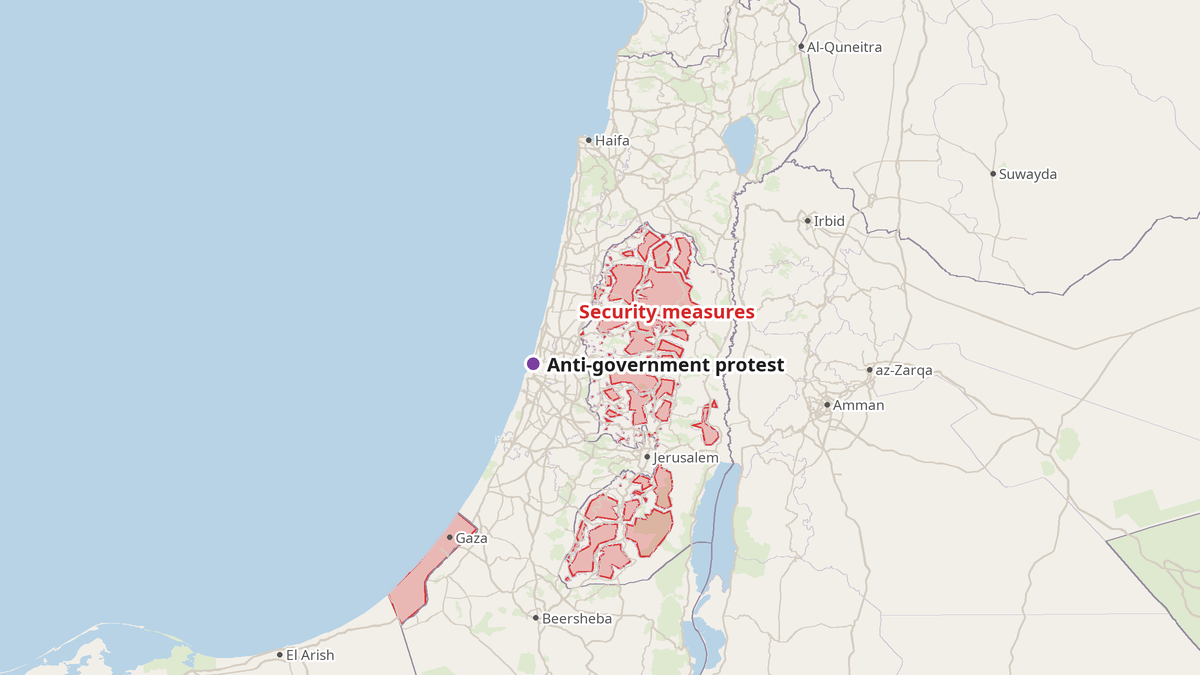
Israeli forces won’t allow most Palestinian workers with permits to enter Israeli communities on Sunday and Monday, while several crossings will remain closed until after Tuesday’s election. The restrictions follow an Israeli military operation in Hebron after an attack that killed two Israeli soldiers and wounded three; the Associated Press reported that hundreds of Palestinians were displaced and movement restricted. Three days before voters choose a government, Palestinians are already living with decisions made by the state apparatus.
Thousands of Israelis marched through Tel Aviv on Saturday, Oct. 24, demanding a change of government and an independent inquiry into the security failures surrounding the Hamas-led Oct. 7, 2023, attacks. The election, set for Oct. 27, is widely viewed as a referendum on Prime Minister Benjamin Netanyahu and his handling of the wars, as well as Israel’s domestic and international direction.
An inquiry, appointed by politicians
The October Council, founded by families of victims and hostages taken on Oct. 7, organized the demonstration. It called the rally the “culminating event marking three years of struggle to uncover the truth, demand accountability, and establish a state commission of inquiry.” An AFP reporter saw thousands march from Rabin Square to Hostages Square, where earlier demonstrations had called for the release of captives held in Gaza.
Civil society groups and opposition parties have campaigned for years for an independent commission into the security failures that led to the attacks. Netanyahu’s government hasn’t established one, arguing that such an inquiry could be biased against it. Instead, it proposed a “political” commission, with governing-coalition and opposition lawmakers appointing equal numbers of members. Opposition leaders say they’d boycott a commission appointed by politicians.
The dispute centers on who gets to investigate the state’s failure. The government wants an inquiry whose members come from the same political system under scrutiny; its opponents reject that arrangement and call for a different commission. The October Council demands accountability. No commission exists.
Hadas Feuershtein, 68, told AFP before the rally: “Whoever has been leading us for the past four years (since Netanyahu’s government took office in late 2022) has done such a terrible job.” She added: “Israel has never been in a situation as it is now.” The October Council warned law enforcement about possible “provocations” by pro-government agitators. Israeli police said they had “arrested a suspect for assaulting the security team of a public figure” in Tel Aviv. Israeli media identified the target as Naftali Bennett, a former prime minister and opposition party leader.
A ballot, not a break with the apparatus
The latest polls, published before a blackout period began Friday night, showed neither bloc winning a parliamentary majority. A poll by public broadcaster KAN projected 52 of the Knesset’s 120 seats for Gadi Eisenkot’s bloc and 50 for Netanyahu’s, with the remaining seats going to non-aligned parties, including Arab parties. Leaders of the four main opposition parties attended the rally, Israeli media reported. The crowd warmly greeted Eisenkot, a former military chief of staff and leader of Yashar.
Naama Bitterman, an 18-year-old first-time voter, said she expected the anti-Netanyahu bloc she supported to win and improve Israel’s international standing. “I think that if we win -- and we are going to win -- we can change how other people in the entire world see us,” she told AFP. Palestinian observers and journalists, however, voiced skepticism that Israeli policy toward Palestinians would change, citing political and social shifts and coalition constraints. Elie Podeh said a change in prime minister could mean a shift in tone, relations with Washington and diplomatic pragmatism, rather than a fundamental change toward Palestinians. Jordanian journalist Osama al-Sharif argued that leading candidates shared security-focused positions and offered no new approach to the Palestinian question.
Barry Praag, a left-wing Democrats Party voter from Kibbutz Dafna, said a coalition should work with Israeli-Arab parties to address the Palestinian question. “We must face the idea of a two-state solution with the support of the surrounding Arab countries otherwise, it won’t work,” he said. Arab commentators also questioned whether Jewish opposition parties would rely on Arab parties to form a government, and whether Arab voters could help change the government without becoming partners in shaping policy.
Grassroots ties amid state pressure
Haviva Ner-David urged Arab Israelis to vote and participate in government, while describing community organizing and violence against Arab citizens. She wrote that she had taken part in nonpartisan voter-encouragement work in Arab Israeli communities and cited the grassroots movement Standing Together, the interfaith group Spirit of the Galilee, and her children’s attendance at a Hand in Hand bilingual Arab-Jewish school. She said the groups were starting a youth program that year.
Ner-David cited attacks on Arab bus drivers in Jerusalem and Beit Shemesh, the beating of Arab security guard Qais Haddad outside Teddy Stadium, and the beating of Khalil Sabach, a high school senior from Shefa-Amr, by Jewish youths in Haifa’s bayside suburbs. She said Sabach told her the incident hadn’t broken his belief in Arab-Jewish partnership. She also wrote that some Arab Israelis who spoke against the Gaza war were arrested, humiliated and released without charges.
In the north, Eyal Dror, a lieutenant-colonel reservist who had returned from a tour of Lebanon, said nearly 70,000 people had been evacuated from the region for almost two years after the war with Hezbollah that followed the Hamas-led attacks. “I pray and hope that there is a new government which makes this a very important election,” he said. Dror described fearing for his son’s safety at a school 600 metres from Lebanon, where he said Hezbollah could fly a drone across the school. He hoped diplomacy could help but didn’t rule out further military action.
Israel’s election also unfolds amid international sanctions on goods from Israeli settlements in the West Bank, imposed by Britain and several other countries in response to settler attacks on Palestinians and settlement construction approved by Netanyahu’s right-wing government. Netanyahu said Israel might need an alternative digital economy to circumvent growing international isolation. Eisenkot mocked the proposal as “bbCoin”; Yair Lapid warned that sanctions, security agreements and the economy were at stake. The rival politicians offer different warnings. Palestinians facing displacement and closed crossings won’t cast ballots in Israel’s election.
- israel election
- tel aviv
- benjamin netanyahu
- october council
- security inquiry
- gaza war
- gadi eisenkot
- naftali bennett